Medical Robotics Sector Surges with 34.45% CAGR, Strong Future Outlook Drives IPO Filing
Artificial intelligence and medical robots are gradually transitioning from cutting-edge technologies to widely accessible infrastructure. Given their unparalleled advantages over humans in precision, stability, strength, and endurance, medical robots hold significant promise for application in the healthcare sector, which demands exceptionally high levels of professionalism. Medical robots refer to mechanical entities endowed with perception, mobility, and intelligence, developed through the integration of medicine, biomechanics, mechanics, mechanical engineering, materials science, computer vision, mathematical analysis, and robotics. These systems assist healthcare professionals in performing interpersonal interactive tasks related to surgical procedures and health services.
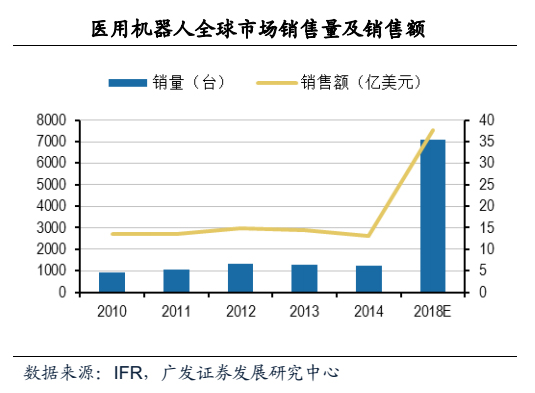
Recently, Shanghai Timi Robot Technology Co., Ltd. completed its angel financing round, raising nearly RMB 10 million. The investment was jointly made by Guoke Jiahe and Shanghai Chuangtu. This round of funding will be primarily used for clinical trials of specialized medical service robots, with plans to debut at Peking Union Medical College Hospital by the end of October this year. Medical robots have become a hot spot of attention in the capital market.According to IFR data, global sales of medical robots reached 1,224 units in 2014, with sales revenue amounting to $1.317 billion, accounting for 35% of the professional service robot market. The IFR predicts that global sales of medical robots will reach approximately 4,000 units by 2018. From 2014 onward, the compound annual growth rate (CAGR) over the subsequent four years is projected to reach 34.45%. Consequently, medical service robots are poised to become one of the fastest-growing segments within the robotics industry, inevitably attracting intense competition for investment capital.
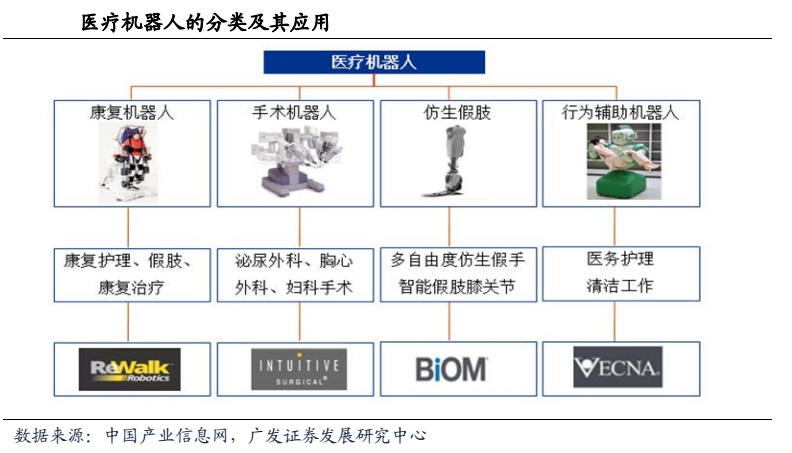
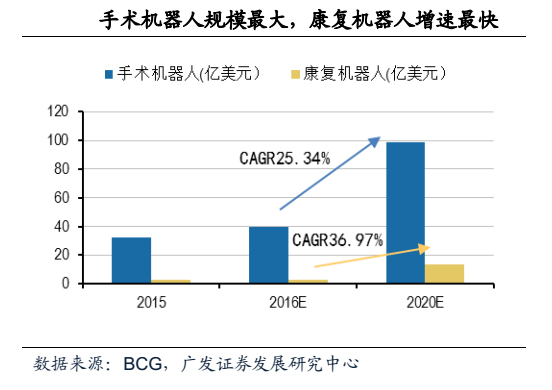
Medical robots can be categorized into four types: rehabilitation robots, surgical robots, bionic prosthetics, and behavioral assistance robots. In terms of market structure, surgical robots hold the largest market share. In 2014, sales of surgical robots accounted for more than 60% of the global medical robot market. On the other hand, rehabilitation robots have become the fastest-growing subsector. According to BCG forecasts, the compound annual growth rate (CAGR) of the rehabilitation robot market size will reach 36.97% over the next five years.
Medical robots have an average selling price of up to $1.1 million per unit, with additional costs for accessories and services, resulting in high unit value. Exoskeleton robots are poised to disrupt the rehabilitation industry. In China, physical disabilities account for 29% of all disabilities, ranking first, while disabled elderly individuals constitute 30% of the total elderly population. Exoskeleton robots enable patients with paraplegia and disabled elderly individuals to stand and walk, offering advantages incomparable to those of wheelchairs. Furthermore, exoskeleton robots serve dual functions: assistance/substitution and rehabilitative training. They are expected to revolutionize the entire rehabilitation sector in the future. Assuming that 5% of patients with lower-limb disabilities adopt exoskeleton robots, with the price of each domestically produced unit set at RMB 100,000, the market size would reach RMB 86.5 billion. Additionally, exoskeleton robots can enhance the physical capabilities of healthy individuals, holding promise for future applications in engineering, rescue operations, military affairs, and other fields.
Currently, medical enterprises in Europe and the United States hold a significant market share and dominate the global medical robotics industry. The majority of the world’s top 10 medical robotics companies are based in the U.S. and Europe. In particular, the U.S. medical robotics sector leads globally, with more than 30 established players. These medtech companies boast extensive resource networks, comprehensive service offerings, and excellent R&D teams, enabling them to provide hospitals and other healthcare institutions with more scientific, precise, and safe surgical assistance services.
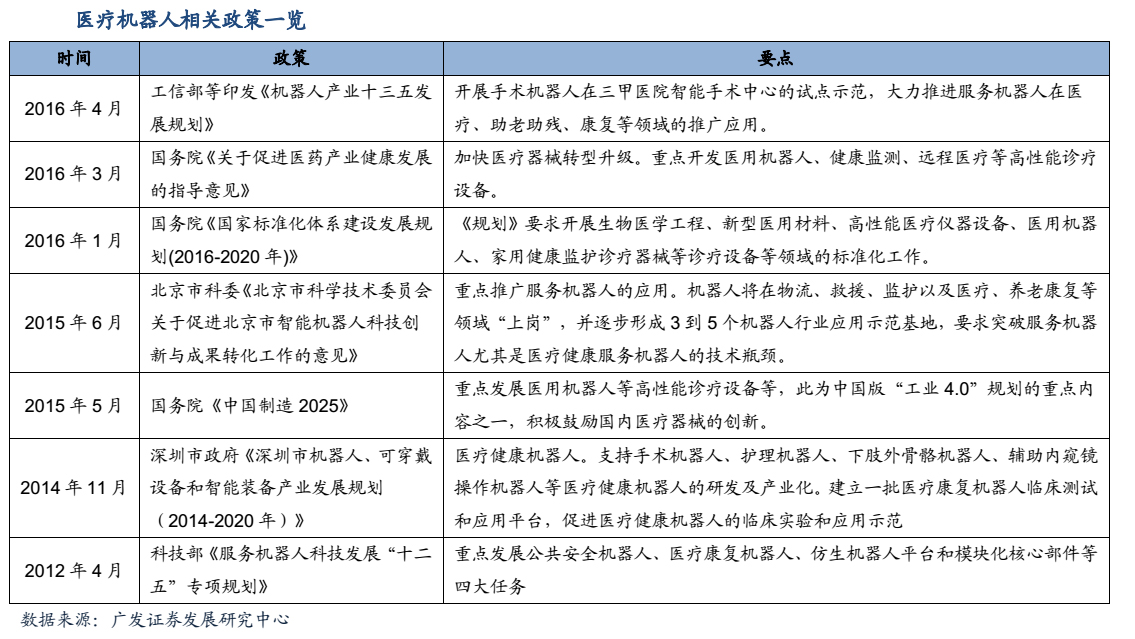
With the rise of the concept of intelligent manufacturing, the Chinese government has continuously introduced relevant policies to encourage and support the cultivation of the medical robot market. In April 2016, the Ministry of Industry and Information Technology (MIIT) and two other ministries issued the "13th Five-Year Plan for the Robot Industry," which provided top-level design for the development of the service robot industry. In the field of medical robots, the plan proposed pilot demonstrations of surgical robots in the intelligent surgery centers of Grade A tertiary hospitals, and vigorously promoted the application of service robots in healthcare, elderly and disability assistance, rehabilitation, and other areas.
From the perspective of the industrial chain, the upstream sector of the medical robotics industry consists of robotic components, the midstream sector comprises robot bodies, and the downstream sector encompasses various application markets within the smart healthcare industry. Notably, it will take time before domestically produced core components—specifically servo motors, controllers, and reducers—are widely adopted at scale. In the midstream segment, more than 100 domestic enterprises engaged in the production of robot bodies were operating by the end of 2014, resulting in intense competition, severe product homogenization, and overcapacity in low-end manufacturing. From the standpoint of the industry life cycle, China’s medical robotics sector is in the introduction phase, characterized by strong demand and rapid growth. (Source: GF Securities Development Research Center)
The “2016 World Medical Robot Conference,” hosted by the World Association of Medical Robotics, is scheduled to take place in Shenzhen, China, on October 29–30. This inaugural global summit integrates scientific research, clinical practice, and industry development in the field of medical robotics. More than 20 academicians from various countries will attend the conference, alongside dozens of presidents of renowned hospitals worldwide and clinical experts who will deliver reports and participate in discussions. Experts and scholars from prestigious domestic and international institutions—including the Swiss Academy of Technical Sciences (SAWT), the UK Royal Academy of Engineering, the Chinese Academy of Sciences, the Singapore Academy of Medicine, and the ROBO Medical Robotics Institute—will share insights on global trends in medical robot applications and research directions. They will engage in thematic discussions centered on the conference theme: “Technology Transforms Healthcare, Health Leads the Future.”

Related Reading:
“2016 World Medical Robot Conference” News Preview
Click the link below or scan the QR code to register. For investment and sponsorship inquiries, please contact Peipei at VCBeat (WeChat ID: xiaopeiling185025).