How Pharma Giants and Insurers Forge Strategic Ties with Health Tech Startups

For traditional healthcare giants such as pharmaceutical companies and insurance providers, a key component of implementing innovative strategies like digital or internet-based transformation is establishing partnerships with startups. VCBeat has previously collaborated with industry leaders such as Pfizer and Taikang Life Insurance to host startup competitions and selection events, thereby increasing exposure for qualifying startups. Which types of startup projects should traditional healthcare enterprises choose to partner with, and how can they structure these collaborations to maximize value? R2G has proposed several strategies; although primarily focused on the U.S. market, VCBeat Research Institute believes they hold certain applicability for China’s healthcare industry and has therefore compiled this article.
In the venture capital and private equity sector, there are numerous incubators, accelerators, hackathons, and investment funds. Accelerators primarily target early-stage startups that are still at the conceptual phase or have only launched minimal viable products. Once accepted, these startups often gain visibility, develop business models with sustainable competitive advantages, generate revenue, and access sales channels, among other benefits. However, according to a 2015 analysis by R2G Consulting’s mHealth Economics, 95% of these companies ultimately fail.
Few traditional enterprises independently launch such startup acceleration programs. Even if they have established corporate accelerators, their value tends to lean more toward cultural promotion and market education rather than commercialization. Nevertheless, a few companies, such as Bayer Pharmaceuticals, have launched their own startup initiatives. These accelerator programs are at least based on company-specific search directories to identify and select startups.
Typical startup accelerator programs cast a wide net, often accepting ventures with merely an interesting business model or innovative technology; however, few of these startups align closely with the core business of the sponsoring corporation.
To foster more collaborations with startups, healthcare companies should adjust their strategies. The first step is to focus on “hidden champions” rather than fixating on the dozens or even hundreds of early-stage technology research projects and mobile health applications.
“Hidden Champions” originates from management guru Hermann Simon’s book Hidden Champions: Who Are the Best Companies?, which defines hidden champions as small and medium-sized enterprises that hold a dominant share in their domestic or international markets yet maintain low public visibility.
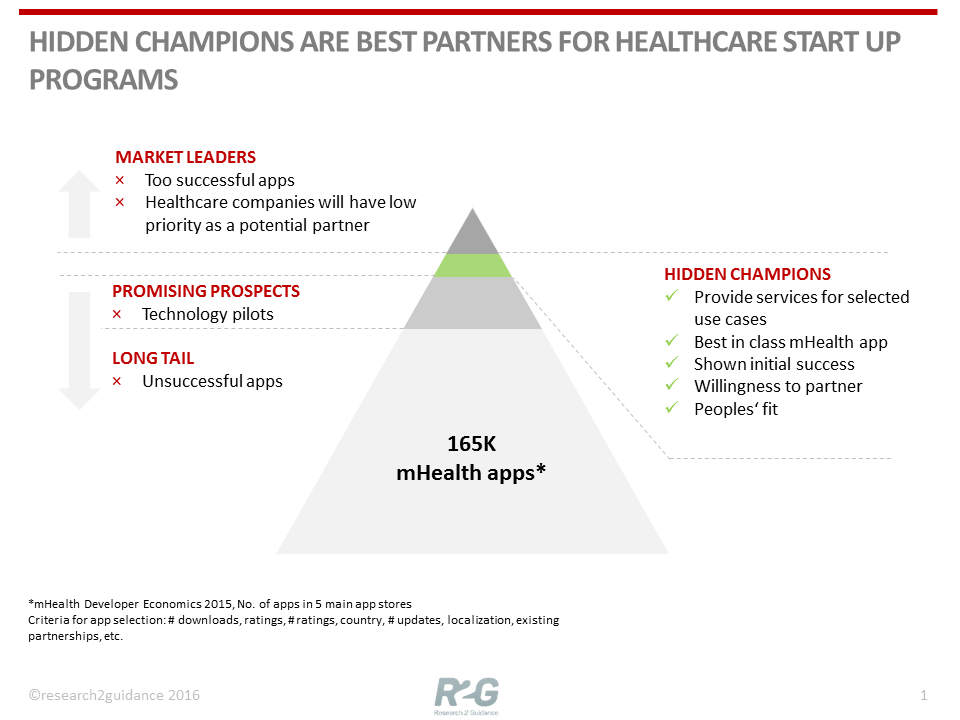
Healthcare startup initiatives should revolve around the following five dimensions:
1.From Pre-selection to Precision Search. In other words, instead of trying to swallow the entire spread at once, select what suits your appetite. That is, create a specific combination; the more precise the corporate requirements, the greater the benefits.
2.From Investment to Collaboration Models。For healthcare companies, true value lies in integrating their operations with online platforms, rather than establishing entry and exit strategies akin to venture capital firms. Such strategies are not part of their core business and would hinder their integration efforts. Companies should develop collaborative models that connect startups with their existing operations, thereby enhancing flexibility and achieving better collaborative outcomes.
3.From Cultural Shifts to Business Focus。It is essential to have sufficient ambition. Even though there are many unconventional ideas and everyone has their own perspectives, ambitions should be set higher. For instance, in the case of mobile health app solutions, their business models have reached a level of complexity where it is time to address issues such as “generating revenue,” “reducing costs,” and “gaining better customer insights.”
4.From Early-Stage Startups to “Hidden Champions”。To minimize risk, companies should systematically identify firms that have gained a certain level of user recognition but are not yet strong enough to possess the flexibility required for genuine partnership models.
Consider this: “Hidden champions” account for only 3%–5% of the mobile health app market. For most mobile health applications—such as those for diabetes, pregnancy, asthma, and remote diagnosis—they represent merely a small handful.
5.From Temporary Screening to Sustained Collaboration。For instance, participating in a screening program once a year or occasionally attending startup pitch events is far from sufficient for building a digital health business. Healthcare enterprises should establish a continuous process that spans from initial engagement and screening to the integration of service products, consistently measuring the success of integration and digitalization.
As is well known, the underlying objective of health insurance providers, pharmaceutical manufacturers, and medical technology companies is to expand their core businesses. Rather than halting at an intriguing concept, enterprises should establish end-to-end processes; developing a replicable collaboration model and integrated workflow may well be the key to achieving decisive competitive advantage.
Compiled by Deng Xueyuan
[Further Reading]Eggshell Report | 77 Top Enterprises Have Deeply Invested in China’s Digital Health Industry
By VCBeat. Please credit the WeChat Official Account when reposting:VBResearch2016
↓↓↓