

Johnson & Johnson: Beyond the $4.3 Billion Abbott Eye Care Acquisition – A Decade of Strategic Expansion and Innovation
By Zhou Mengya, Wang Xiaohang
Founded in 1886, Johnson & Johnson is a century-old enterprise well known to the general public. Since acquiring Pfizer’s consumer health division in 2006, Johnson & Johnson has become the world’s largest, most comprehensive, and geographically diversified healthcare company, with operations spanning three major sectors: consumer products, pharmaceuticals, and medical devices.
Currently, the Johnson & Johnson family owns the world's sixth-largest consumer goods company, the world's most comprehensive medical device company, the world's sixth-largest biotechnology company, and the world's fifth-largest pharmaceutical company,Headquartered in New Brunswick, New Jersey, USA,With over 265 subsidiaries in more than 60 countries worldwide, the company employs nearly 126,500 people.
As the healthcare sector garners increasing attention, internet giants such as BAT (Baidu, Alibaba, and Tencent), Apple, and Google have begun to make significant inroads. Established healthcare leaders like Johnson & Johnson are certainly not lagging behind. Through strategic mergers and acquisitions, Johnson & Johnson has kept pace with the times in driving intelligent transformation and upgrading within the healthcare industry. Furthermore, by forging strategic partnerships with internet giants, it has built formidable capabilities in mobile health and big data.
On March 14 this year, Johnson & Johnson acquired medical device company NeuWave for $55 million to gain access to its soft-tissue microwave ablation technology. On September 16, Johnson & Johnson made a bold move by acquiring Abbott’s Vision Care division for $4.3 billion. Abbott Vision primarily manufactures equipment for cataract and LASIK vision correction surgeries, as well as contact lenses. These frequent moves in the healthcare sector underscore Johnson & Johnson’s ambitions.
Furthermore, Johnson & Johnson’s medical startup incubators have blossomed worldwide, spanning fields such as medical devices, pharmaceuticals, consumer health, health technology, and healthcare solutions. The company is far removed from the common perception of merely “selling consumer healthcare products” or “band-aids.” How has Johnson & Johnson built its medical empire? And how has it steadily penetrated the internet healthcare sector? VCBeat (WeChat ID: vcbeat) has conducted a detailed review of Johnson & Johnson’s strategic moves over the past two years.
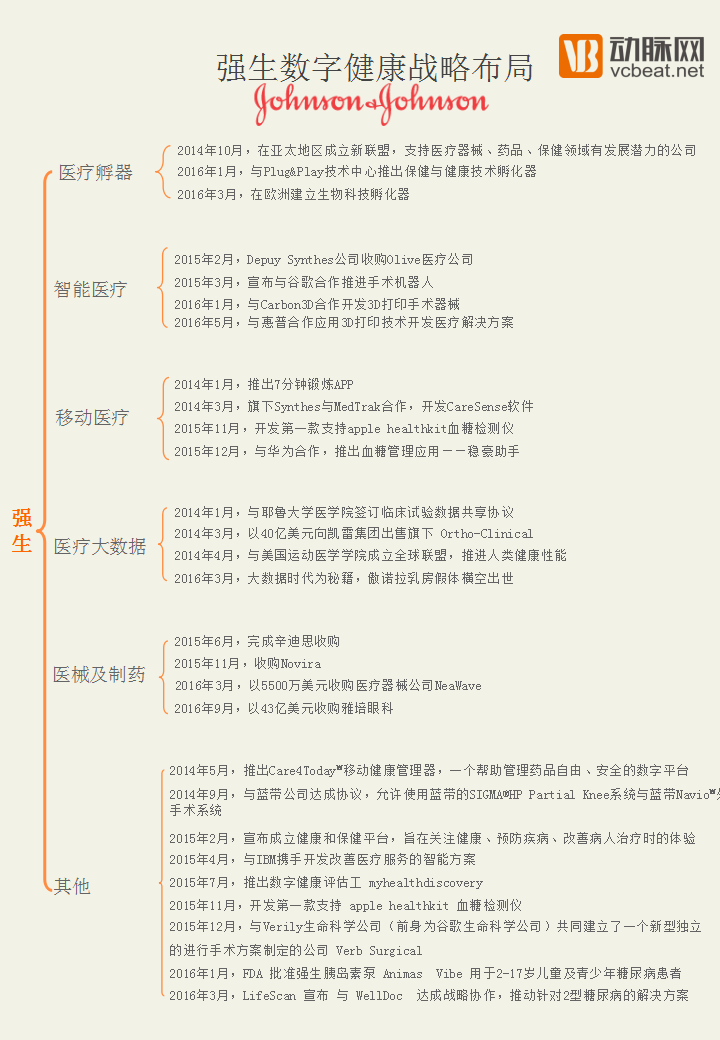
In January 2014, Johnson & Johnson officially launched its 7-Minute Workout app. The app provides a simple fitness experience that combines high-intensity aerobic and resistance training. Additionally, it sets intelligent training targets based on users’ initial fitness levels and progressively increases workout intensity according to their usage patterns. By November of the same year, downloads had reached one million, marking Johnson & Johnson’s gradual entry into the mobile market.
Furthermore, Johnson & Johnson has actively courted strategic partners to expand its market presence and enhance its influence. In March 2014, Depuy Synthes, a subsidiary of Johnson & Johnson, signed an agreement with MedTrak to develop the CareSense software, aiming to improve treatment outcomes and satisfaction for short-term patients while reducing medical costs.
In May of the same year, Johnson & Johnson launched the mobile health manager Care4Today™. Through Care4Today™, users can track and manage their medications and treatment regimens. The platform also sets reminders for correct dosages and administration times, ensuring patients adhere to their medication schedules and thereby facilitating their recovery. Through collaborations and in-house development, Johnson & Johnson has gradually expanded from mobile health into the broader field of health management.

Johnson & Johnson’s Official 7-Minute Workout App
With 400 million diabetes patients worldwide, there is a broad market prospect. In November 2015, Johnson & Johnson developed the first blood glucose meter supporting Apple HealthKit. Unlike other blood glucose meter manufacturers, Johnson & Johnson closely targeted the mobile healthcare market and chose to collaborate directly with Apple, becoming the first manufacturer to directly support synchronization of blood glucose monitoring data with the Apple HealthKit app. The OneTouch Verio Sync meter, designed by LifeScan, a subsidiary of Johnson & Johnson, can wirelessly connect to its own mobile app, and now these data can be directly synchronized to Apple’s HealthKit app, enabling more comprehensive integration of diabetes data into overall health records.
A month later, Johnson & Johnson extended another olive branch to Huawei. It launched the SureStep Assistant, a blood glucose management application that leverages the highly accurate SureStep series of blood glucose meters as its measurement platform, with a focus on comprehensive diabetes management. This new product can be connected to the “Huawei Health Platform,” integrating functions such as measurement analysis and remote consultation. It marks a transition from simple blood glucose testing to holistic home-based blood glucose management and services. By facilitating patient adherence in areas including diet, exercise, blood glucose monitoring, medication, and diabetes education, it provides diabetic patients with more detailed, comprehensive, and personalized professional services, helping them better achieve long-term blood glucose control. With this move, Johnson & Johnson has formally entered the mobile health sector.
In the era of data and information, the value of big data is becoming increasingly evident. As a global, diversified multinational corporation, Johnson & Johnson naturally understands the value of big data for its market positioning and development. In recent years, although Johnson & Johnson has maintained a relatively low profile, it has been building and strengthening its own big data network.
In January 2014, a clinical trial data sharing agreement was signed with Yale School of Medicine.
In April of the same year, Johnson & Johnson and the American College of Sports Medicine formed a strategic alliance aimed at investigating how energy expenditure and scientifically guided exercise can improve individuals’ suboptimal health status. By recording and monitoring data on participants’ exercise volume, physical condition, mental state, and work performance, the collaboration sought to identify specific correlations between physical activity and healthy living.
Johnson & Johnson’s strategic layout also encompasses fields such as smart healthcare. The company is actively advancing the intelligent upgrading of its technologies, maintaining its vitality and competitiveness through innovation. It has not only acquired medical device companies such as Oive Medical and Neawave, but also partnered with tech giants like Google and HP to drive technological innovation.
Following the acquisition of Olive Medical, its advanced visualization technology was leveraged to integrate and enhance DePuy Synthes’ arthroscopic visualization solutions, thereby expanding the company’s global sales network. Through the acquisition of NeuWave Medical, Johnson & Johnson acquired its developed microwave ablation technology for soft tissue. This technology has already been adopted in half of the top cancer treatment centers across the United States.
Not only that, Johnson & Johnson has also been closely monitoring cutting-edge technologies, seeking their organic integration with medical technology. In March 2015, Johnson & Johnson signed a collaboration agreement with internet technology giant Google to jointly develop a new generation of surgical robots. The two companies will combine their R&D capabilities, intellectual property, and specialized expertise to create an entirely new robot-assisted surgical platform, fully integrating advanced technology with healthcare. Robot-assisted surgery is a type of minimally invasive procedure that employs mechanical systems to achieve precise control during operations, thereby minimizing trauma and accelerating postoperative recovery.
Over the past 60 years, Johnson & Johnson has been dedicated to developing new products and technologies. This collaboration with Google represents a critical step in advancing J&J’s surgical diagnosis and treatment capabilities, fully integrating academia, science, and surgery to build a world-class technical team.

Carbon3D isOne of the Most Promising Startups in 3D Printing: A Rising Star
Johnson & Johnson has also entered into collaborative agreements with Carbon3D and HP, respectively, to further develop the application value of 3D printing technology in the medical field. By integrating advanced data mining and software technologies, 3D printing enables distributed manufacturing models and patient-specific products, therapies, and solutions, thereby delivering improved outcomes, favorable economic benefits, and enhanced global accessibility.
As one of the leading developers of global healthcare solutions, Johnson & Johnson has made significant efforts in recent years to strengthen its strategic footprint in this sector.
In September 2014, Synthes entered into an agreement with Blue Belt Technologies, granting Synthes the right to use Blue Belt’s SIGMA® HP Partial Knee System in conjunction with the Blue Belt Navio Surgical System.
In February 2015, Johnson & Johnson announced the launch of a new health and wellness platform aimed at promoting health, preventing disease, and improving patients’ treatment experiences. Yet these were merely preliminary steps; the subsequent moves would prove far more sweeping and decisive.
On April 13, 2015, Johnson & Johnson and IBM announced a collaboration to develop next-generation intelligent virtual “health coach” solutions. This marks only the initial step in their partnership with IBM’s newly established “Watson Health.” The two companies will also leverage the Watson Health big data platform to jointly develop innovative models for more accurately predicting patient responses to various medical treatments. By employing advanced data analytics, they aim to facilitate the development of personalized healthcare solutions, spanning from consumer health management to chronic disease care. Additionally, Johnson & Johnson will capitalize on IBM’s partnership with Apple to develop iPhone and iPad applications, providing end users with simple, seamless experiences and intuitive design.
In December of the same year, Johnson & Johnson joined forces with Verily Life Sciences (formerly Google Life Sciences) to establish Verb Surgical, a new independent company focused on surgical procedure planning. The formation of this company was based on a strategic alliance between Ethicon, a Johnson & Johnson medical device company, and Google Life Sciences. This collaboration is expected to improve global personalized medicine and healthcare through innovative technologies and solutions, further solidifying Johnson & Johnson’s leadership position in the industry.
Beyond the internet sector, Johnson & Johnson has also made significant moves in the medical device and pharmaceutical sectors, primarily expanding its footprint through acquisitions.
Synthes, one of Johnson & Johnson’s largest subsidiaries, was acquired for $21.3 billion in 2011 (the largest acquisition in Johnson & Johnson’s history). Synthes primarily focuses on medical devices for fracture and trauma care. The acquisition was completed in June 2015. The newly formed “Johnson & Johnson DePuy Synthes Group” is the world’s most innovative and comprehensive orthopedic and neurosurgery company. For Johnson & Johnson, this acquisition represents a significant milestone, marking the realization of its strategy to strengthen its leadership position in key healthcare markets.
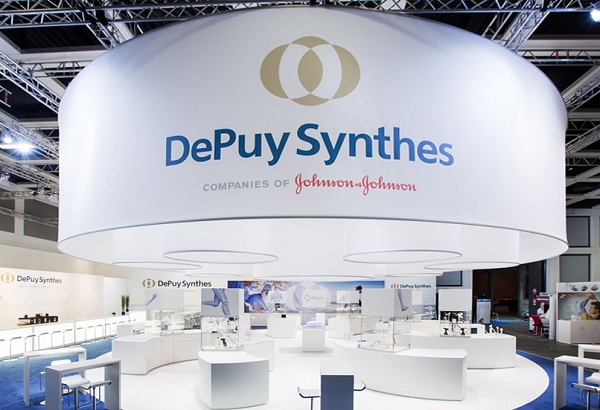
Johnson & Johnson DePuy Synthes Group
The $40 billion global orthopedic and neurosurgery market represents significant growth potential, and Johnson & Johnson has clearly established a strong leadership position in this sector. True to its longstanding commitment, the company will continue to leverage bold decision-making to drive long-term growth and deliver unparalleled services worldwide.
In November 2015, Johnson & Johnson made another significant move by reaching an acquisition agreement with Novira Therapeutics. Through this deal, Johnson & Johnson will acquire NVR3-778, a hepatitis B drug developed by Novira, along with a series of other antiviral drug candidates. NVR3-778 will become part of Johnson & Johnson’s extensive product portfolio. Novira currently has a capsid protein inhibitor in preclinical development. This acquisition marks another major step by Johnson & Johnson in the field of antiviral drug R&D, following its $1.75 billion purchase of Alios BioPharma the previous year.
With the addition of Novira, Johnson & Johnson’s R&D capabilities in this field will be further strengthened. Janssen, a subsidiary of Johnson & Johnson, has entered into a collaboration agreement with Ichor Medical Systems, a San Diego-based biopharmaceutical and medical device company, to jointly develop DNA vaccines for the treatment of hepatitis B. Johnson & Johnson also announced that its long-acting HIV therapy, developed in partnership with ViiV Healthcare, has successfully completed a Phase II clinical trial. In the Phase II study, this long-acting regimen demonstrated efficacy comparable to that of current standard-of-care treatments.
Following encouraging results, Johnson & Johnson and ViiV Healthcare plan to launch a larger Phase III clinical trial, with the therapy expected to reach the market in 2020.
Johnson & Johnson also recognizes the vast potential of the eye care market. Its recent acquisition of Abbott’s ophthalmics business fills certain gaps in J&J’s eye care portfolio, introduces additional products, and expands its presence in the eye care sector, which is expected to generate $7 billion in annual global revenue.
In addition to accelerating its own growth, Johnson & Johnson is looking to the future by establishing J&J Family Incubators around the world, with a focus on supporting high-potential companies in the fields of pharmaceuticals, medical devices, consumer health products, biotechnology, medicine, and digital health. Currently, five incubation centers have been established in the United States: San Diego (flagship), San Francisco, South San Francisco, Boston, and Houston, hosting more than 100 startups engaged in biotechnology, pharmaceuticals, medical devices, and digital health.
In September last year, the first bio-incubator outside the United States was established in Toronto, Canada. The Province of Ontario will allocate CAD 19.4 million to this incubator hub through the Strategic Partnerships Initiative of the Jobs and Prosperity Fund, thereby strengthening support for the province’s burgeoning life sciences industry.
Meanwhile, Johnson & Johnson has established a life sciences network in the Asia-Pacific region, with reach extending to Shanghai, Singapore, Australia, Japan, and other locations. It also set up the ioBAY incubation center in Suzhou, providing support to more than 400 companies in fields such as drug development, medical devices, nanotechnology, and biotechnology.