

Thalmic Labs Advances Gesture Control Technology in Healthcare Following $120M Series B Funding
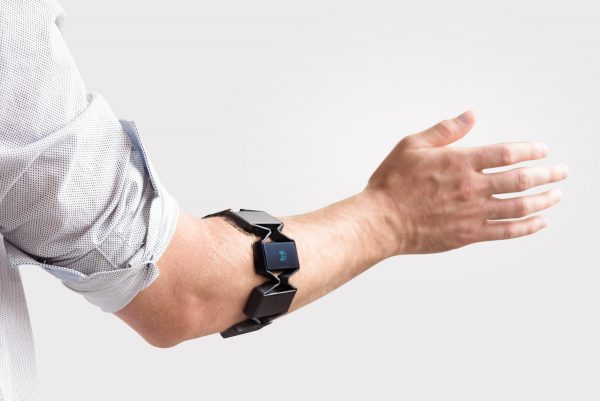
Myo Armband
With last week'sThalmicThe laboratory secured a total investment from six companies, including Intel Capital.1.2With investments in the hundreds of millions of dollars, augmented reality technology has once again garnered attention for its applications in the medical field.
Thalmic Labs is a pioneer in the future of human-computer interaction. The company’s first product, the Myo armband, enables users to control computers, smartphones, and other electronic devices through gestures. Thalmic Labs describes its product as the world’s first electromyography (EMG)-based gesture control device. Its working principle is as follows: when users perform different gestures, the muscles in the forearm generate distinct electrical signals. The Myo’s built-in advanced sensors capture these signals and process them using embedded algorithms. The gesture recognition results are then transmitted via Bluetooth 4.0 Low Energy (LE) to the connected electronic devices.
Since its launch, the product has been applied in entertainment, virtual reality, prosthetics, and even sign language interpretation. It has not only reshaped people’s perception of future products but also revealed a larger market potential in the healthcare sector.
The company has partnered with the Johns Hopkins University Applied Physics Laboratory to apply this technology to prosthetic limbs, enabling patients to control their prostheses via the Myo armband. Leveraging gesture-control technology, the company has also developed gesture-controlled tools for surgical applications. Surgeons can perform procedures using hand gestures, significantly reducing their workload and enhancing precision.
Furthermore, this technology can also be applied in the medical and caregiving sectors. In collaboration with Samsung’s Smart Infinity Network technology, the company has co-developed a smartwatch that allows users to unlock doors and lights simply by flicking their wrist, offering significant convenience for the elderly. Moreover, through this smartwatch, healthcare providers can monitor seniors’ biometric data, such as activity levels and GPS location.
Stephen Lake, Co-founder and CEO of Thalmic Labs, stated, “With the development of Myo, researchers are continuously striving to apply this technology to an expanding range of fields. We have already witnessed the Myo armband enabling control of prosthetic limbs—a project that has excited us more than any other. We believe that, through the efforts of researchers, Myo can play a remarkable role in the medical field, and we will continue to bring more products to market.”
In the future, this technology will enable even more applications, potentially helping paralyzed patients walk again. A report by Goldman Sachs earlier this year highlighted the potential of augmented reality (AR) to revolutionize patient monitoring in healthcare. The report also projected that the market would grow to $5.1 billion by 2025.
Founded in 2012 by Stephen Lake, Matthew Bailey, and Aaron Grant, three graduates from the University of Waterloo’s Faculty of Electrical and Computer Engineering, Thalmic has grown into a world-leading engineering research team dedicated to building future wearable devices and pioneering new ways of interacting with digital devices.
Lake stated that the funds secured this time will be used for product development. He expressed hope that, through Thalmic’s efforts, more future products can be brought to market, enabling seamless integration between virtual digital elements and the real world, thereby ushering in a new era of information technology.
“During the three years of Intel’s investment, Thalmic achieved significant technological breakthroughs,” said Josh Walden, Senior Vice President and General Manager of Intel’s New Technology Group. “These innovations have strengthened Intel’s capabilities in the wearable technology sector, and Thalmic has also reached a consensus with us to deliver exciting experiences for users. We are delighted to collaborate with them.”
Steve Rabuchin, Vice President of Alexa, also believes that Thalmic has pushed the boundaries of gesture control technology. He stated, “We are delighted to invest in Thalmic to support their ongoing innovation, and we look forward to collaborating with them on future products.”
Thalmic Labs currently employs over 100 engineers and R&D personnel, and will continue to drive the development of new products and technologies. To date, it has raised more than $140 million in investment from investors including Mars Capital, Intel Capital, and Y Combinator, among others.