

Medical Tech Revolution: ROSA Surgical Robot Cuts Epilepsy Surgery Time by Two-Thirds
With the rapid development of robotics, their precision and stability have gradually gained recognition in the healthcare industry. Surgical robots have become increasingly vital in the medical field, and many hospitals have already begun to extensively adopt robotic systems to assist physicians in performing surgical treatments for complex and challenging conditions.
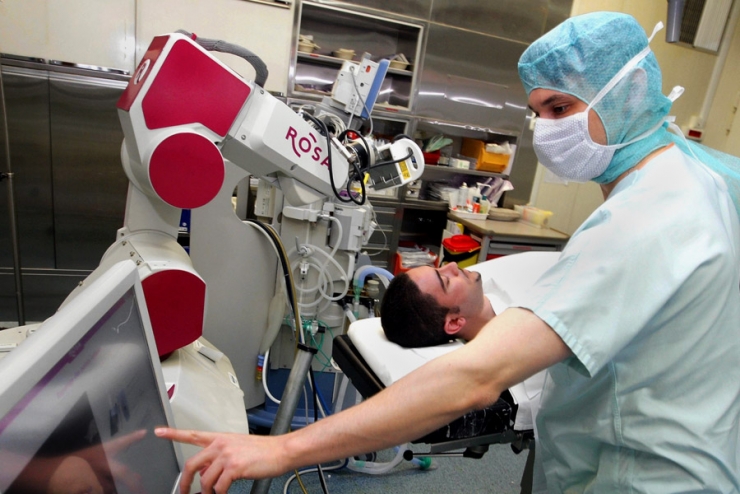
Robotic Brain Surgery
In February this year, a brain surgery was performed at Mater Hospital in Brisbane, Australia. The procedure was led by Jason Papacostas, a clinical neurosurgeon specializing in epilepsy surgery in Brisbane, and the patient was a 47-year-old individual with drug-resistant epilepsy.
Mater Hospital is known for its willingness to adopt various advanced therapies, so it comes as no surprise that the hospital utilized a surgical robotic system called ROSA for this procedure. Professor Jason Papacostas stated that approximately 90,000 households in Queensland, Australia, are affected by epilepsy. However, many patients develop resistance to conventional pharmacological treatments during their course of therapy, making surgery the optimal option when medications fail. Traditional surgery for drug-resistant epilepsy typically takes around six hours, a duration that not only predisposes surgeons to fatigue but also compromises treatment efficiency. In contrast, procedures performed using the ROSA surgical robot can be completed in approximately two hours, offering safer and more stable outcomes.

Medtech SA and ROSA
The ROSA surgical robot system was designed and developed by the French company Medtech SA. Founded in 2002 and headquartered in Montpellier, southern France, Medtech specializes in the design, research and development, and sales of innovative medical robotic-assisted surgical systems, dedicated to enabling surgeons to perform minimally invasive procedures more safely and efficiently. To date, the company has deployed 51 surgical systems worldwide, installed in leading neurosurgical centers across the globe, including the Cleveland Clinic and Massachusetts General Hospital.
In 2007, Medtech developed the renowned ROSA surgical robotic assistance system. Specifically designed for brain surgery assistance, ROSA was rapidly adopted by multiple hospitals across Europe and North America upon its launch, with physicians hailing it as a revolutionary new technology in the treatment of brain conditions.
Taking drug-resistant epilepsy as an example, accurate localization of the epileptogenic zone is key to achieving favorable surgical outcomes. In the early stages, localization primarily relied on scalp electroencephalography (EEG). However, due to significant attenuation of EEG signals as they pass through the scalp and skull, combined with interference from electromyographic activity during seizures, approximately 38% of patients remain unable to have their epileptogenic zones localized even after comprehensive non-invasive evaluations. The advent of intracranial electrode implantation has brought hope to these patients. Its advantages include immunity to interference from the scalp, skull, electromyographic artifacts, and daily activities, allowing for clear visualization of subtle changes in EEG patterns with high sensitivity. The drawbacks are that patients must undergo craniotomy for electrode placement, enduring associated pain and facing low but present surgical risks such as intracranial hemorrhage, cerebral edema, cerebrospinal fluid leakage, and infection. The ROSA robotic-assisted surgical system makes intracranial electrode implantation more convenient and safer, minimizing patient harm and risks, thereby offering significant benefits to a broad population of epilepsy patients.
In 2013, the company was named “European Company of the Year” in the neurosurgical robotics category by the global growth consulting firm Frost & Sullivan.
Initially, ROSA was exclusively a robotic-assisted surgical system for neurosurgery. However, this clearly did not align with the company’s goal of “revolutionizing medical technology.” Consequently, following further research, development, and integration, Medtech launched a minimally invasive spinal surgery robot based on the ROSA platform in July 2014. The two mature flagship products were integrated and named “ROSA Brain” for neurosurgical robotics and “ROSA Spine” for minimally invasive spinal surgery robotics. Both products have received CE Mark certification and U.S. FDA approval and are marketed globally. The neurosurgical robot obtained approval from China’s National Medical Products Administration (NMPA) in 2014 and has been sold to several leading general and specialized neurological hospitals in China.

ROSA Spine Minimally Invasive Spinal Surgery Robot
Capital Injection
With the rapid development of the robotics industry, medical robots have garnered significant global attention, and Medtech’s reputation in the sector has attracted considerable interest from investors. In November 2015, Ally Bridge Group announced a $15 million investment in Medtech through convertible bonds and warrants. As a fund specializing in cross-border healthcare investments, Ally Bridge Group’s capital infusion has injected new vitality into Medtech.
The gradual maturation of the medical technology market has promoted market consolidation. In July this year, foreign media reported that Zimmer Biomet, a global orthopedic giant based in Indiana, USA, would acquire Medtech. The specific acquisition method involves purchasing over 1.4 million ROSA shares held by founders and other individual holders at a price of €50 per share, while the remaining shares held by Huiqiao Capital will be acquired at a separately negotiated price.
Thus, it marks a new beginning for Medtech.
Robots are becoming increasingly important in healthcare. Currently, the United States has identified six key research directions for future development: surgical robots, prosthetic robots, rehabilitation robots, psychological rehabilitation assistive robots, personal care robots, and intelligent health monitoring systems. Europe is also planning to establish a “Robotics for Health-care” network to promote the development and application of medical robots across the continent. Many hospitals in China and the Asia-Pacific region have begun introducing and researching medical robots, signaling a major trend in the future of healthcare. With increased financial backing and leading-edge technology in the field, Medtech SA’s advancements will be beneficial to the surgical robot market, hospitals, and patients alike.
By Zhao Qinghui
Source: Leiphone