

The Future of Precision Medicine Remains 'Boundless Possibilities' Amid U.S. Experts' Divergent Perspectives
Genomics and personalized medicine are closer to realization than many imagine, but the current development levels of healthcare systems and electronic health records have not yet met the requirements. As policymakers and innovators strive to catch up, they must clearly define what information they need to know.VCBeat (WeChat ID: vcbeat) has compiled data within the U.S. healthcare industry,New Perspectives on Precision Medicine from Multiple Medical Experts.

Given the rapid technological advancements and development in the healthcare industry, concepts that were once considered cutting-edge can become obsolete or commonplace within a few years. As knowledge, understanding, and capabilities continue to improve, failure of supportive equipment to keep pace will hinder the progress of the healthcare sector. If no measures are taken, the severity of this issue will intensify.
Some argue that such developments demonstrate how the rapid advancement of precision medicine is continuously breaking the stagnation in electronic health record (EHR) development, with medical research driving genomic exploration. A similar situation faced EHR development when the Healthcare Information and Management Systems Society (HIMSS) introduced its interoperability proposal in 2004.
During that period, IT teams at healthcare institutions worked tirelessly to implement electronic health record (EHR) systems and achieve industry-wide interoperability. If the relationship between science and equipment has created an inevitable bottleneck in the development of the healthcare industry, what are the underlying reasons?
“It depends on how you look at it,” said Nephi Walton, MD, a genomics researcher and biomedical informatician at Washington University School of Medicine in St. Louis. “One issue I’ve identified is that when new features are introduced into electronic health records (EHRs), they do not necessarily integrate well with the overall data structure, often resulting in redundant data structures across many EHR systems. We seem to be frequently patching gaps and innovating on top of existing frameworks, rather than discarding legacy systems and rebuilding them correctly from the ground up.”
At the recent HIMSS Big Data and Analytics Forum in San Francisco, Walton highlighted the gap between advances in precision medicine and the limitations of healthcare facilities.
“For various reasons, IT in the healthcare industry lags slightly behind other sectors,” he said. “One reason is that, in most cases, healthcare IT is viewed as a cost center rather than a revenue-generating core, resulting in fewer resources being allocated.”
“Overall, healthcare organizations have received negative reviews since they began using electronic health records due to their limitations,” said Dave Bennett, Vice President of Product and Strategy at Orion Health, based in Scottsdale, Arizona.
Bennett stated, “Electronic health records (EHRs) have suffered significant failures due to the lack of patient-centered, high-quality healthcare services, satisfactory physician experiences, and cost reductions. According to a recent study, EHRs have become the primary source of dissatisfaction among users in healthcare institutions. As reported by clinical end-users of EHRs, excessive time is spent on managing trivial administrative tasks, which reduces face-to-face interaction with patients and compromises documentation quality. In summary, ‘EHRs have failed to deliver value to healthcare institutions and patients.’ Despite numerous limitations, the design of EHRs is not the primary cause.”
“This is not an issue with the technology itself, but rather a challenge of finding new ways to enhance data-driven insights and the technological usability of healthcare,” he said. “We need to redesign electronic health records (EHRs) with patients in mind and establish the technical foundation for their full integration into the healthcare system. Current EHRs excel at billing and documentation, but their design lacks real-time capabilities and actionability. They do not support an ecosystem for real-time interaction and lack the data-driven approaches used to optimize systems in the retail, financial, and high-tech industries.”
“There is no technological gap between medical research and electronic health records, but there are technical challenges in how EHRs are applied within healthcare systems,” said Jon Elwell, CEO of a Boise-based company in Idaho.
“One of the biggest challenges facing healthcare IT today is the widespread uneven distribution of medical institutions, facilities, and systems on the path toward future digital healthcare,” he said. “AAdvanced“The technology of the healthcare system is on par with the technological advancement of the least mature healthcare institutions or network infrastructure.”
For example, he stated that an advanced and trustworthy healthcare institution might employ electronic health records (EHRs) across all departments and use secure messaging to exchange information with patients and other network participants. However, he noted that some individuals still rely on fax communication, which “would push advanced systems back into the Dark Ages.”
“In the healthcare industry, healthcare organizations ‘must work harder to propose solutions that prevent early users’ experience from falling below minimum industry standards,’ said Elwell. ‘These new solutions should adopt straightforward approaches to digitize service workflows, thereby helping to uplift less advanced healthcare institutions and facilities, particularly in terms of interoperability.’”
The China Health Information Technology Association has been supporting the development of electronic health records (EHRs) for the past 12 years. However, as imbalances have gradually come to light, it has not relaxed its efforts in the slightest. Dr. Jon White is fully aware of the current situation and states that it is time to view precision medicine and EHRs with a fresh perspective.
“What we need to do is turn the vision into reality,” he said. “It’s not only about science, but also about the IT infrastructure that supports it.”
Tracing back to 2000, precision medicine emerged from genomic sequencing and has since advanced further. White noted that in the early stages, China’s Health Information Technology Association recognized the need to improve information infrastructure, a goal also reflected in proposals for electronic health records.
“Correct”Precision Medicineexpectations and vision have extended beyond the scope of genomics, while genomics remainsPrecision Medicine"...parts of the field are poised to achieve," said White, "but it all depends on people's data and how they understand the relationships within that data."
Precision medicine is adopting a cross-institutional approach, applying novel scientific and analytical methods as well as a carefully planned new strategy. White stated that in the IT sector, engineers have built a robust and dynamic infrastructure. “This scenario was rare over the past seven years; now, physician adoption rates of electronic health records have risen from 30% to 95%.”
“Therefore, the vast majority of healthcare institutions are currently using electronic health records (EHRs), and healthcare systems are gradually realizing clinical utility,” said White. He added that the next steps toward achieving interoperability and enhancing utility involve incorporating logical components into long-term processes.
“Electronic health records are progressing in the direction we hope for,” he said. “The current situation is that the information structure is already in place, but we need to understand how best to apply it and continuously optimize and adapt the system.”
“To enhance the functionality and interoperability of electronic health records (EHRs) and promote their wider adoption, we must devote greater attention to optimizing service workflows,” Walton added.
“I don’t think people are paying attention to interoperability among healthcare systems, especially given that a small number of players already command the majority of market share,” he said. “I am concerned that innovation within the industry diminishes when consumers have limited choices. Moreover, I have observed that current electronic health record (EHR) vendors tend to cater to existing consumer demands rather than uncovering latent needs.” The primary obstacle to achieving interoperability is the lack of a universal data model—not only across multiple vendors but also within individual vendors’ own systems. The healthcare industry indeed requires a standardized data model.
However, precision medicine—particularly in genomics-related fields—is continually emerging. Analysts such as Eric Just, Associate Director of Technology at Health Catalyst, a healthcare data management and analytics services company based in Salt Lake City, are uncertain whether IT infrastructure is the sole cause of this issue.
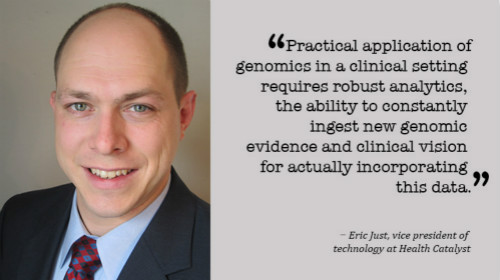
Eric Just, Deputy Technical Director at Health Catalyst
Eric stated, “I do not believe that interoperability of electronic health records is a limiting factor for development, except in a very small number of advanced healthcare institutions.” He also said, “The practical clinical application of genomics requires evidence-based analysis, the capacity to continuously incorporate new genomic discoveries, and the ability to translate data into clinical care; however, few healthcare institutions are capable of achieving these objectives to break through the bottlenecks hindering industry development.”
What is certain is that White believes academic institutions driving the development of genomics for research purposes need to enhance functionality and build capacity through electronic health records (EHRs). “Those large academic institutions have been reminding their vendors that, when it comes to EHRs, this is our business, and you need to meet our requirements,” White said.
When discussing precision medicine and electronic health records, Just noted that he found significant differences in the focus between academic and non-academic circles on this topic.
“Our survey indicates that the issue may not lie with electronic health records, but rather with unresolved scientific questions,” he said. “Although significant progress has been made, comprehensively analyzing genomics and applying it to clinical cases is not a priority for many healthcare institutions that lack a clear vision and objectives.”
These new analyses feature a novel workflow distinct from conventional practices. While they require further development, current technological limitations preclude this. Although the use of electronic health records (EHRs) facilitates workflow establishment, it is essential to open up these workflows to enable third-party institutions to expand into the EHR domain.
“Given the current situation, leaders of medical IT infrastructure simply fail to recognize the importance of electronic health records,” said Chris Callahan, Vice President of Genelnsight, based in Cambridge, Massachusetts. This means that genetic data has no place in electronic health records.
Epic and Cerner have not applied data fields to what they call “variant” systems; for example, the basic units in genetic analysis are not displayed in their systems. They are not well prepared for genomics.
Enakshi Singh is a genomics researcher who first identified the academic community’s growing demand for enhanced functionality in electronic health records. As a Senior Product Manager specializing in genomics and healthcare SAP solutions, she works at Stanford University School of Medicine to integrate genomic data into clinical care. In this role, she collaborates with cross-functional teams to identify software development solutions that enable real-time analysis of large-scale biological, wearable, and clinical data.
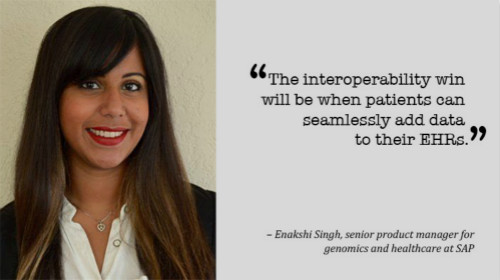
Enakshi Singh is a genomics researcher.
“Interoperability can only be achieved when patients can seamlessly add data to their electronic health records,” she said. “However, at present, electronic health record systems cannot handle genomic data or data streams from wearable devices.”
Electronic health records may not yet possess the capability for ultra-precise data processing and storage, but Singh also recognizes that this reflects healthcare institutions’ deficiencies in genomic knowledge. Each individual’s genetic code comprises approximately 3 billion base pairs, with around 3 million variants unique to each person.
“General practitioners have yet to grasp the three million variant genetic letters that make each individual unique,” she said.
“One reason for the progress in precision medicine is that the cost of sequencing has decreased,” said Singh. When genome sequencing was first performed in 2000, it took large consortia 13 years and $13 billion to complete. Today, genome sequencing can be done for just $1,000. This has also led to a growing number of consumers willing to identify their genetic predispositions.
Singh’s colleague, Carlos Bustamante, a professor of biomedical data science and genomics at Stanford University, described this trend as “trading a $1,000 genome for $1 million worth of expert interpretation.”
Singh stated that genomics andPrecision MedicineThere remains a vast expanse of the unknown; due to the existence of those three million variants, “we only understand a small fraction of what that entails.” When we discuss complex diseases, multiple diverse traits and genetic mutations interact with external environmental factors and lifestyle. Currently, we have not yet integrated these two aspects.
Another challenge lies in integrating clinical data with information known to play a role in disease, determining how to incorporate information within healthcare workflows, and making judgments based on patient records. Singh is involved in developing software that integrates new data streams and provides rapid analysis. Stanford Hospital is piloting a genomics service program that enables hospital staff to inform patients about swab collection and sequencing services.
“They will refine and manage the workflow by eliminating non-essential components and systematically cross-referencing symptom-related checklists,” said Singh. “This approach will replace database search methods. Our achievements to date include developing an automated workflow, creating a streamlined workflow, and building a prototype app capable of analyzing data for a larger patient population. Currently, the non-automated workflow requires 50 hours per patient, whereas our newly developed application significantly reduces this time. Although we are still some distance away from achieving full clinical decision support, the prototype app has already been deployed in genomic services for 30 patients, demonstrating substantial potential for further development.”
Jeffrey Wu, who has a background in electronic health records (EHRs), is the Director of Product Development at Health Catalyst and an expert in the field of population health. To fully leverage EHRs in genomics, Wu is working on developing an analytical framework capable of collecting and integrating data from diverse sources, thereby enabling the application of genomics to a broader range of precision medicine initiatives. He further stated that this approach would empower EHR systems to handle more comprehensive patient information.
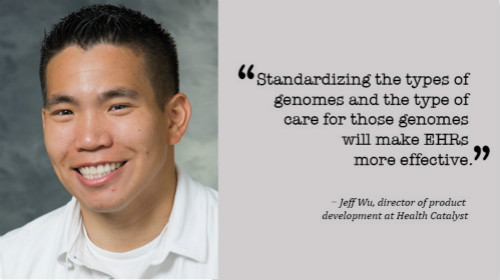
Jeffrey Wu is the Director of Product Development at Health Catalyst.
“At present, there are only minimal differences among patients, making it more difficult to distinguish between them,” said Wu. “Standardizing genomics and the types of genomic medical services can make electronic health records more effective.”
Wu explained that his project features two spaces—the electronic health record (EHR) serves as the workflow space, aligned with a separate analytics engine designed for large-scale computations and complex algorithms.
“These two devices operate independently,” he said. “Our goal is to integrate these data aggregation points, maintain current capabilities, and leverage the advantages of future technologies to acquire real-time data.”
One important way to help vendors expand the functionality of electronic health records is FHIR—Fast Healthcare Interoperability Resources, an open healthcare standard originating from HL7 that has been available for trial use since 2014.
SMART is the latest platform provided by Rapid Interoperability of Medical Resources, designed to offer a fully open, standards-based technology stack. This design enables developers to easily access vast amounts of clinical data.
Joshua Mandel, MD, is a scientist in biomedical informatics at Harvard University and the chief architect of the SMART Health IT project. Dr. Mandel is optimistic about the SMART project for rapid health data interoperability and a pilot initiative called Sync for Science. He believes that these two initiatives will incentivize vendors to enhance electronic health record (EHR) capabilities and provide support for more advanced healthcare service platforms.
“When the Healthcare Information and Management Systems Society (HIMSS) and the National Institutes of Health (NIH) attempted to incorporate electronic health record (EHR) data into research through a forward-looking approach, it was natural to leverage the application programming interfaces (APIs) of the Substitutable Medical Applications and Reusable Technologies (SMART) project for rapid medical resource interoperability,” he said. “This is not merely a technology for research; it also provides a platform for accessing other categories of data. This technology aligns with the national development plan to provide patients with API access, enabling them to choose their preferred mobile apps and integrate those apps with their electronic health records. In this sense, research represents just one use case—if we have an ecosystem of functional apps, researchers can leverage this ecosystem just like other software developers.”
Through the development of Sync for Science, the Mandel team at Harvard University’s Department of Biomedical Informatics is leading a technology coordination initiative. Initially funded for 12 months and partnering with seven electronic health record (EHR) vendors—namely Allscripts, athenahealth, Cerner, drchrono, eClinicalWorks, Epic, and McKesson/RelayHealth—the project aims to ensure that each vendor adopts standardized application programming interfaces (APIs), enabling patients to share their clinical data with researchers.
“Sync for Science—known as S4S—is designed as an application to help all researchers request access to (or, with patient consent, receive) patients’ electronic health record data,” Mandel said.
“Keep in mind that many of the most interesting projects often involve collecting data through multiple channels, including self-reported data, mobile devices/sensors, ‘omics’ data, and electronic health records (EHRs), all of which are critical sources of information,” he said. “S4S is focused on advancing the latter—establishing connections with EHRs.” This will help ensure that outcomes remain aligned with traditional clinical concepts, such as historical diagnoses and laboratory results.
This project focuses on a relatively small “summary” dataset, known as the “Common Clinical Data Set for Meaningful Use.” It encompasses foundational structured clinical data types that form the core of health records, including allergies, medications, laboratory results, immunizations, vital signs, surgical history, and smoking status. The structured timeline enabled the pilot work to be completed by December, and Mandel expects that technical coordination efforts will also be finalized within the same timeframe. The next step, he stated, is to test the feasibility of the deployment plan with real patients.
“We are still working to understand the details of how to conduct these tests,” Mandel said. “One possible scenario is that the Precision Medicine Initiative Cohort Program will be able to successfully run these tests as part of their early user app data collection workflow.”
Built on the foundation of rapid interoperability of medical resources, S4S is designated as a key factor in expanding interoperability research, clinical data, and patient access. Rapid interoperability of medical resources is organized into profiles, user cases, and data types that describe them. S4S is establishing profiles for rapid interoperability of medical resources, so that results including demographics, medication therapy, and laboratory tests can be accessed and contributed to precision medicine initiatives.
As a supporter of S4S, the China Health Information Technology Association views this project as an extension of the “foundational building blocks of interoperability,” said White. The application programming interfaces (APIs) required by S4S have long been used in electronic health records (EHRs), but he believes that vendors have consistently kept them proprietary.
“In 2015, when we told suppliers they needed to open application programming interfaces (APIs) to enable proper data access, they agreed and further pledged to take the lead and set an example,” said White.
In 2004, when the healthcare industry began implementing electronic health records and interoperability initiatives, the concept of “Meaningful Use” had not yet been conceived. When Meaningful Use was introduced as part of President Obama’s American Recovery and Reinvestment Act, healthcare organizations were suddenly compelled to deviate from their original development plans and make changes under the specific influence of bureaucratic forces.
Walton discussed the impact on overall efforts: “Meaningful Use has had some value, but in most cases it has not achieved its original goals,” he said. “Essentially, I think many people have implemented systems to serve their own financial interests, without considering how to translate them into benefits for patients. Meaningful Use has prompted discussions about interoperability, which is a good thing, but it seems its role has been limited to that. Most changes in electronic health records driven by Meaningful Use have been motivated by billing and financial reimbursement, but it has opened the door to more possibilities.”
“Another more significant issue is that the healthcare industry essentially lacks a B2B (business-to-business) business model,” said Wayne Oxenham, President of North American Operations at Orion Health. “Thus, MU and MACRA have different incentive focuses. Meaningful Use solely concentrates on the interoperability of electronic health records and quality measurement methodologies, failing to create greater value compared to proactive care models.”
In fact, Oxenham stated that “Meaningful Use has not been particularly effective. The initiative aimed to achieve too many objectives, such as digitizing healthcare within a decade. Paradoxically, its approach prioritized technology over patients and value creation. The key priorities should be improving clinical outcomes and stabilizing costs, rather than exchanging medical records unnecessarily when they remain siloed within patient portals, delivering no tangible value. Meaningful Use missed the mark—it merely facilitated the digitization of processes that were historically, and still remain, focused on billing, but it failed to help optimize healthcare delivery or leverage data in a meaningful way.”
Just as with meaningful use, the new requirements of the Medicare Access and CHIP Reauthorization Act may also affect the momentum of precision medicine and genomics, but Walton believes this is not the current focus.
“I don’t believe that the development of Meaningful Use has been completely stifled, and people are still grappling with issues related to Medicare access and the CHIP reauthorization bill,” said Walton. “A significant part of the problem is the lack of genuine economic incentives to achieve this; many healthcare IT innovations are driven by reimbursement and revenue enhancement. I think the Meaningful Use initiative has tied up a substantial amount of healthcare IT resources, but I am not sure whether it can be determined that these resources would have been directed toward advancing precision medicine if they had not been tied up.”
Eric Rock is the CEO of Vivify, a healthcare company based in Plano, Texas. He describes Meaningful Use as “a metric driven by penalties or incentives to improve service quality; the most powerful driver in the healthcare industry has changed.” While he considers Meaningful Use a “commendable initiative,” he suggests that it may not yet be robust enough to exert a significant impact on interoperability and healthcare costs.
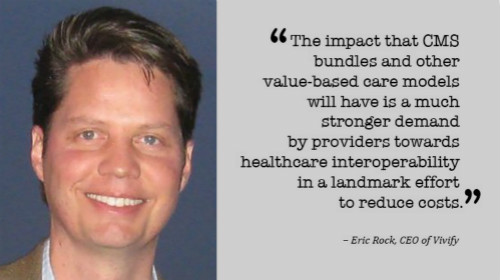
Eric Rock is the CEO of Vivify.
"Upcoming content management system packages, such as the recent model for comprehensive care in joint replacement, can further strengthen incentives for meaningful use," he said.
“The impact of content management system software packages and other value-based healthcare service models is that healthcare institutions will have a greater demand for improving interoperability to reduce costs,” said Rock. “Therefore, committing to a new level of interoperability may become a prerequisite for winning large contracts.”
If the current trajectory of precision medicine—characterized by the uneven development of electronic health records (EHRs)—persists, the medical and healthcare industries will continue to strive to curb this trend. Initiatives such as Sync for Science require time to mature and demonstrate their effectiveness. Nevertheless, significant questions remain regarding how the “technology gap” will evolve and whether it will continue to widen.
From a scientific and technological perspective, Walton believes that the focus should be on horizontal scaling.
“Currently, electronic health records are primarily based on large-scale servers rather than distributing tasks across multiple computers,” he said. “You cannot process them in this manner.”Precision Medicinedata—this simply doesn’t work, especially when multiple departments attempt to access and process the data simultaneously.”
“True cloud computing requires this type of data, both internally and externally,” said Walton, because “the underlying database frameworks behind electronic health records and clinical data warehouses are not suited for precision medicine and cannot handle the data generated.” While some clinical data warehouses can better process data, they typically lack real-time updating capabilities, which is essential for an effective precision medicine system. This will require investment in high-speed hardware and distributed computing, areas where we still have a long way to go.”
Based on the current trajectory of development,Precision Medicine“We are slowly establishing standards for medical care, and what we are doing is exploring, step by step, where personalized medicine is applicable and viable,” said Callahan.
“The only way the current trajectory will change is by altering the reimbursement model,” he said.
“If, when taxpayers havePrecision Medicine“...the idea that it is actually a key factor in public health, then they should view taxes as an investment,” he said. “That would be a game-changer, and the development trajectory would change accordingly. Currently, the taxpayer community views”Precision Medicine“Genomics is yet another costly test, and people do not know what it means or what its clinical utility is.” This is precisely the wrong way of thinking.Precision Medicineand genomics are key drivers of population health management. Once you grasp these perspectives and genuinely embrace them, you will truly begin to understand the broader landscape and its evolving dynamics.