

GraftWorx Files IPO Prospectus, Pioneering the Internet of Bodies with Cloud-Connected Implantable Sensors
In mid-September 2016, the renowned startup accelerator Dreamit announced the 17 startups selected for its Fall 2016 Healthcare and EdTech programs. Chosen from hundreds of applicants, these 17 companies will undergo rigorous stress testing by the Dreamit team over the next fourteen weeks, collaborate closely with Dreamit’s “Customer Immersion Experience” program, and refine their execution strategies in preparation for investor pitch roadshows. Among those selected is GraftWorx, a healthcare data startup.
GraftWorx is developing a novel implantable medical technology: it manufactures implantable grafts, such as stents, integrates them with its proprietary information-sensing platform, and leverages patented cloud-based software to process the resulting big data, thereby enabling remote patient monitoring.
This technology is currently primarily targeted at peripheral artery disease (PAD), a condition in which atherosclerotic plaques accumulate within blood vessels, obstructing blood flow. According to the U.S. Centers for Disease Control and Prevention, approximately 8 million Americans are suffering from PAD. Generally, patients with PAD require surgical implantation of stents or prosthetic grafts into the affected vessels to restore smooth blood flow. However, over time, traditional vascular stents can also become occluded, necessitating further surgical intervention to clear the blockage. If the accumulation is not addressed promptly, patients may even face the risk of amputation.
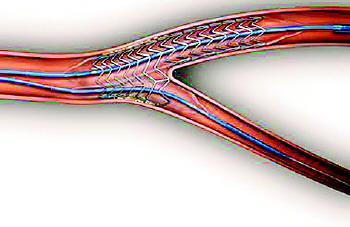
Schematic Diagram of Surgically Implanted Vascular Stents
GraftWorx manufactures sensor-equipped stents and prosthetic grafts. The sensors can precisely measure blood flow, and when vascular occlusion in patients reaches a certain threshold, they promptly alert physicians, significantly reducing the risk of amputation. According to the company’s estimates, this technology could prevent approximately 40,000 amputations annually.
In addition to detecting blood flow, GraftWorx’s broadband sensors can measure various other parameters, such as temperature, pressure, and vibration. This enables GraftWorx to detect not only vascular restenosis but also arrhythmias, systemic infections, and blood pressure abnormalities.
Smartphones Receive Sensor Information
Seamlessly integrate the sensor module with organ bypass stents and grafts, enabling convenient daily access to sensor data via a smartphone app to monitor the status of implanted grafts.
Cloud Technology Complies WithHIPAA Standards
GraftWorx’s cloud-based software is compliant with the U.S. Health Insurance Portability and Accountability Act (HIPAA), enabling seamless connectivity with “smart” cardiovascular grafts to securely store and analyze sensor-derived data.
Hospitals Reduce Pharmaceutical Expenditures
The cloud platform features data integration capabilities, enabling hospitals to identify patients at risk of subsequent complications (such as amputation or myocardial infarction), thereby reducing medical expenditures associated with preventing these risks. Additionally, it significantly lowers overall hospital costs and reduces patient readmission rates.
Increasing Physician Income
Recently, remote monitoring for the treatment of chronic diseases has been included in the new scope of medical reimbursement. As a result, GraftWorx enables physicians to increase their monthly income by an average of $50–$100 per patient seen, while also improving treatment outcomes.
GraftWorx was founded in 2012 and is based in Bel Air, Maryland. In June 2015, the company raised $1.9 million in its first seed round and $1.2 million in its second seed round, with investors including the Maryland Venture Fund, BioMaryland Center, and TEDCO. In 2015, GraftWorx received the Innovation Award from the Rosenman Institute.
“We are proud of our investment in GraftWorx and look forward to their growth and success in Maryland,” said Mike Gill, Secretary of the Maryland Department of Commerce. “Small innovative companies like GraftWorx play a critical role in Maryland’s economic development. They are our future business leaders, and their new technologies have the potential to improve the lives of millions of Americans.”
Founder David Kuraguntla stated that GraftWorx is honored to develop in Maryland, the most entrepreneurial region in the United States. “Our local medical device industry is rapidly expanding, built upon Maryland’s strong foundations in cybersecurity and biotechnology. Our goal is to integrate implantable hardware with digital health software, thereby benefiting both physicians and patients.” GraftWorx plays a pivotal role in the revolution of smart implantable devices.

Core Team
GraftWorx’s founder and CEO, David J. Kuraguntla, originally planned to become a resident surgeon. However, during his clinical practice, he identified the drawbacks of vascular endovascular stents, which led him to conceive the idea of integrating sensors into stents. He founded GraftWorx while conducting related research. The other co-founder and CTO, Samit Gupta, also has a medical background; he holds a Ph.D. in Biomedical Engineering and previously founded O2 Insights, a point-of-care medical diagnostics company that was later acquired by Johnson & Johnson. Other key team members include Anthony Flannery (Vice President of Technology), Victor Moussalem (Head of Product), Amy Steig (Vice President of Clinical Trials), Ray Farnham (COO), and Robert McCullock (CFO).
This June, GraftWorx welcomed a new team member—Frank Honoré, former Technical Lead at Verily Life Sciences, Google’s life sciences research institution, who has joined the company as Vice President of Product R&D. With over 20 years of experience in the technology sector, he possesses deep insights into medical IT and remote patient care. During his tenure at Verily Life Sciences, Honoré led several projects under the Moonshot initiative, including research on wireless relays for non-invasive glucose monitors. He was also a co-founder of WebLine Communications, an intelligent connection management company acquired by Cisco Systems in 1999, and has been a key contributor to multiple startups.

A statement on the company’s website outlines its vision and development path: GraftWorx is ushering in the era of the “Internet of the Body” from the “Internet of Things (IoT).” The IoT connects various devices—such as radio-frequency identification (RFID) tags, infrared sensors, global positioning systems (GPS), and laser scanners—to the internet, enabling intelligent identification and management. In contrast, the “Internet of the Body,” advocated by GraftWorx, connects implantable medical devices to the internet, leveraging cloud technology to harness big health data and support medical decision-making.
What sets GraftWorx apart is its “smart” expertise in peripheral vascular surgical implants—GraftWorx is the first company to combine vascular stents with sensors. “Our novel cardiovascular grafts are merely the beginning of a revolution in implantable sensing devices. Future implantable sensing devices will leverage remote monitoring to integrate information among patients, physicians, and hospitals,” said Frank Honoré.
Series Report:
[Medical Big Data] $30 Billion in Sales! SHYFT Analytics Is Expanding Aggressively
[Medical Big Data] Zephyr Health: Market Insights Consultant for Pharmaceutical Companies