Home Rock Health Releases Top 10 Digital Health Investment Trends of 2016 Based on 176 Companies

Rock Health Releases Top 10 Digital Health Investment Trends of 2016 Based on 176 Companies

Oct 09, 2016 09:30 CST Updated 09:30

RockHealth has reviewed 176 financing and investment transactions involving digital health companies this year (up to the time of publication), analyzed big data, and identified ten highly reference-worthy year-end financing and investment trends along with interpretations of related phenomena. VCBeat (WeChat ID: vcbeat) has compiled this information for our readers.


1
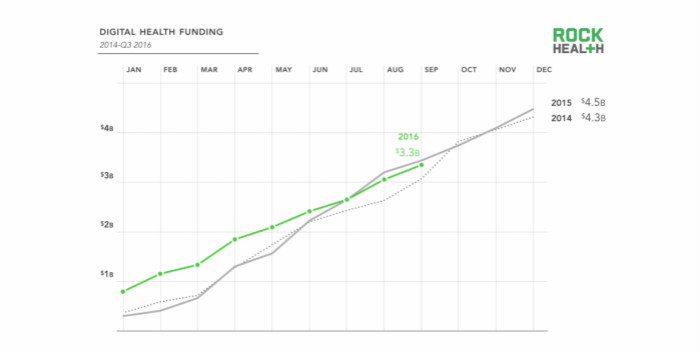
With less than two months remaining in the year, the likelihood of record-breaking financing deals is low. To date, there have been 233 venture capital transactions in digital health (involving a total of 176 companies), amounting to $3.3 billion. This represents an increase of 14 transactions compared with the third quarter of 2015. Despite the depreciation of the U.S. dollar, the total transaction volume is expected to remain broadly flat compared with the previous two years by year-end.


第一张_meitu_1.jpg

2

Deals involving growth-stage digital health companies have hit a historic low, accounting for only 10.2% of all transactions. On the other hand, investors show the greatest interest in early-stage companies, particularly seed- and Series A-startups, which accounted for 60.9% of total deals in 2016, making them the absolute mainstream.


3
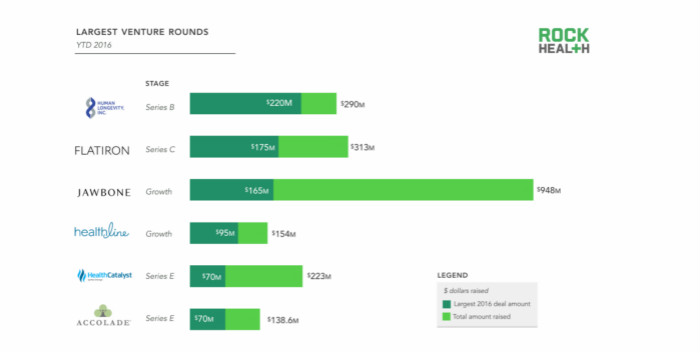
The top six companies by transaction amount accounted for nearly one-third of the total transaction value this year. There were three deals exceeding $100 million in scale this year. Human Longevity, a U.S.-based company driven by genomics as its core technology, completed a Series B financing round worth over $220 million at the beginning of the year (second only to Jawbone’s $300 million raise in 2015 and NantHealth’s $250 million financing deal in 2014).

第二张_meitu_2.jpg

4
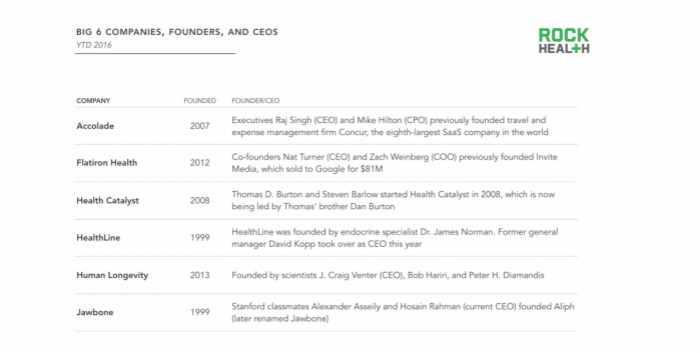
The top six companies by transaction volume this year have an average founding history of 10 years. The youngest, Human Longevity, was established in 2013, while Jawbone and HealthLine were both founded in 1999. A study of these six companies also reveals some interesting phenomena:


1. The average age of founders at the time of company establishment was 37 years, and it rose to 46 years by the time of the latest funding round.


2. The most common undergraduate majors for founders and CEOs of these companies are economics, engineering, and biology. However, some aspiring CEOs always prefer to take an unconventional path. David Kopp, CEO of HealthLine, holds a liberal arts degree from Harvard University; Peter Diamandis earned a master’s degree in aerospace engineering from the Massachusetts Institute of Technology (MIT); and Steven Barlow, co-founder of Health Catalyst, obtained a Bachelor of Science degree in Health Promotion and Education from the University of Utah.


3. Although nearly one-third of all CEOs in this year’s survey hold an MBA, among the top six companies, only Dan Burton, CEO of Health Catalyst and a Harvard Business School graduate, holds this degree.
3_meitu_3.jpg

5
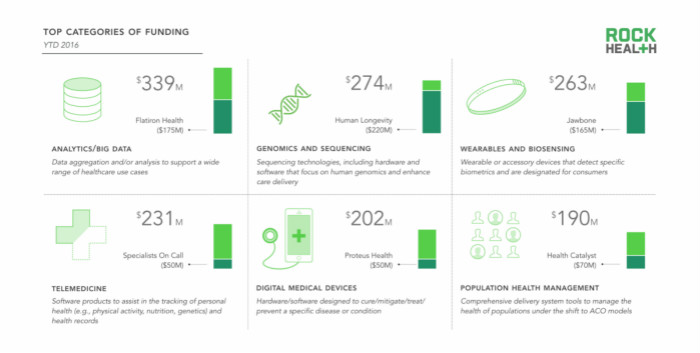
Transaction volumes in the top six categories—namely, medical big data, genomics and gene sequencing, wearable devices and biosensors, telemedicine, digital health devices, and population health management—accounted for 44% of the total transaction value this year. Driven by Human Longevity’s $220 million financing round, genomics and gene sequencing have gained strong momentum, with a significant surge in transactions, marking their first appearance among the top-ranked sectors.


5_meitu_4.jpg

6
For every US dollar in transaction value, 47 cents flowed to companies headquartered in California, bringing the state’s total transaction value to US$1.5 billion. New York State recorded 28 investment and financing deals this year, followed closely by Massachusetts with 24 deals. Emerging hubs Texas and Illinois continued to grow, with 14 and 12 deals, respectively (in 2015, each state averaged only eight deals per week).
7
This year, 21 CEOs who secured funding hold MD degrees. The most represented medical school is Stanford University (3), followed by the University of Pittsburgh School of Medicine (2). Additionally, five CEOs graduated from medical schools in other countries, such as China and Israel.
8
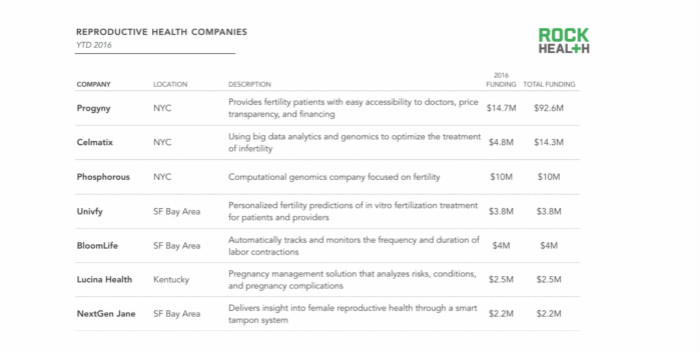
Reproductive health companies that secured financing this year provide women with comprehensive health tools covering the entire journey from pregnancy to childbirth. Notably, these companies have the highest proportion of female CEOs, with five out of seven CEOs being women. In contrast, across all financed enterprises, this proportion stands at merely 8%.

8_meitu_5.jpg

9
Some new investors became active in the third quarter, with 25 investment firms each making three or more investments, compared to only 12 funds that crossed this threshold in the first half of the year. Although the University of Pittsburgh Medical Center (UPMC) only entered the investment arena this year, it has already become one of the most active venture capital investors, completing six investments (including Health Catalyst and Lantern). It is closely followed by the established healthcare venture capital firm Khosla Ventures, which recorded a total of five deals (including Neurotrack and Color Genomics).
10

Among the 176 companies that received venture capital investment, failures were rare. Nevertheless, the most notable cases involved four companies and two high-profile products:


Wellero:Founded just two years ago, the mobile payment startup Wellero shut down its related business in January of this year. According to MobiHealthNews, “the app had only about 1,100 users; although it offered a broad portfolio of 700 health plans, the service failed to attract users.”


HealthSpot :Despite having secured $43.8 million in financing, operating in the highly competitive telemedicine sector, and boasting prominent backers such as Rite Aid, Cleveland Clinic, and Xerox, this once-celebrated startup was forced to file for bankruptcy in January of this year—just five years after its founding.


BioBeats Pulse app:BioBeats, a company that integrates physiological data (heart rate) with music services using smartphone cameras, raised $2.3 million in funding and ceased development of its BioBeats Pulse app this April.


Google MyTracks app:Google, renowned for its ruthlessness toward projects with limited prospects, discontinued its open-source application MyTracks this May. The app tracked users’ routes, distance, and speed while walking, running, or cycling. Following the discontinuation, Google shifted to leveraging Google Fit and Google Now to continuously monitor users’ activity trajectories and behaviors, utilizing these data to pursue a broader health ecosystem strategy.


Enigma :Cambia’s internal startup project (formerly known as Muse), which primarily employed a “cognitive-behavioral” approach to help patients reduce medically unexplained symptoms, was shut down in May this year.


Drugstore.com :This August, Walgreens, the largest pharmacy chain in the United States, announced the closure of its subsidiary, drugstore.com. Notably, just five years ago, the acquisition of drugstore.com was valued at a staggering $429 million.