

Rayhan Medical Submits IPO Prospectus: Hand Rehabilitation Robots Achieve 80% Efficacy Rate
Ruihan Medical, established in May 2016, has independently developed three major categories of hand rehabilitation robotic products: Ruihan Type I, II, and III. Gu Xiangdong, the head of operations at Ruihan Medical, stated that clinical practice has demonstrated an overall effectiveness rate of up to 80% for Ruihan’s rehabilitation robots. In more tangible terms, this means that stroke patients can regain the ability to perform daily activities with their affected hand, such as washing their face and eating. VCBeat (WeChat ID: vcbeat) has provided follow-up coverage on this development.
Shenzhen Ruihan Medical Technology Co., Ltd. is a high-end intelligent manufacturing company dedicated to the research and development, production, and sales of high-tech intelligent rehabilitation robots. Specializing in the field of stroke rehabilitation robotics, the company has independently developed three series of hand rehabilitation robots—Ruihan Type I, II, and III—to address the scarcity of domestic products for hand rehabilitation among stroke patients in China. The company has filed nearly ten patents, including inventions, utility models, and design patents. Several of its products have been successfully adopted for clinical trials by dozens of authoritative medical institutions across China.
Wang Jing, founder of Ruihan Medical, is an associate professor and doctoral supervisor at the School of Mechanical Engineering, Xi’an Jiaotong University. He completed his postdoctoral research at Georgetown University in the United States and was a Xiangjiang Scholar at The Chinese University of Hong Kong and The Hong Kong Polytechnic University. He has long been engaged in research in fields such as rehabilitation robotics and brain-computer interfaces. Huangfu Zhigang, Marketing Director, previously served as marketing director for a family-owned enterprise and has five years of experience in corporate management.
Gu Xiangdong, Director of Publicity, holds a Master’s degree in Film and Television Arts from the Communication University of China. As a senior journalist at CCTV News Channel, he is well-versed in the reporting practices of national-level media and has access to broadcast resources across multiple CCTV programs. He previously participated in the overall operations and program promotion of CCTV-1 and brings ten years of experience in CCTV program production and brand promotion.
According to statistics from the National Health and Family Planning Commission, there are currently approximately 12 million stroke survivors in China, with an annual increase of 2 million. As population aging intensifies, the number of stroke survivors is projected to reach 32 million by 2030. Furthermore, Gu Xiangdong noted that market research revealed a concentration of stroke risk among middle-aged adults due to high work-related stress, heavy family burdens, and insufficient physical activity, leading to a trend of younger stroke onset.
Data show that nearly 50% of stroke patients are aged 40–64 years; among individuals at high risk for stroke, those aged 40–64 years account for more than 60%. Moreover, middle-aged stroke patients demonstrate significantly stronger willingness and determination to undergo rehabilitation than elderly stroke patients. Their daily exercise duration is 1.5 times that of elderly patients.
In accordance with the “Notice on Including Additional Medical Rehabilitation Items in the Scope of Basic Medical Insurance Coverage” jointly issued by the Ministry of Human Resources and Social Security, the National Health and Family Planning Commission, and other departments, the number of rehabilitation items covered by medical insurance will increase from 9 to 29 starting June 30 this year. Meanwhile, medical rehabilitation items already included in the local medical insurance coverage will remain covered. Among the newly added items are exercise therapy, comprehensive limb training for hemiplegia, and hand function assessment.
Although demand for rehabilitation medical services in China is substantial, the system remains imperfect. There are 3,800 rehabilitation departments in general hospitals and specialized rehabilitation institutions nationwide, accounting for 28.4% of the total; rehabilitation beds number 98,992, representing 2.2%; and rehabilitation medical personnel total 39,833, making up 0.72%. A systematic, comprehensive, and adequate supply system for rehabilitation medical services has yet to be established. Furthermore, unified industry management standards are lacking. Rehabilitation institutions are generally small in scale, low in quality, and limited in number, with their development levels needing significant improvement.
In the rehabilitation medical market, upper and lower limb rehabilitation robots are mature products, with manufacturers including Switzerland’s Lokomat, Israel’s ReWalk & MediTouch, and Anyang Shenfang. However, hand rehabilitation products remain scarce. Currently, products available in the domestic market include Guangzhou Yikang A5 and Hong Kong RehabRobotics’ Hand of Hope. The Guangzhou Yikang A5 was developed by simulating real-time kinematics of human finger and wrist movements. It features assessment capabilities for flexor and extensor muscle strength signals in the fingers and can train both the hand and the wrist, with a price range of RMB 500,000–600,000. The Hand of Hope by Hong Kong RehabRobotics is a product of the Dexin Group based in Hong Kong, priced at RMB 800,000–900,000. Both products are relatively expensive.
Furthermore, the majority of stroke patients rely on traditional rehabilitation methods such as massage and acupuncture; however, these approaches are largely ineffective for patients who are more than six months post-stroke. Additionally, hand rehabilitation is particularly challenging due to the involvement of distal nerve recovery.
Against this backdrop, Shenzhen Ruihan Medical was established, and its products have gradually been introduced to the market.
Ruihan Medical has independently developed three major categories of hand rehabilitation robotic products: Networked Intelligent Self-Driven Hand Rehabilitation System, Wearable Hand Rehabilitation Robot, and Brain-Controlled Hand Rehabilitation Robot.
Networked Intelligent Self-Driven Hand Rehabilitation System: This product is designed for individual consumers and community medical institutions. Users wear the device and undergo one-hour training sessions each in the morning and afternoon, with a rehabilitation cycle of three months. Based on daily training performance, the system generates a training report that highlights progress and provides recommendations, thereby motivating users through visible results. The current selling price of this product is20,000Renminbi.
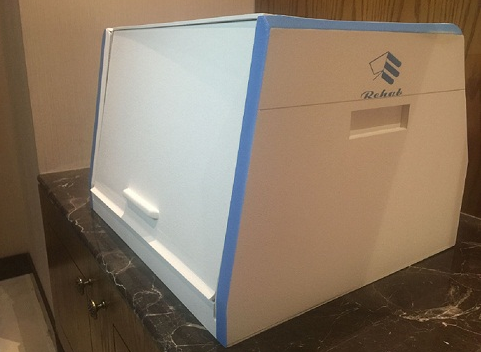
Ruihan Type I
Wearable Hand Rehabilitation Robot: This product is designed for B2B clients and represents an advancement from basic muscle rehabilitation to neuronal rehabilitation of the brain. It utilizes residual electromyographic signals in the hand to control a rehabilitative robotic hand. When the brain issues active motor commands, it induces changes in surface electromyography (sEMG) of the hand. Capture electrodes detect these signal changes, which are then processed to drive the movement of the robotic hand. Currently, its price is at200,000。
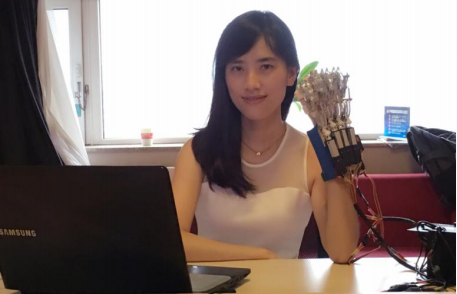
Ruihan Type II
Brain-Controlled Hand Rehabilitation Robot: This product is also designed for B2B clients. It integrates virtual reality, brain-computer interface, and robotics technologies, with the aim of restoring neural pathways between the hand and the brain. After the brain issues active motor commands, the device captures neural signals from the head; these signals are processed by algorithms and then transmitted to a robotic hand to execute the movements intended by the brain. Meanwhile, virtual reality technology immerses patients in simulated scenarios, enhancing engagement and fully activating mirror neurons associated with movement. One user who had suffered a stroke eight years prior was able to eat, wash their face, and write independently without difficulty after three months of rehabilitation training. Its current price is2 million。
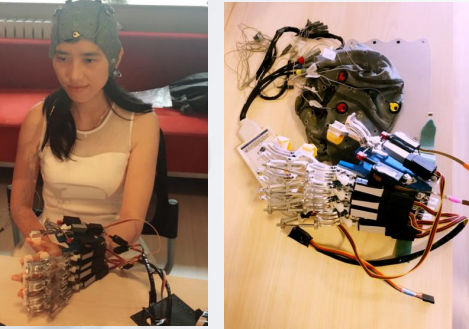
Ruihan Type III
Clinical practice has demonstrated that the Ruihan rehabilitation robot achieves an overall effective rate of 80%. Regarding treatment costs, the typical rehabilitation period is three months, which is fully covered by medical insurance, thereby alleviating the financial burden on patients. Compared with other hand rehabilitation robots currently available on the market, Ruihan Medical’s Generation I and II products offer superior cost-effectiveness. The Generation III product primarily targets neural repair between the brain and the hand, yielding improved rehabilitation outcomes.
In late October this year, Ruihan Medical will partner with two large Grade A tertiary hospitals to launch its first- and third-generation rehabilitation robots for clinical use. Additionally, through collaborations with community healthcare institutions, the first-generation robots will be deployed in community healthcare settings and the consumer market. All products are expected to officially go on sale in February 2017. The sales model will adopt a direct-to-consumer approach driven by physician recommendations, and Ruihan Medical’s team has already reached cooperation intentions with 38 hospitals across China.
Starting in 2017, the company will expand into the field of upper and lower limb rehabilitation. Since hand rehabilitation is more challenging than upper and lower limb rehabilitation, product development will be relatively easier.
Ruihan Medical is currently raising its angel round.