Is the Funding Winter Here? China's Q3 Digital Health Funding Plummets 41% Quarter-over-Quarter

If digital health is viewed as a living organism, it has had a fraught existence.
From its breakout year in 2014, through the discourse of a “capital winter” in 2015, to this year’s frequent negative headlines featuring transformations, layoffs, and closures, just three years have seemed to drain much of its vitality. It is suffering from a serious illness without yet finding an effective cure. The search for a remedy has been agonizing, akin to the predicament of being unable to cross a river without feeling one’s way across by stepping on stones. Thus, the capital winter appears to have truly arrived.
According to the Q3 China Digital Health Startup Investment and Financing Report released by VCBeat, analysis shows that the financing amount in Q3 2016 was $576.71 million, a year-on-year decrease of 30% and a quarter-on-quarter decrease of 41%.
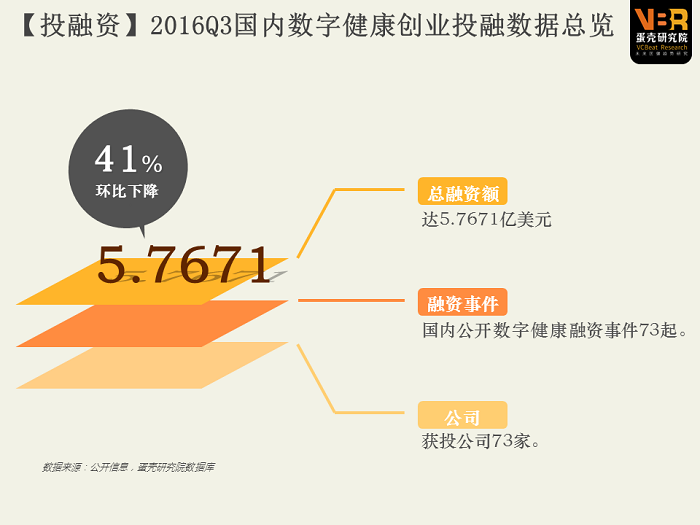
This outcome does not appear to be a positive sign for entrepreneurs, investors, or industry insiders.
“The Boy Who Cried Wolf” has been shouted so often that the wolf seems to have actually arrived.
Has the wolf come? Is there truly a capital winter?
VCBeat has always held the view that there is no such thing as a “capital winter” in the absolute sense. The so-called winter only affects projects with unclear business models and no profit prospects. For specialized, scaled-up projects with proven profitability, weathering the “winter” is never a concern.
Digital health is a vast market in its nascent stage, replete with both abundant opportunities and numerous pitfalls. The key to mitigating these risks may lie in adopting targeted, precise strategies.
Below is an excerpt from VCBeat’s report “Q3 2016 China Digital Health Investment and Financing Report.” For the full version, please click “Q3 2016 Investment and Financing Report"Purchase."
According to the report, although the total transaction value has declined, the number of transactions has continued to rise year over year. There were 73 deals in the current quarter, representing a 100% year-on-year increase and a 16.7% quarter-on-quarter increase. A comparison of transaction volume and value indicates that capital remains open to investing in projects but is exercising greater caution when making commitments.
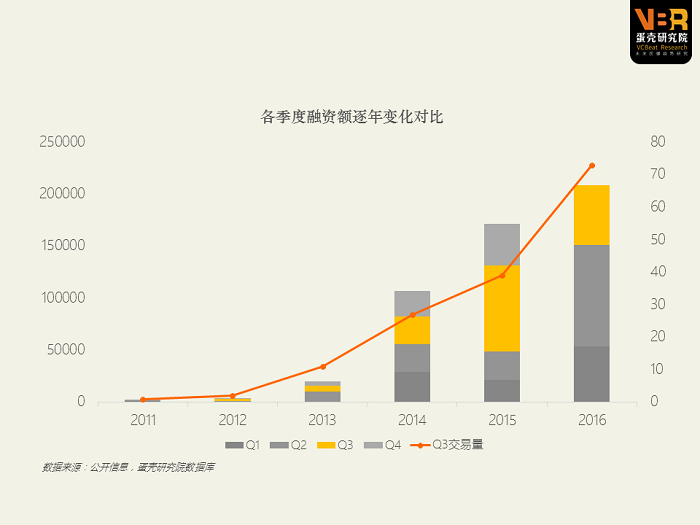
From the perspective of investment and financing transaction volumes in recent years, there has been an overall upward trend. Specifically, the surge in digital health in 2014 spurred a rise in capital market activity, followed by year-on-year increases thereafter. In the coming years, financing amounts are expected to stabilize, influenced by product and market factors.
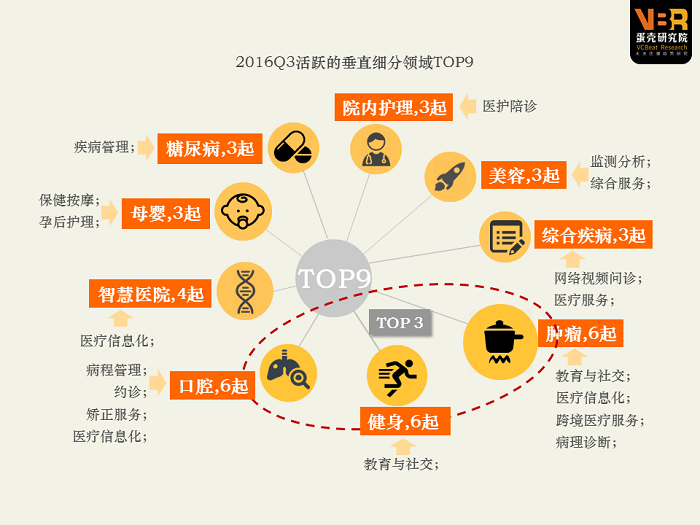
According to the report, there were nine active sub-sectors this quarter, with oncology, dentistry, and fitness ranking first in a three-way tie, each recording six transactions.
Oncology has attracted significant investor attention this year, with a total of 11 transactions completed by the third quarter. The key focus areas include healthcare informatics, pathological diagnosis, cross-border medical services, and education and social networking. In terms of investment and financing nature, the sector remains in its early stages. Overall, oncology is still a field dominated by traditional research; the application of cutting-edge new technologies will further enhance it, and projects with strong technical capabilities offer greater value potential.
The dental sector completed six transactions this quarter, involving Meiya Meili, Yake, Haoyayi, York Dentist, LinkedCare (Lingjian Information), and Youya. The entry models included appointment scheduling, disease course management, medical informatization, and orthodontic services. As a healthcare segment with strong consumer-oriented characteristics, the most critical factor for digital projects is user experience. It is essential to optimize traditional dental services through technology and integrate various stakeholders across the traditional industry chain, rather than operating in isolation.
Fitness has also been in the spotlight in this year’s venture capital and private equity circle. As of the third quarter, 12 deals were completed, with a total financing amount of $54.85 million. The funded projects include Orange Yoga–Orange Sports, Top Fitness, KEEP, Piggy Circle Fitness, Coach Booking, and U-24. These investments are concentrated in education and social services. Such asset-light service models are prone to falling into the trap of homogenization; only by achieving differentiation can they find room for growth.
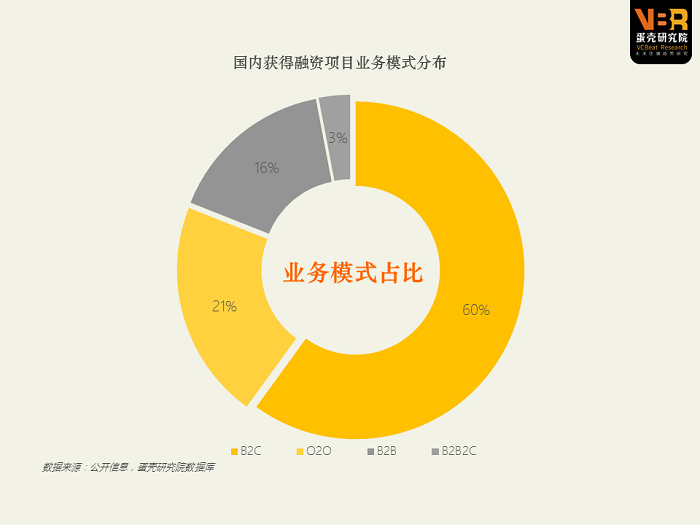
There are four main business models, with B2C projects accounting for 60%. In-hospital nursing services for patients and consumer-oriented dental O2O projects rank second, representing 21% of the total.
B2B projects serve a more diversified clientele, including healthcare institutions, enterprises, government agencies, and end-user retailers. Technological and market dynamics will drive multi-party integration, thereby fostering diverse innovative initiatives.
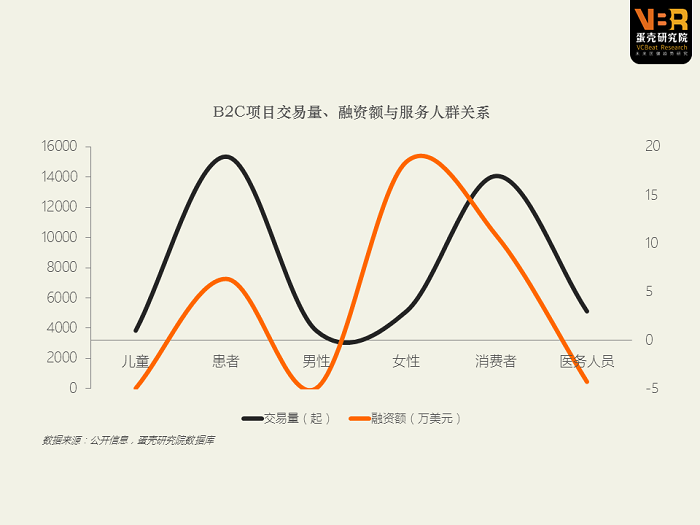
B2C project financing reached $328.72 million. The services primarily target six major groups: children, patients, men, women, consumers, and healthcare professionals. Among these, fitness and women’s health projects targeting women secured the highest funding, amounting to $150.26 million.
In addition, 17 consumer-focused projects in areas such as massage therapy and fitness, ophthalmology, maternal and infant care, beauty, workplace health, and health insurance secured $102 million. Meanwhile, 19 patient-focused projects covering oncology, gastrointestinal health, hypertension, diabetes, heart disease, critical illnesses, and asthma obtained $72.64 million.

Author: VCBeat. Please credit the WeChat Official Account when reposting.VBResearch2016
↓↓↓