

LeYu Care Files for IPO: Building a Full-Chain Rehabilitation Ecosystem from Caregiver Platform to Home-Based Recovery
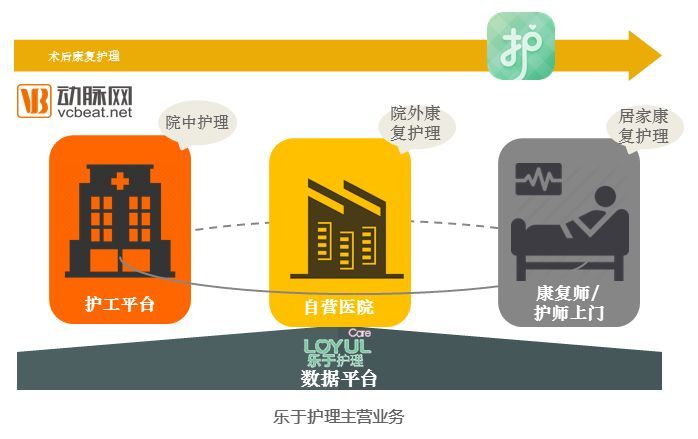
In the healthcare sector, LeYu Nursing is at the forefront.
On April 1, 2008, Chen Zhengdong founded Chengdu Leyu Health Care Co., Ltd., focusing on providing professional care and rehabilitation services for patients and individuals with disabilities, including post-operative care, home care, and rehabilitation center services.
To date, the LeYu Care management team comprises over 600 members, including nursing specialists with years of clinical experience, executives from multinational corporations, professional managers with EMBA qualifications, and an internet technology team. The organization provides care services to more than 20,000 clients annually, with over 4,000 patients undergoing rehabilitation.
After eight years of development, we have proudly provided nursing services to over 150,000 patients, generating revenue exceeding RMB 120 million. What does it mean that our business operations across three segments—in-hospital caregiver platforms, self-operated hospitals, and home-based nursing care—have now been fully integrated?
The term “scattered” entrepreneurs mentioned here actually refers to consumer-facing Internet-plus healthcare startups (operating on an O2O business model). These ventures burned through capital in the early stages to acquire a large user base, but later failed to sustain sufficient patient traffic to support platform operations. Coupled with market saturation from homogeneous competitors and a lack of core competitive advantages, numerous rehabilitation and nursing care startups struggled to achieve monetization or faced widespread closure. Specific companies include:
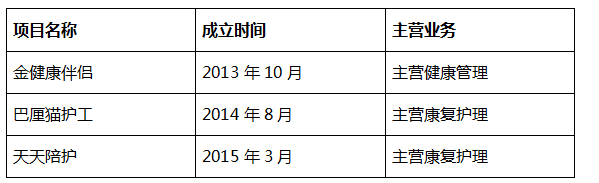
Tiantian Peihu, mentioned in the list, is affiliated with Chengdu Xiaoqiao Technology Co., Ltd. It is a C2C caregiver platform that enables users to seek and book caregiver services via its WeChat service portal. By introducing advanced management systems from Europe and the United States, it provides high-quality services including hospital care, elderly care, and maternal and infant care, striving to become China’s leading companion care platform.
Ideals are lofty, but reality is stark. “Although Tiantian Peihu secured angel-round financing, the rehabilitation and nursing market was not yet mature, and our product failed to effectively address real-world problems. As a result, the company is comprehensively adjusting its product strategy and exploring how to resolve industry-wide challenges in rehabilitation and nursing care,” founder Yu Le told VCBeat.
In terms of capital, due to the impact of the bankruptcy turmoil, many venture capital firms have halted investments in angel-round projects. The large number of failed startups further corroborates that monetization on the periphery of core medical services is extremely difficult in this highly monopolized industry. Moreover, as healthcare reform remains in a critical and rapid advancement phase, the overall policy environment is highly unstable, giving rise to significant policy risks.
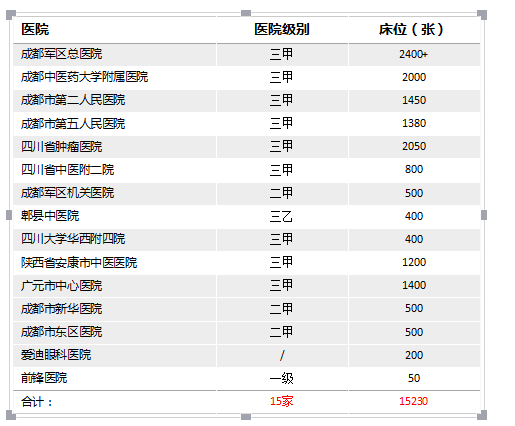
Figure: Hospitals Willing to Collaborate on Nursing Care
LeYu Nursing, with over eight years of experience navigating the rehabilitation industry, has chosen an unconventional path for business development. Founder Chen Zhengdong has adopted a strategy for market expansion that emphasizes “speed,” rapidly breaking down barriers within hospitals and swiftly adjusting the company’s service offerings.
On one hand, Chen Zhengdong rapidly penetrated hospital networks by leveraging departmental nurse stations as focal points for market development. By enabling online ordering via apps or WeChat, establishing service protocols and elimination mechanisms, and streamlining service workflows, he facilitated rapid dissemination and scalability of the model. On the other hand, he swiftly established an internal training mechanism within the company. Utilizing online video tools to simplify training complexity and achieve accelerated learning outcomes, this approach addressed patient education and transitional care training needs, thereby fulfilling the company’s staffing requirements.
To date, 15 hospitals have partnered with Leyu Nursing, providing over 15,000 beds and serving a cumulative total of 157,500 patients. In terms of nursing training, the Hulianwang Education Platform engages 26 nursing experts from across China.
Furthermore, through collaboration with hospitals, Chen Zhengdong observed that due to the scarcity of beds in tertiary Grade A hospitals, patients cannot receive long-term treatment there. Relying solely on supportive rehabilitative care is not conducive to their speedy recovery. Diverting these patients to general hospitals and implementing scientific nursing practices characterized by dedicated care would not only alleviate patients’ concerns but also enhance user stickiness.
Subsequently, Chen Zhengdong visited numerous hospitals in hopes of finding a suitable partner. After extensive visits and negotiations, he ultimately established a deep strategic partnership with Qianfeng Hospital, located at No. 1, North Section 4, First Ring Road, Chengdu, by taking over its management (self-operation). This move marked a critical step in his strategic layout of the rehabilitation and nursing care chain.
At this point, LeYu Nursing’s business model has evolved from a peripheral healthcare innovator to one that is genuinely integrated into the medical sector. Leveraging its self-operated Qianfeng Hospital as a base, it secures a steady patient flow through collaborations with Grade 3A hospitals, and then provides extended services outside the hospital setting—namely, home-based rehabilitation nursing—thereby completing its full-industry-chain layout in rehabilitation and nursing care.
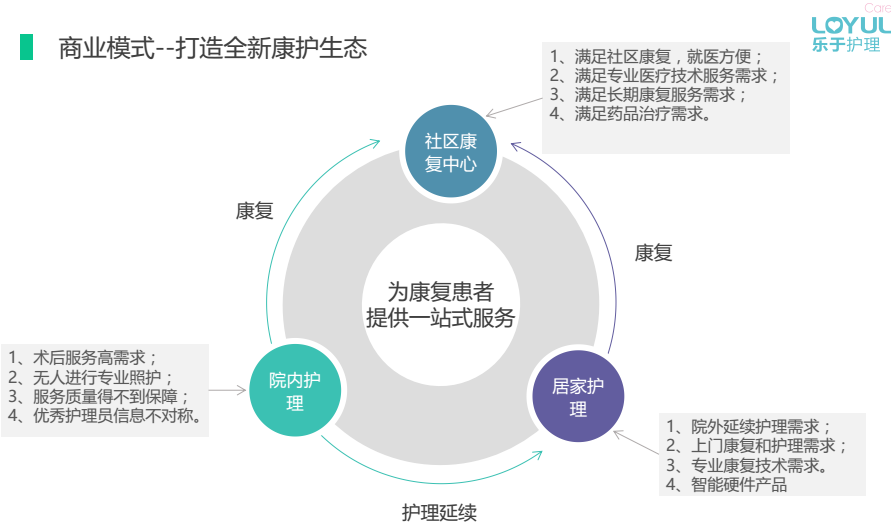
In Chen Zhengdong’s view, medical treatment accounts for only 30% of patient care, while nursing constitutes the remaining 70%, serving as the cornerstone of the entire healthcare process. However, from the demand side, although treatment is a basic need for patients, nursing and rehabilitation remain strong demands, with service scenarios continuously evolving. “Based on years of experience in rehabilitation and nursing services, the key to the success of such programs lies in their ability to bridge care within and outside hospital settings.”
Consequently, there is a high demand for in-hospital nursing services, including postoperative care; however, the lack of professional caregivers compromises service quality. Patients or their relatives can place orders via the “LeYu Nursing” app, and the platform matches them with professional nursing staff to provide care.
Outside the hospital, specifically in home care settings, LeYu Nursing continues to provide on-site rehabilitation and nursing services. By leveraging professional rehabilitation expertise and smart hardware, it helps patients regain their health. “The latter represents the most robust demand.”
China sees approximately 10 million new elderly individuals added to its population each year, with 60% to 70% of them having rehabilitation needs. Based on calculations that meet the basic domestic demand for rehabilitation services, the market size would exceed RMB 100 billion; however, if benchmarked against standards in developed countries, the market size would surpass RMB 600 billion.
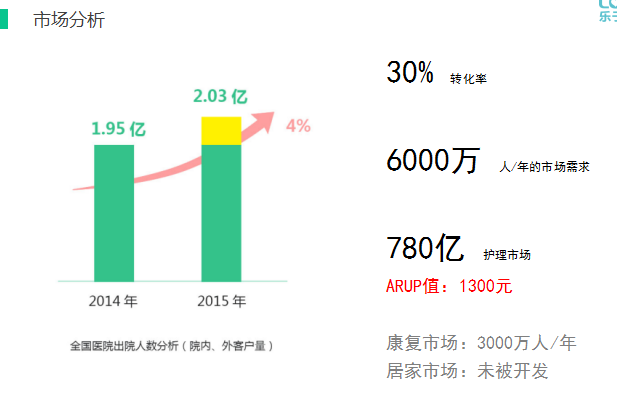
VBInsight Nursing Care Analysis Report
As the domestic rehabilitation market has entered a fast lane, outpatient visits in China’s rehabilitation departments have grown from 18.74 million in 2009 to 37.60 million in 2014, representing an average annual growth rate of 15%. The scale of China’s rehabilitation medical industry is projected to reach RMB 103.8 billion by 2023, with a compound annual growth rate (CAGR) of no less than 18%.
According to Chen Zhengdong’s market research, the home care market remains largely untapped and holds immense potential. In response, LeYu Care has proactively positioned itself across the entire rehabilitation and nursing value chain to build a novel rehabilitation ecosystem.