

Baidu Unveils Medical Brain to Rival Google and IBM, Launching a New Era of AI-Driven Healthcare
Yesterday, Baidu officially unveiled its latest achievement in the field of healthcare—Baidu Medical Brain—under the theme “Opening a New Era of Intelligent Healthcare,” positioning it againstGoogle and IBM's competing products.
Two years ago, Baidu’s founder and CEO, Robin Li, publicly revealed Baidu’s artificial intelligence project, “Baidu Brain.” On September 1, 2016, at the Baidu World Conference, Robin Li for the first timeComprehensively showcase Baidu’s artificial intelligence achievement, “Baidu Brain,” to the outside world, and announce the opening of its core capabilities and underlying technologies to developers, entrepreneurs, and traditional enterprises.
According to the introduction, Baidu Brain consists of three components: artificial intelligence algorithms (ultra-large-scale neural networks), computing power (hundreds of thousands of servers for computation, based on GPUs)) and big data. It primarily encompasses four core capabilities: speech capabilities (speech synthesis and speech recognition), image processing capabilities, natural language processing capabilities, and user profiling capabilities.
As a specific application of Baidu Brain in the medical field, Baidu Medical Brain is an AI-driven product design based on the collection and analysis of massive amounts of medical data and professional literature, mod-Simulate a physician's consultation process, engage in multi-turn dialogue with the user, identify potential issues based on the user's symptoms, conduct iterative verification, and provide final recommendations. During this process, collect and summarizeClassify and organize patient symptom descriptions, alert physicians to additional diagnostic possibilities, and assist primary care doctors in completing clinical consultations.
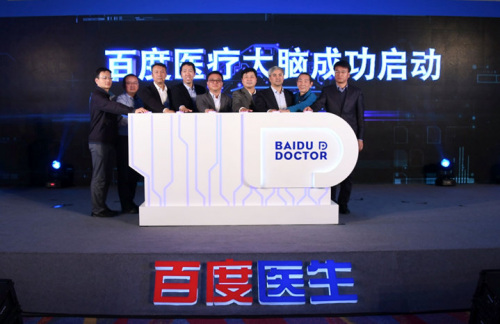
Baidu stated that Baidu Medical Brain will uphold an open and win-win strategy, gradually building an open medical intelligence platform.
Fan Wei, Director of the Big Data Laboratory at Baidu Research Institute and head of technical development, outlined three major challenges facing this technology: defining user intent, the colloquial and diverse nature of user descriptions, and the extremely limited volume of annotated data. Regarding “defining user intent,” Baidu stated that it categorizes user intent into five major types: diseases, symptoms, medications, tests, and surgeries.
At the event, Li Zheng, General Manager of Baidu’s Healthcare Division, played a pre-recorded video. The video showcased a “crowd-testing” initiative conducted by “Baidu Medical Brain” in the lobby of a large hospital, demonstrating the product’s high diagnostic accuracy through comparison with diagnoses made by real physicians.
At the beginning of the year, Baidu President Zhang Yaqin proposed the development concept of “Intelligence+,” stating that “Intelligence+” is an extension and the next stage of “Internet+.” “Intelligence+” will accelerate the integration of the physical and digital worlds, once again reshaping the business models and competitive rules across 3,600 industries.
Baidu’s Chief Scientist, Andrew Ng, likens artificial intelligence to a new form of electricity, predicting that AI will bring about equally transformative changes within five years, particularly in the healthcare sector. He stated that artificial intelligence can assist physicians in delivering more efficient patient care.
From initially providing searches for basic medical information, to partnering with renowned hospitals to offer appointment registration services, and further to consulting on medical conditions and healthcare resources while integrating an expanding array of services, Baidu Health has made numerous attempts and strategic arrangements since its establishment. Its understanding of internet-based healthcare and the next generation of “AI + Healthcare” has become increasingly profound. Leveraging innovative technologies to effectively facilitate the upgrading of the healthcare industry and benefit patients represents the development direction for internet healthcare platforms.
In this process, the distinctive features and advantages of the Baidu Healthcare Platform will be reflected in two aspects: first, the matching and distribution of data, information, and services; and second, technology. AI-powered Baidu Healthcare can not only create greater new value for patients, physicians, and the platform, but also drive the evolution of “AI + Healthcare” platforms toward mobile integration, aggregation, personalization, and service orientation.
Powered by Baidu Medical Brain and Baidu Open Cloud, Baidu Healthcare integrates cloud computing, big data, and artificial intelligence with the traditional healthcare industry. By leveraging richer datasets to construct precise user health profiles, it delivers more accurate medical matching services, driving a revolutionary advancement in internet healthcare platforms.
In his address, Robin Li, President of Baidu, outlined a promising vision for Baidu Healthcare in the era of artificial intelligence. He stated that Baidu’s AI technologies should not only be integrated into applications but also serve everyday life. As a technology-driven enterprise, Baidu’s deep commitment to artificial intelligence is aimed not merely at facilitating technological upgrades and enhancing core competitiveness, but more importantly, at ensuring that scientific and technological achievements benefit the general public by enabling intelligent, efficient, and convenient lifestyle experiences. The launch of Baidu Medical Brain represents a thorough implementation of this principle.
Healthcare is one of the vertical sectors that Baidu prioritizes most highly. Li Zheng, General Manager of Baidu’s Healthcare Division, stated that after undergoing two key developmental phases—“connecting people with information” and “connecting people with services”—Baidu Healthcare’s next strategic objective is “connecting people with intelligence.” Guided by its mission to “leverage Baidu’s technological strengths, transform traditional doctor–patient matching, and promote the health and well-being of the general public,” and building on Baidu’s technological advantages, Baidu Healthcare will drive faster progress across both the information technology industry and the healthcare sector, officially ushering in a new era of “Intelligence + Healthcare.”
Related Reading: