

AiYisheng Expands from Bedside Services to a Comprehensive Health Ecosystem, Files IPO Prospectus with 8,000 Hospital Beds Under Contract
Drawing on the bedside service concept that originated in Europe in recent years, Ai Yisheng has innovated the HaaS (Hardware as a Service) model to meet the needs of ordinary patients by providing services and equipment typically available only in premium hospital wards at lower prices with higher-quality service. Focusing on both in-hospital services and the post-discharge market, the company aims to build a new ecosystem for health services and make its offerings standard equipment for every hospital bed.
To date, Ai Yisheng has established partnerships with four tertiary hospitals and one secondary hospital in Xuzhou, securing contracts for a total of 8,000 hospital beds, which accounts for 50% of the hospital beds in urban Xuzhou. It is projected that within three to five years, every hospital bed will be equipped with an Ai Yisheng smart bedside terminal device.
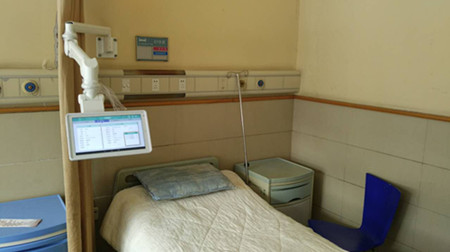
Ai Yisheng Smart Hospital Bed Terminal
In March 2015, Yu Ling was hospitalized due to illness. He summarized his greatest suffering with a single word: “endurance.” He once stared at the IV bottle, calculating how long it would take for the infusion to complete. “A standard 250ml fluid bag contains roughly over 5,000 drops.”
Each day, apart from the nurses changing his IV bottles and a few brief words during the attending physician’s rounds, Yu Ling was left entirely alone. He would either stare at the IV bottle or gaze up at the ceiling, finding it utterly tedious. He longed to watch entertainment programs and news, so he asked his family to bring him an iPad, but on several occasions, he fell asleep and dropped it on his face.
In fact, for hospitalized patients in greater need of assistance, beyond enduring suffering, they must also cope with the fear stemming from their illness and the unfamiliar hospital environment.
Upon discharge and transition to home-based rehabilitation, patients encounter even more challenges. According to statistics from health authorities, approximately 50.8% of patients experience at least one medication error after discharge; furthermore, many patients miss the optimal window for recovery due to a lack of knowledge regarding post-discharge care and related practices.
For hospitals, the high patient-to-staff ratio leaves little capacity for doctor-patient communication. This is one of the reasons why medical treatment is relatively accessible while service quality remains challenging. In Yu Ling’s view, the lack of direct and effective communication channels between doctors and patients also prevents hospitals from promptly identifying patient dissatisfaction, thereby hindering timely resolution, reporting, and emergency response.
To this end, Yu Ling, a seasoned entrepreneur, aims to alleviate the “boredom” experienced by hospitalized patients while improving current doctor-patient communication. He conceived a smart terminal mounted on an arm-style bracket at the patient’s bedside. This mobile screen also meets various inpatient needs, such as checking hospitalization costs, ordering meals, entertainment, and shopping.
To ensure the swift implementation of a startup project, the key lies in the team. As an expert in e-government and the Internet of Things (IoT), Yu Ling has successfully acquired central state-owned enterprises (SOEs) with “Zhong”-prefixed names, boasts over a decade of entrepreneurial experience, and has attracted a large pool of talent around him.
Yu Ling shared his entrepreneurial vision with friends, and a founding team quickly took shape. The brand was named “Ai Yi Sheng.” “Ai” signifies benevolence; it is love that gives rise to healthcare and hospitals. “Ai Yi Sheng” is also a homophone for “Ai Yi Sheng” (Love for a Lifetime), reflecting his commitment to providing patients with long-term care and services. As the company’s CEO, he is primarily responsible for strategy, resource integration, and fundraising.
As CTO and a co-founder of the company, Guo Liang oversees product technology. He previously served as an architect for multiple national-level IoT technology platforms, bringing extensive technical expertise and management experience.
Another co-founder of the company is Wang Yong, who serves as President and is responsible for executing strategic initiatives, including business development, market expansion, and product iteration. He holds three invention patents, has contributed to the publication of one industry standard, and possesses a senior-level certification in the China Computer Technology and Software Professional Technical Qualification (Soft Exam). He demonstrates exceptional cross-disciplinary innovation and learning capabilities.
As the company’s core founders, they are all members of the post-1970s generation and old friends who have known each other for a decade. Beyond their individual track records of success, they excel at solving complex problems and possess unwavering resilience. In addition, the team is supported by a medical advisory board comprising an academician of the Chinese Academy of Engineering, senior healthcare experts, and elites from the pharmaceutical supply chain, as well as a cohort of post-1980s and post-1990s young professionals skilled in internet marketing.
To date, the Aiyisheng team comprises a total of 14 members, including five responsible for technical products and six for operations.
According to Wang Yong, Ai Yisheng’s products come in two forms—hardware and software—namely, the Smart Bed Terminal and the Rehabilitation Cloud App. Ai Yisheng aims to evolve from a product-centric model to a platform-based one, and ultimately establish a vertical micro-ecosystem.
Step 1: Partner with hospitals to acquire seed users at low cost, deeply understand their needs, and leverage resources. Aiyisheng’s smart bedside terminal services are directly integrated into the hospital’s HIS/LIS systems, providing inpatients with comprehensive medical and lifestyle services. Based on patients’ conditions, Aiyisheng offers intelligent triage guidance, treatment order tracking, precautionary reminders, and specialized disease education. Patients can check medical expenses and laboratory reports at their bedside, search for reimbursement procedures, locations for handling formalities, and required document lists. Additionally, patients can learn about the hospital’s specialties, view profiles of medical staff, provide satisfaction evaluations for medical and nursing teams, and submit feedback and suggestions.
Step 2: Maintain continuity of care by providing extended medical orders and guidance on post-discharge nursing knowledge, thereby reducing patient churn and enhancing engagement. This primarily involves offering patients personalized post-hospital rehabilitation methods tailored to home settings, connecting them with high-quality and cost-effective service resources, and providing consultation services to address their queries. Additionally, it includes conducting disease follow-ups and satisfaction surveys, with feedback provided to hospitals to track both patient recovery outcomes and hospital treatment efficacy, thus establishing a virtuous cycle.
Step 3: Focus on building an entry-point platform. Establish a third-party platform that effectively connects the patient pool with service resource pools, fostering bidirectional synergy to drive ecosystem development. The platform’s services are categorized into five major sectors: rehabilitation, entertainment, communication, O2O (Online-to-Offline), and shopping. Qualified partner companies have been carefully selected to join the platform, collaborating with hospitals to build “Caring Wards,” thereby enabling patients to feel genuine care from the hospital.
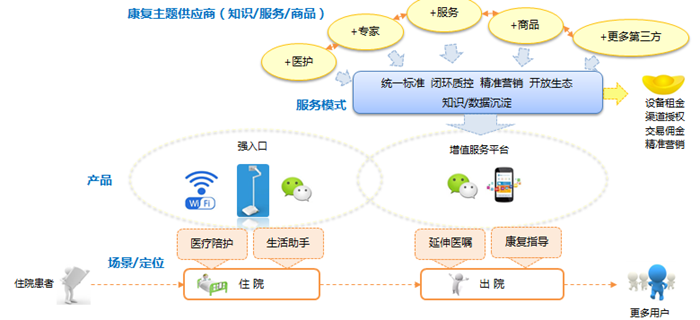
So, how does this project generate profit? Wang Yong told reporters that the project can achieve cash flow as soon as it is launched, and there are multiple revenue streams. The most direct source is the rental fee for patients using the equipment, which is generally 10 yuan per day.
Jiangsu Province, the wealthiest among the four national-level pilot provinces for comprehensive healthcare reform, boasts concentrated medical resources in Xuzhou. Serving a surrounding population of 143 million, Xuzhou has long been a strategic stronghold, as encapsulated by the adage, “If Xuzhou is connected, the whole country is connected.” Therefore, AiYisheng’s decision to launch in Xuzhou carries significant strategic importance. Currently operating under an MVP (Minimum Viable Product) model, AiYisheng has initially deployed its equipment in orthopedics and obstetrics. Within a short period, the company has achieved rapid growth, with rental income, advertising and transaction commission revenues, and WeChat Official Account followers all surpassing 10,000, indicating an increasingly mature and stable operational model.
By independently developing smart hospital bed terminals, Ai Yisheng has significantly reduced the cost of bedside care equipment. The company deploys these devices in hospitals free of charge to co-create "compassionate wards," establishing a powerful entry point to acquire high-value, precise seed users—such as postpartum women, chronic disease patients, and postoperative patients—at a lower cost.To address patients' needs for in-hospital medical care and out-of-hospital rehabilitation, we create a synergistic force that connects offline with online services and in-hospital with out-of-hospital care. By building a third-party value-added service platform, we attract both medical and lifestyle resources to provide precise, high-quality services and cultivate a healthy micro-ecosystem.
Next, Ai Yisheng is set to sign agreements with more hospitals and replicate its products and business model across other provinces and municipalities. According to data from the National Health and Family Planning Commission, there are 6 million hospital beds nationwide. At a daily rental rate of RMB 10, this translates to an annual revenue potential of RMB 20 billion. With over 200 million patients discharged from hospitals each year, most of whom transition into long-term home-based rehabilitation settings, there exists a large population with essential healthcare needs, driving robust demand in the rehabilitation services market.
Despite strong market demand, the costs associated with independently developing smart hospital bed terminals and operational expenses remain high. Ai Yisheng has not yet secured external financing, having invested approximately RMB 3 million to date in areas such as industrial design, mold manufacturing, product research and development, and business promotion. In this pre-A funding round, the company plans to raise RMB 5 million by offering a 10% equity stake. The proceeds will be allocated to the production of smart hospital bed terminal devices, market expansion, product iteration, and marketing initiatives via its WeChat official account and mobile app.