China Oncology Medical Services Market: Current Status and Outlook (2016)
This article reviews and analyzes the current market status and future prospects of China’s oncology healthcare services industry, providing investors with data-driven insights and perspectives to support their decision-making. The following content is republished by VCBeat (WeChat ID: vcbeat).
By Jiuqian Consulting (Zhang Sisi, Cui Jinglei, Cheng Shibin, Fu Qiqi, Lequn Li) and Sean
The oncology healthcare services market in China has experienced rapid growth in recent years, with the overall market size exceeding RMB 300 billion. This article examines the current status and primary components of the domestic oncology healthcare services market from both the demand and supply sides, and analyzes the opportunities and challenges facing private oncology hospitals, aiming to provide insights for private capital investment in the oncology healthcare services sector.
I. Current Status of the Demand-Side Market
1. At present, public awareness of cancer prevention and tumor prevention and control efforts remain relatively weak, with low coverage of early screening and diagnosis; approximately half of patients are diagnosed at advanced stages, resulting in a 5-year survival rate for Chinese cancer patients that is significantly lower than that in developed countries.
According to projections by the National Cancer Center, the cancer incidence rate in China in 2015 was approximately 312 per 100,000 population. The five most common cancers were lung cancer, gastric cancer, esophageal cancer, liver cancer, and colorectal cancer. Meanwhile, liver cancer, pancreatic cancer, lung cancer, esophageal cancer, and gastric cancer had the highest case fatality rates (case fatality rate = annual mortality rate / annual incidence rate).
With societal development, the ranking of incidence rates for various types of tumors has also changed. For instance, in recent years, improved economic standards have led to increased consumption of high-fat and high-protein foods, resulting in a continuous rise in the incidence of colorectal cancer. Conversely, reduced intake of pickled foods and increased consumption of fruits and white vegetables can lower the risk of gastric cancer.
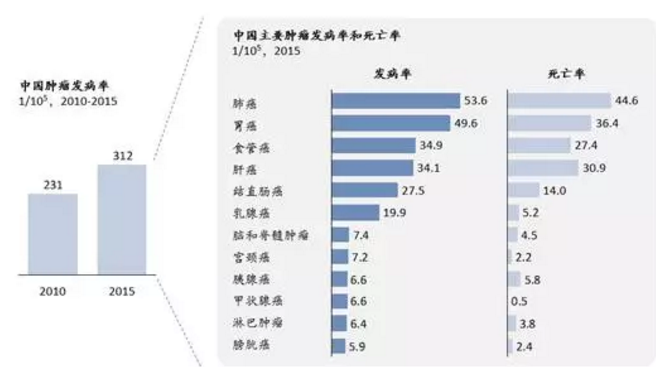
Source: National Cancer Center of China
A comparison with the United States reveals that although its cancer incidence rate is 1.6 times that of China (65% higher), its five-year survival rate is 1.8 times that of China (81% higher). One of the primary reasons for this disparity is the higher prevalence of early cancer screening and diagnosis in the United States, where only 24% of newly diagnosed cases are advanced-stage cancers, compared to approximately 50% in China.
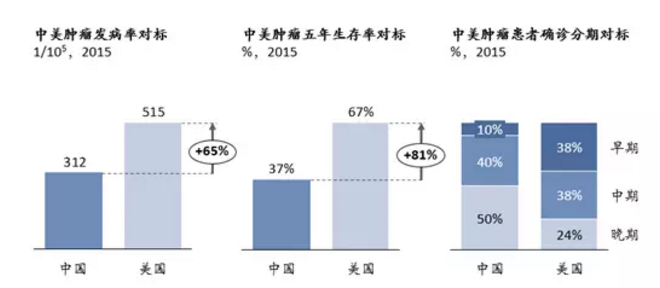
Sources: National Cancer Center of China, U.S. National Cancer Institute
To address this issue, the National Health and Family Planning Commission launched a major national public health initiative in 2012 called the “Urban Cancer Early Diagnosis and Treatment Project.” Nine provinces, including Beijing, Guangdong, and Shandong, were among the first to implement the program. The project primarily focuses on the risk assessment, screening, early diagnosis, and early treatment of high-risk populations for lung cancer, breast cancer, colorectal cancer, gastric cancer, esophageal cancer, and liver cancer.Furthermore, the rural cancer early diagnosis and treatment program has been implemented for 10 years, establishing 218 project sites to date and screening a total of 1.57 million high-risk individuals over the past decade.
2. In 2015, the market size of oncology medical services in China was approximately RMB 320 billion, with pharmaceutical therapy accounting for about 50% of the market share; driven by early diagnosis and treatment of cancer, the market shares of surgical oncology and radiotherapy are expected to gradually increase in the future.
According to statistics from the National Cancer Center, there are approximately 7.5 million prevalent cancer patients in China. Based on an annual per capita expenditure of RMB 70,000 and a tumor treatment penetration rate of 60%, the market size of China’s oncology medical services is estimated at around RMB 320 billion. Generally, cancer patients undergo three stages: initial screening and diagnosis, mid-stage treatment, and late-stage palliative care.
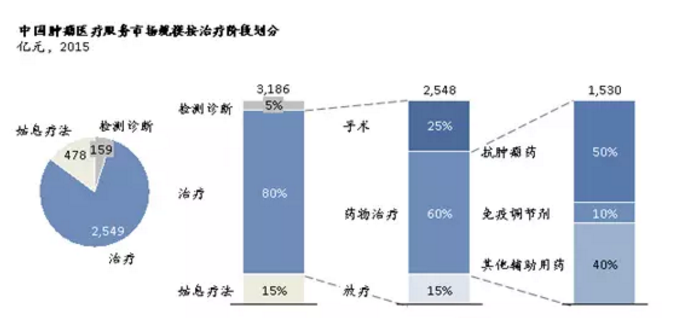
Source: National Cancer Center of China, IMS Database (2015)
Currently, China’s cancer screening and diagnostics industry is still in its early stages of development, accounting for only about 5% of the oncology healthcare services market, valued at approximately RMB 16 billion. In terms of primary screening and diagnostic methods, there are no significant differences between China and the United States; both predominantly rely on endoscopy, blood tests, and imaging examinations. However, the screening penetration rate in China remains substantially lower than that in the U.S. It is expected that the market share of screening and diagnostics will increase in the future, driven by heightened public awareness of cancer prevention, strengthened cancer control and prevention efforts, and supportive national policies.
Furthermore, with the advancement of genetic technologies, bioinformatics, and big data, new platforms for early cancer prediction have emerged. Corresponding tumor databases have been established, enabling risk prediction for early cancer screening in populations by integrating data ranging from lifestyle habits and clinical signs to blood biochemical indicators, micro-level changes in tumor markers, and genetic and molecular alterations.
The mid-stage cancer treatment market constitutes the main body of the oncology medical services market, accounting for 80% of the market share. Based on the three major cancer treatment modalities, the treatment market can be preliminarily segmented into surgery, radiotherapy, and chemotherapy (i.e., pharmacological therapy). Among these, the pharmacological therapy market is the largest, with a scale reaching RMB 150 billion. In addition to anti-cancer drugs, immunomodulators and other adjunctive medications (such as antibiotics, antiemetics, and nutritional support agents) also account for 50% of the pharmaceutical market share. In the radiotherapy market, linear accelerators are the predominant equipment currently used in China, holding approximately 90% of the market share.
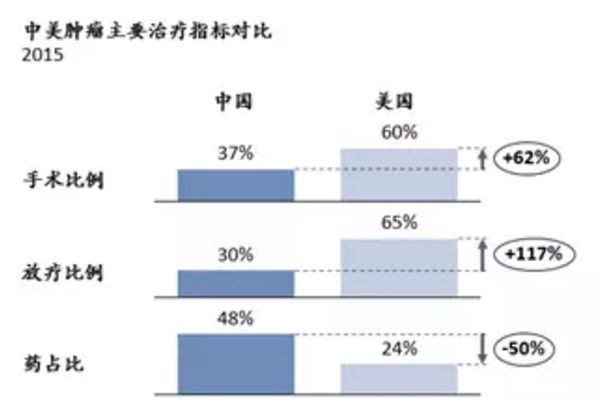
Compared with developed countries such as the United States, China’s cancer treatment landscape is characterized by a high proportion of pharmaceutical expenditures, low surgical rates, and low radiotherapy utilization. It is projected that as early screening becomes more widespread, leading to earlier-stage diagnoses, the proportion of surgical interventions—particularly minimally invasive surgeries—will increase significantly. Furthermore, enhanced awareness of radiotherapy among both physicians and patients, coupled with greater availability of radiotherapy equipment, will drive higher penetration rates for radiotherapy. In terms of chemotherapy, stricter requirements from the National Health and Family Planning Commission to reduce the drug expenditure ratio in public hospitals, along with clearly defined principles and quotas for the use of antineoplastic versus adjuvant drugs, are expected to substantially decrease the market share of certain pharmaceutical treatments and the proportion of adjuvant drug usage.
Sources: National Cancer Institute, California Cancer Registry, literature search
Palliative care is generally administered to cancer patients with an expected survival of less than one year. The World Health Organization defines it as follows: “Palliative medicine is the active, holistic care of patients who do not respond to curative treatment. It focuses on controlling pain and other symptoms, while addressing psychological, social, and spiritual issues, with the aim of achieving the best possible quality of life for patients and their families.”
The current market size for palliative care is approximately RMB 43 billion, accounting for about 15% of the oncology market share. The average monthly expenditure per patient ranges from RMB 10,000 to 20,000, primarily covering low-dose radiotherapy, chemotherapy, other adjunctive medications, and psychotherapy. The penetration rate of palliative care in China is only 20–30%, indicating significant growth potential as patients increasingly demand better pain relief, improved quality of life, and enhanced hospice care services.
II. Current Status of the Supply-Side Market
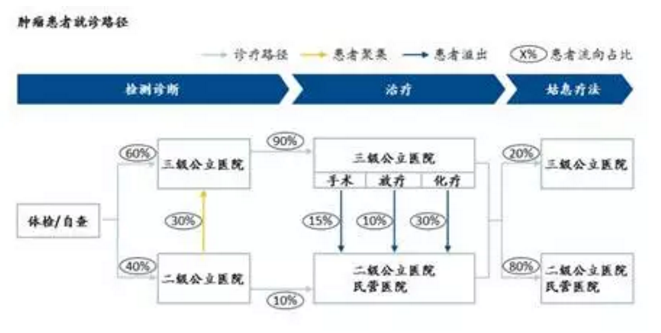
Public tertiary hospitals, which bear over 80% of the oncology treatment burden, are operating beyond capacity while simultaneously delegating certain diagnostic and therapeutic tasks. With future expansion of public hospitals constrained by policy, a significant supply-demand gap in oncology care is anticipated.
In the oncology care pathway, initial diagnosis and treatment planning are the aspects most valued by cancer patients; therefore, public tertiary hospitals with high-quality physician resources and a long-standing positive reputation are the preferred choice for patients.(Some patients opt for overseas medical treatment, which falls outside the scope of China’s oncology healthcare service market discussed in this article.)
Source: Expert Interviews
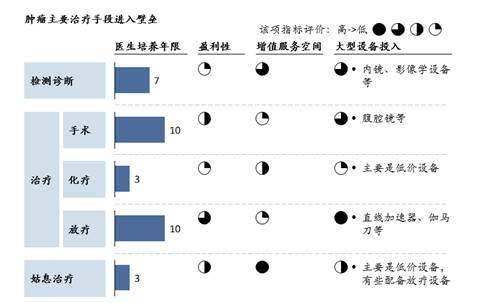
However, due to limited capacity, tertiary hospitals need to offload a portion of their oncology treatment responsibilities. Among these, chemotherapy is a service that public hospitals are willing to decentralize, as it is constrained by regulations on the drug-to-revenue ratio and markups on pharmaceuticals. Typically, high-quality physicians at tertiary hospitals formulate the chemotherapy regimen for patients and monitor them for a period to confirm therapeutic efficacy before transferring them to other facilities for ongoing treatment. Future national policies on tiered diagnosis and treatment will further support the shift of chemotherapy services to secondary hospitals and private healthcare institutions.
Radiotherapy exhibits an extremely high dependency on physicians and equipment, and as one of the most profitable diagnostic and therapeutic services, it has the lowest rate of decentralization to lower-tier institutions. Surgical treatment for tumors primarily relies on the expertise of surgeons; secondary hospitals and private hospitals can capture a portion of tumor patients by recruiting surgeons with extensive operative experience.
Palliative care primarily aims to regulate patients’ physiological and psychological states through low-dose radiotherapy and chemotherapy, combined with pain management and psychological counseling. The profit margin of palliative care stems from the high-quality services and comfortable living environments it provides. As these are not the core values of tertiary hospitals, palliative care is among the clinical services that tertiary hospitals are most willing to divest, which also aligns with the requirements of the tiered diagnosis and treatment policy.
Currently, palliative care is primarily provided by secondary hospitals. Private hospitals can attract patients with high service expectations and generate profits by offering premium services and a comfortable living environment.
Source: Expert Interviews
The proportion of tumor patients undergoing surgery reflects the market demand for tumor treatment. Assuming that China’s surgical rate among tumor patients in 2020 reached the current level in the United States, and excluding factors such as rising incidence rates, the introduction of new radiotherapy technologies, and targeted therapies, the demand-side market for tumor treatment would have approximately 60% room for growth.
According to the 13th Five-Year Plan for Healthcare, the number of hospital beds per 1,000 people in public hospitals will increase from 3.02 in 2014 to 3.3 in 2020, indicating an approximately 10% growth potential in the supply-side market for public hospitals. Based on this estimate, a significant supply-demand gap is expected in oncology treatment in the future, leaving ample room for private capital to enter the oncology treatment market.
III. Opportunities and Challenges for Private Oncology Hospitals
1、The expansion rate of public hospitals is unlikely to meet the growing demand for oncology care in the future. Private capital is poised to enter the oncology healthcare market by leveraging its financial strength to secure high-quality physician resources and advanced equipment, while enhancing the patient experience.
There is a significant supply-demand gap in the oncology healthcare services market. Currently, oncology departments in tertiary general hospitals and specialized oncology hospitals are largely operating at full capacity. Furthermore, future expansion of public tertiary hospitals is constrained by national policies. As penetration rates for cancer screening and diagnosis rise and patient awareness improves, public hospitals will struggle to meet the growing demand for cancer treatment. Consequently, a portion of patient volume will inevitably be diverted to lower-tier public hospitals and private medical institutions.
There is room for value-added services in oncology treatment. Within the conventional oncology care pathway, early screening and palliative care offer significant opportunities for value-added services and are well-suited for private capital investment. Meanwhile, public hospitals, constrained by scale and mandated to uphold their non-profit, public-welfare nature, often struggle to meet patients’ expectations for service quality.
In the field of cancer screening, private capital has captured approximately 30% of the health checkup market, contributing to improved early detection rates for tumors. In contrast, there are no significant signs of large-scale entry by private capital into the palliative care sector, which is characterized by relatively lower technical barriers but higher service demands.
Policy support enables private hospitals to reasonably equip themselves with large-scale medical devices. On the other hand, their strong financial strength and diversified financing channels make it easier for private hospitals to enter treatment fields with high capital barriers, such as tumor radiotherapy. Furthermore, the State Council explicitly stated in the "Opinions on Further Encouraging and Guiding Social Capital to Establish Medical Institutions" that it supports the reasonable allocation of large-scale medical equipment in private hospitals, thereby removing policy obstacles for private capital to enter treatment areas with high requirements for funding and equipment, such as radiotherapy.
2. Private specialized oncology hospitals will face significant challenges, including a limited pool of high-quality physician resources, high customer acquisition costs, and intensifying market competition.
Private hospitals lack access to high-quality physician resources. Oncology is a multidisciplinary field encompassing pathology, surgery, internal medicine, radiation oncology, and other specialties. Treatment teams are typically composed of the top specialists from each of these disciplines. Currently, however, such leading physicians are almost exclusively concentrated in tertiary hospitals, making it difficult for independent private specialized hospitals to establish comprehensive treatment teams in the short term. As the training of oncologists generally requires 8–10 years, the scarcity of physician resources cannot be resolved in the near future. Even with a supply-demand gap in the market, this shortage cannot be adequately addressed simply by building new hospitals or expanding existing ones.
The cost of patient acquisition for private hospitals is extremely high. As cancer is a life-threatening critical illness, patients place greater trust in tertiary public hospitals with long-standing positive reputations and tend to seek diagnosis and treatment at these institutions during key stages of care, a pattern that is difficult to change in the short term. Currently, private oncology hospitals are in their early development phase and largely rely on patient spillover and referrals from public hospitals.
However, the stability of collaborations between private hospitals and public hospitals is difficult to guarantee, and in practice, private hospitals are required to cede a portion of their profits to their public hospital partners. Additionally, while some private hospitals acquire patients through marketing and promotion, the incidence rate of tumors is significantly lower than that of diseases treated in departments such as stomatology, ophthalmology, and gynecology; consequently, the customer acquisition cost per patient tends to be relatively high.
Tertiary public hospitals designate oncology as a key specialty and are reluctant to refer patients to lower-tier facilities. Oncology represents the pinnacle of a hospital’s medical expertise, helping institutions and top-tier physicians enhance their academic standing and build reputation. Furthermore, due to prolonged care pathways and the high concentration of advanced technologies, per-patient expenditures for oncology are significantly higher than for other diseases. Consequently, tertiary public hospitals with the requisite resources prioritize the development of oncology-related departments, ensuring adequate equipment, staffing, and bed capacity.
The emergence of prefecture-level public cancer hospitals will also intensify competition in the oncology treatment services market. The State Council, in its "Outline of the National Healthcare Service System Plan (2015–2020)," stated that municipal specialty hospitals for pediatrics, psychiatry, obstetrics and gynecology, oncology, infectious diseases, and rehabilitation should be planned and established at the prefecture level according to local needs. According to incomplete statistics, there are now more than 60 newly built or renamed prefecture-level public cancer specialty hospitals and cancer prevention and treatment centers.
It is foreseeable that, under the policy trends of national tiered diagnosis and treatment and strengthening primary healthcare services, the government will use administrative measures to facilitate the formation of medical consortia between prefecture-level cancer hospitals and tertiary hospitals. This aims to promote consultation and referral cooperation among hospitals, thereby achieving a gradual decentralization of medical resources. Consequently, it can be argued that private cancer hospitals will face increasing competitive pressure in this process.
IV. Case Study of a Private Oncology Hospital
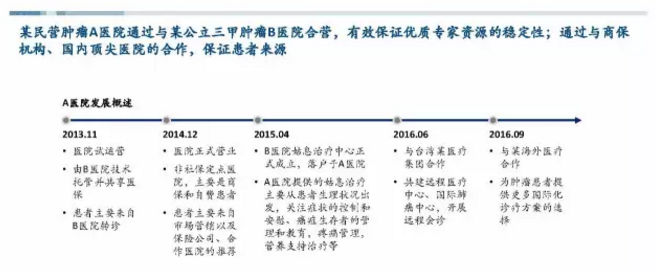
Private Oncology Hospital A, through a joint venture with Public Grade-A Tertiary Oncology Hospital B, effectively ensures the stability of high-quality expert resources; and secures patient referrals through collaborations with commercial insurance providers and leading domestic hospitals.
Oncology Hospital A, a joint venture established by a private hospital group and Public Grade-A Tertiary Oncology Hospital B, commenced trial operations in 2013 and officially opened at the end of 2014. The hospital’s core services include surgical oncology, radiotherapy, and chemotherapy, complemented by a specialized palliative care center.
Hospital A collaborates with Hospital B through an equity partnership model, wherein the latter provides medical technology and high-quality expert resources. Targeting mid-to-high-end patients, the facility adopts a payment model combining out-of-pocket payments and direct billing with premium commercial insurance.
As Hospital A has developed, its patient acquisition channels have diversified from sole reliance on referrals from Hospital B to include marketing initiatives, recommendations by commercial insurance providers, and referrals from partner hospitals. Hospital A has currently established collaborations with numerous insurance companies, which refer their mid-to-high-end clients for medical care. In return, Hospital A provides these insured clients with expedited access to medical services (green channels) and offers discounted treatment fees, thereby achieving a win-win outcome for both the hospital and the insurers. Meanwhile, Hospital A maintains its long-term partnership with Hospital B by engaging experts from Hospital B to conduct outpatient consultations and perform surgeries.
Source: Expert interviews, Hospital A’s official website
In April 2015, the Palliative Care Center of Hospital B was officially established, becoming the first specialized palliative care center set up by a tertiary A-grade oncology hospital in China. The center’s inpatient ward is located at Hospital A. Leveraging Hospital B’s advanced technical capabilities and high-caliber medical team, and seizing the historical opportunity presented by the rapid development of palliative care, Hospital A is poised to differentiate itself from other public oncology hospitals and establish a distinguished service brand.
In 2016, the controlling shareholder of Hospital A established partnerships with overseas medical institutions to jointly build a telemedicine center and an International Lung Cancer Center, launching services such as remote consultations and overseas patient referrals. Top-tier physicians from abroad can develop personalized treatment plans for patients through remote consultations, enabling them to receive care at Hospital A. Meanwhile, patients can also seek medical treatment overseas via relevant platforms. The hospital’s extensive collaborations have provided patients with more options for accessing healthcare.
Conclusion:
There is still significant room for improvement in cancer prevention and control in China. The prevalence of early screening and diagnosis, as well as the rate of surgical intervention for tumors, are both lower than those in developed countries in Europe and the United States, resulting in a relatively low five-year survival rate for cancer patients.
Driven by growing awareness and supportive policies for early diagnosis and treatment of cancer, the proportion of surgical and radiotherapeutic interventions in oncology care is expected to increase. Meanwhile, as patients place greater emphasis on quality of life, the palliative care market, with its focus on service-oriented support, also holds promising development prospects.
Benchmarking against the United States, China’s oncology healthcare service market has at least 60% room for growth. As public tertiary specialized oncology hospitals and oncology departments in general hospitals are operating beyond capacity with limited bed expansion, some diagnostic and treatment tasks will be delegated to secondary hospitals and private hospitals.
Leveraging their advantages in services and funding, private oncology hospitals are poised to capture a share of the rapidly expanding market for cancer medical services.
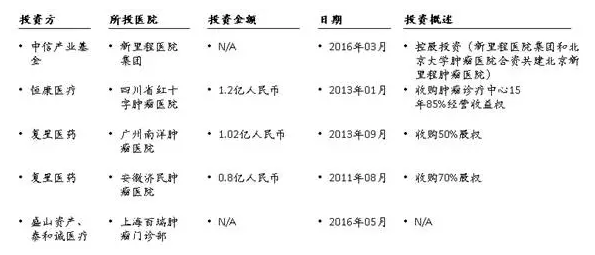
Appendix: Examples of M&A and Investment & Financing Cases in Oncology Hospitals