

Cardiogram Secures $2M Seed Funding to Advance Clinical Disease Prediction Using Apple Watch Sensor Data
"Personal Application
On October 20, Cardiogram, a newly established health tech company this year, secured $2 million in seed funding. Cardiogram is dedicated to meticulously refiningApple Watchsensor data, enhancing the experience for general users and ultimately achieving more effective clinical outcomes.
The list of angel investors is quite impressive.Led by Vijay Pande, an investor in a16z’s new bio fund that specializes in medtech companies, with co-investors includingSatya Patel (former Vice President of Product at Twitter) and Hunter Walk (former Director of Product at YouTube) from Homebrew Seed Capital, and Elad Gil, co-founder of the genetic testing company Color GenomicsandOthman Laraki, Assistant Professor at the Icahn School of Medicine at Mount Sinai; Jeff Hammerbacher; Justin Palmer, former Deputy Director of Data at the P2P lending platform LendingHome; Joshua Reeves, CEO of the payroll and HR services company Gusto; Kevin Scott, Senior Vice President of Engineering at LinkedIn; and Halle Tecco, founder of the healthcare startup incubator Rock Health。
Lead investor Vijay Pande stated that he is fundamentally bullish on every capability Cardiogram is delivering. The company’s core premise is to aggregate vast amounts of first-hand personal data from wearable devices and leverage cutting-edge machine learning technologies to empower individuals to derive greater insights from their own data.
"Personal Use"
Transition to “Professional Diagnosis”
This company is engaged inThe Apple Watch started with integrated apps, but its ultimate goal is to build a “device diagnostics” business and make its app compatible with all wearable devices, such asGoogleSmartwatches on the Android Wear platform, and FitbitorGarminSimilar types of smart wristbands and activity trackers, etc. CurrentlyCardiogram APP is now compatible with Apple Watch and Android Wear.
“If you have an Apple Watch, its built-in software measures your heart rate every five minutes, and continuously monitors it during workouts,” said Brandon Ballinger, CEO of Cardiogram, in a statement. “While this data is indeed stored in your Health app, it consists primarily of raw data that is not easily interpretable at a glance. Our app performs the subsequent processing—organizing the collected data into intuitive charts. These charts come in two forms: one displays short-term data, such as heart rate fluctuations during a stressful meeting; the other illustrates long-term trends in heart rate changes, such as resting heart rate over an extended period. Additionally, we alert you to any potential indicator changes within the data.”
![~}}%GL21FXJ@W0]FDX4$PF7.png](https://cdn.vcbeat.top/upload/image/1e/52/b1/31/b040ff0ccb6ce16256682f1dee7a2a9f.png "1477018194422141.png")
Display Short-Term and Long-Term Heart Rate Trends in Charts
While developing a user-friendly heart rate health profiling app, Cardiogram has collaborated with the University of California, San Francisco (UCSF) since March on a study called mRhythm, leveraging collected Apple Watch user data to create an app capable of diagnosing atrial fibrillation. Currently, the app is limited to predicting atrial fibrillation; however, Cardiogram holds the potential to predict other cardiac conditions in the future, and may even extend to diseases highly correlated with heart rate variability, such as diabetes.
“Over the past six months, we have collected more than ten billion sensor measurements from over 100,000 individuals,” Ballinger stated in a blog post. “Of course, raw sensor data does not equate to biomarkers, biomarkers do not equate to diagnoses, and diagnoses do not equate to treatments. Our first step is to develop an app capable of diagnosing atrial fibrillation, the most common type of cardiac arrhythmia. In our early research conducted in collaboration with the UCSF Cardiology Health eHeart Study, the diagnostic accuracy for atrial fibrillation has already reached 90%, even using sensors at the consumer-grade level found in Apple Watches.”
Cardiogram announced that it would invest the financing proceeds into a new feature for its product called Habits. Similar to an app store, Habits offers Cardiogram app users a variety of health behavior options to choose from. The app comes with several objectively measurable biomarkers preconfigured, and each health behavior can be quantitatively matched with these biomarkers. As users engage with the program, the app tracks their biomarkers, thereby documenting improvements in their health status.
“The Habits feature is divided into three major categories: fitness, sleep, and stress,” Ballinger wrote. “Under each category, there are several healthy Habits to choose from, with a duration of 14 days for each selection. Every day, you can check your progress for the day and monitor whether your health efforts have improved some key metrics. More interestingly, the Cardiogram app includes social features, allowing users to invite their friends to participate as well.”

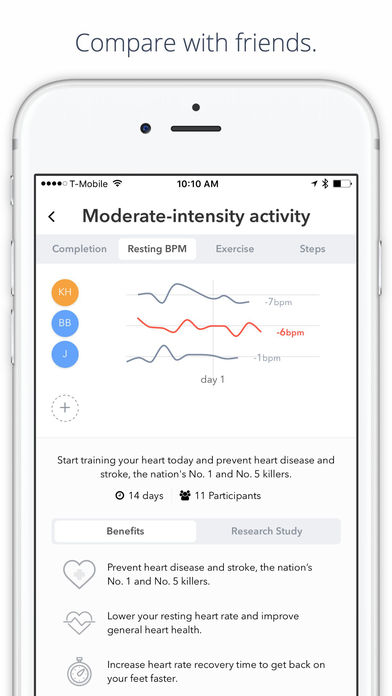
Cardiogram’s New Feature “Habits,” with Social Capabilities
Cardiogram has two co-founders, Brandon BallingerandJohnson Hsieh。
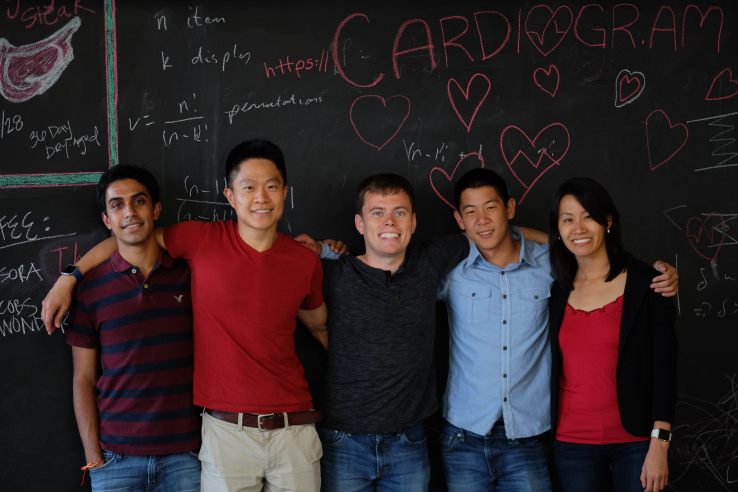
Founder Brandon Ballinger (center),Johnson Hsieh (second from left) andCardiogram Team
Brandon BallingerGraduated with a degree in Computer Science from the University of Washington, and was previously invited to the White House to maintain the U.S. healthcare website.healthcare.gov, and previously Sift Science before founding Cardiograma co-founder, and was formerly an engineer in Google’s speech recognition and ad quality divisions.Johnson HsiehHe was also a Senior Engineer at Google and previously worked in software development at Microsoft, Morgan Stanley, and Sybase.