

Remebot CEO Liu Da Shares 18 Years of R&D Breakthroughs, Aims for Broader Hospital Adoption

Remebot
Developer and Manufacturer of Telesurgical Robots
On October 20, 2016, the “Puhua Medical Hi Conference,” organized by Puhua Capital and Puhua Medical Investment, and co-organized by Zhejiang University Zijing Makers Town, Jingxin Pharmaceutical, and CTIC Capital, was held in Hangzhou. At the conference, ten cutting-edge medical innovation project teams from China and abroad participated in roadshows, including Remebot, a domestic surgical robot; Hangzhou Cognitive, the Watson oncology physician platform; DNAnexus, a DNA data cloud storage platform; and Numedii, which applies artificial intelligence to new drug development. The event brought together emerging technological fields such as artificial intelligence, medical big data, advanced medical devices, and precision medicine.
Remebot, a developer of surgical robots with considerable renown in China’s domestic market, also made an appearance at the roadshow. Liu Da, Founder and CEO of Beijing Bai Hui Wellcome Technology Co., Ltd., the company behind the robot, delivered a speech at the conference. Below are the highlights curated by VCBeat (WeChat ID: vcbeat).
Bai Hui Wellcome was established in 2010, but its Remebot surgical robot actually has a history of nearly 20 years. On May 5, 1997, the Department of Neurosurgery at the Navy General Hospital performed China’s first robotic surgery. The first medical robot, jointly developed by the Navy General Hospital and the Robotics Institute of Beihang University, successfully completed stereotactic radiotherapy for craniopharyngioma under the joint guidance of two surgeons and one computer expert. In 2003, China’s first remote robotic surgery was also conducted by the Navy General Hospital and Beihang University, enabling a neurosurgical procedure to be performed remotely between Beijing and Yan’an. The surgical robots used in these two landmark procedures were developed by Liu Da, who was then a doctoral candidate, and his supervisor, Professor Wang Tianmiao.
In 1998, Liu Da, who had already completed his Ph.D. at Beihang University, continued to follow up on this project. Starting in 2000, with the support of national scientific research projects, it entered clinical trials, and over 15 years, nearly 20,000 free clinical surgeries were performed. After the development of the surgical robot was completed, Liu Da wanted this technology not only to remain at the scientific research level but also to serve more people. Therefore, he resigned from his teaching position and founded Bai Hui Wellcome Company to begin industrializing the surgical robot technology. Over these years, Remebot has undergone six iterations of its technological products.
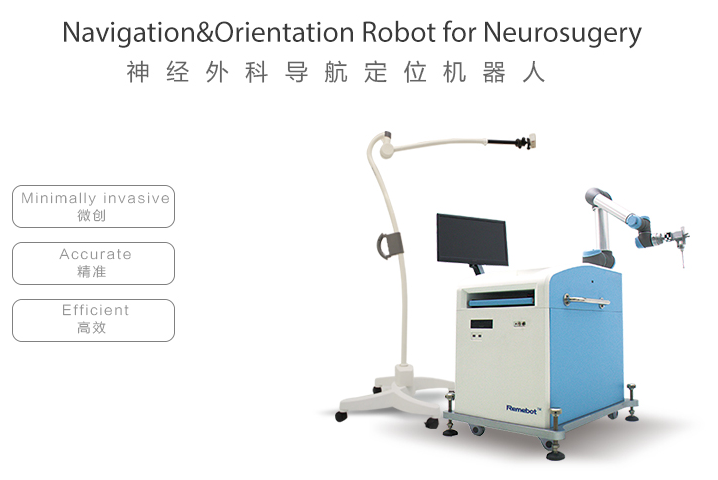
Although Remebot is currently registered with the regulatory authorities as a neurosurgical surgical robot, it is actually capable of performing a wide variety of surgical procedures. In the field of neurosurgery, it can execute various operational tasks, including biopsy, aspiration, drug delivery, and injection, addressing conditions such as cerebral hemorrhage and brain cysts. While these are relatively straightforward procedures within neurosurgery, their annual volume is substantial, reaching millions of cases, which underscores the broad application prospects for robotic assistance. Furthermore, Remebot is capable of performing more precise functional surgeries, such as those commonly required for Parkinson’s disease in the elderly and epilepsy. Currently, there are 12 categories of surgical procedures included in Remebot’s product registration with the National Medical Products Administration (NMPA), and Beijing Bai Hui Wellcome Technology Co., Ltd. continues to expand its range of applicable surgical indications.
The new generation of Remebot neurosurgical robot consists of three parts: a computer software system, a real-time camera, and an automatic robotic arm, which can be likened to the brain, eyes, and hands, respectively. Before surgery, patients are fitted with specialized markers for medical imaging scans. Leveraging 3D visualization and multimodal image fusion technologies, physicians can clearly and intuitively observe the lesion, as well as the surrounding tissues and vascular distribution, to plan the optimal puncture path. During the procedure, patient-to-robot registration is first performed to establish a one-to-one mapping between the virtual 3D model and the physical environment. Upon completion of registration, the robotic arm accurately moves to the preoperatively planned position under camera monitoring. Finally, the physician performs the puncture and carries out procedures such as biopsy, aspiration, ablation, or implantation. With Remebot, surgeons can complete the operation within 30 minutes, achieving a localization error of less than 1 mm. Patients incur only a 2-mm minimally invasive incision and can be discharged after 2–3 days of postoperative observation.
Remebot essentially standardizes the complex process of neurosurgery by dividing it into three standardized steps using robotic assistance. The first step involves medical experts utilizing a surgical computer system for preoperative planning and scheme formulation. Remebot provides 3D software capable of rendering three-dimensional visualizations of medical imaging data, such as CT and MRI scans, which physicians use to develop surgical plans. Without the need for craniotomy, these images guide surgeons in determining the surgical approach, designing the operative trajectory, and avoiding critical structures, including blood vessels and nerves. This surgical planning process is completed by specialist physicians on a computer.
After the surgeon completes the surgical planning, the surgical plan is uploaded to the robotic system, which can execute the predefined plan with 100% fidelity. The surgical precision can reach 0.5 mm, whereas the resolution of the human hand is only 3 mm. Furthermore, the robotic system does not suffer from fatigue, tremors, or lapses in concentration. Once the robot achieves precise positioning, subsequent procedures such as drug administration and puncture are performed by general physicians.
These are the three steps of Remebot surgery: first, complete surgical planning on a computer; then, the robot performs precise surgical positioning; and finally, the surgeon carries out the surgical procedure.
What are the advantages of robotic assistance compared to traditional surgery? The primary benefit is the reduction of patient pain. In neurosurgery, there are three main surgical techniques. The first is traditional craniotomy, which operates on a "what you see is what you get" principle. After opening the skull, the surgeon visually identifies the lesion and proceeds with resection. This approach involves significant trauma, requires a hospital stay of 15 days, and carries the highest risk of intraoperative infection. The intermediate technique is frame-based stereotactic localization, which avoids craniotomy. However, it requires drilling four holes into the skull to attach a frame for surgical guidance and positioning. In contrast, robotic surgery requires only a single incision smaller than 2 millimeters. Patients can ambulate immediately after the procedure, and the wound needs only a bandage. Typically, patients are observed for one day and discharged the next day. The surgical cost is significantly lower, approximately RMB 30,000. Furthermore, robotic surgery offers the highest precision, with a mechanical accuracy of 0.5 mm; when accounting for various clinical factors, the final surgical targeting accuracy reaches 1 mm.
Secondly, surgical efficiency is improved. Robotic surgery offers significant benefits; a conventional craniotomy typically takes three hours, limiting a skilled surgeon to performing only one such procedure per day. Frame-based surgery requires frame installation and subsequent sterilization, allowing a surgeon to perform two cases per day. In contrast, robotic systems enable a surgeon to complete eight procedures daily, with each surgery taking just 30 minutes. In practice, Remebot has achieved a peak volume of 15 surgeries per day, substantially improving efficiency compared to traditional methods. For physicians and hospitals, although the cost per patient for robotic surgery is reduced, the enhanced surgical efficiency generates greater overall revenue.
Finally, robots can be utilized to perform remote surgeries. By employing two networked robotic systems, the optimal surgical plan devised by experts can be combined with the precise positioning capabilities of local robots, thereby enhancing diagnostic and treatment efficiency. The most critical component of this procedure is the initial phase: the formulation of the surgical plan. Once the expert develops the surgical plan and transmits it to the remote robotic system, the robot will execute the procedure strictly according to the plan, ensuring zero errors. Previously, Remebot successfully conducted remote surgeries between Beijing and Yan’an, as well as between Beijing and Shenyang. In the future, it is expected that more successful cases will be achieved through remote surgical procedures.
In addition to the company’s CEO, Liu Da, who has been engaged in the research and development of surgical robots for over a decade, there are two chief experts. One is Professor Wang Tianmiao from Beihang University, Liu Da’s mentor and a leading robotics expert in China. The chief medical expert for clinical affairs is Dr. Tian Zengmin, former President of the Navy General Hospital and Vice Chairman of the Chinese Society of Neurosurgery. After retirement, he joined Tian Zengmin Company full-time as Chief Medical Expert. Since the first robot-assisted surgery in 1997, Beihang University and the Navy General Hospital have maintained close collaboration.
Remebot’s first investor was Yarui Capital. Its Series A investors included ZhenFund and Haiquan Fund, established by celebrity Hu Haiquan. ZhenFund chose to invest in Remebot primarily due to the product’s significant technological breakthroughs. Haiquan Fund aimed to leverage its high-quality resources and strong visibility to increase awareness and understanding of such projects among patients. Meanwhile, Hu Haiquan collaborated with Remebot to establish the Yi Nuo Qian Jin Fund, which identifies suitable patients for free charitable surgeries, thereby promoting the adoption of this new technology among both medical professionals and the general public. Puhua Capital invested in Remebot during its Series B round.
Remebot has successfully entered the green channel for approval of innovative medical devices and established in-depth clinical collaborations with top-tier (Grade 3A) hospitals such as Tiantan Hospital and Xuanwu Hospital. The academic leadership of these institutions will facilitate the promotion of Remebot to primary care hospitals. Furthermore, Remebot offers a degree of customization based on clinicians’ immediate needs, thereby addressing the personalized requirements of different physicians. It is reported that Remebot plans to establish partnerships with approximately 30 hospitals across various provinces and prefecture-level cities this year. By leveraging these comprehensive resources and working together with medical experts and investors, Remebot aims to expand its reach to more hospitals and better serve patients.