Global First VR/AR Healthcare Industry Application Innovation Report

In the past two years, with the widespread application of the internet in the healthcare industry and its growing industry recognition, a host of new technologies have continuously asserted their presence, including big data, artificial intelligence, VR/AR, and blockchain. Among these, virtual reality (VR) has been particularly prominent, experiencing a significant surge in popularity. Augmented reality (AR), often compared and bundled with VR, has also benefited from this trend, though each technology ultimately relies on its own merits. Driven by the strategic investments of major industry giants in VR/AR, the upstream hardware and device market has been ignited, which in turn has spurred extensive applications within the healthcare sector. Consequently, healthcare products and services branded with VR/AR labels have emerged in an endless stream.
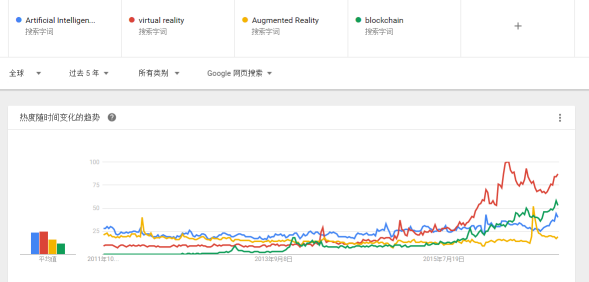
How many products/services have truly adopted VR/AR technology? What are the investment-worthy entry points for VR/AR in the healthcare industry? What is venture capital’s stance on VR/AR applications, and what challenges and risks lie ahead for future investments?
VCBeat Research Institute, starting from global VR/AR healthcare applications, has compiled a list of nearly 100 innovative companies from mainstream markets both domestically and internationally.
We conclude:
VR/AR technologies present opportunities for the optimization and upgrading of the traditional healthcare industry;
There are six major entrepreneurial and investment opportunities in the application of VR/AR in the healthcare industry;
Personalized fitness has become the most popular entry point for startups;
Investors are optimistic about VR/AR healthcare applications, with their transaction volumes ranking second and fifth among VR and AR industry applications, respectively;
VR/AR healthcare applications can initially target the B2B sector, gradually expanding to patients and consumers.
VR/AR: Technology Drivers and Key Differences
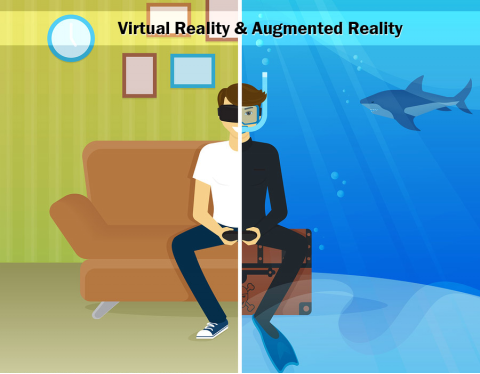
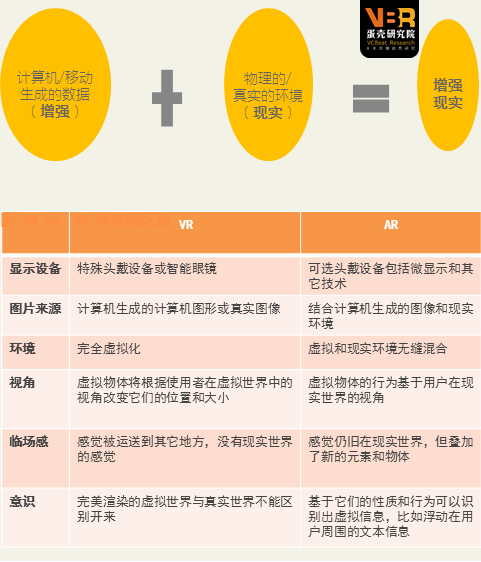
Virtual Reality (VR), by definition, refers to the use of computer technology to simulate a three-dimensional virtual world, providing users with simulated sensory experiences—including visual, auditory, and tactile feedback—so that they feel fully immersed, as if physically present, enabling timely and unrestricted observation of objects within the three-dimensional space. Virtual reality is typically highlighted in two distinct ways of application:
1) Creating and enhancing virtual worlds for gaming and entertainment, such as video games, 3D movies, and head-mounted displays;
2) Create real-world simulated environments for enhanced training, such as flight simulation simulators.
Augmented Reality, a technology that calculates the position and angle of camera images in real time and superimposes corresponding graphics, aims to overlay the virtual world onto the real world on screens for interactive purposes. In other words, it integrates digital information with the real-world environment to enhance context-specific information in the physical world.
The virtual reality industry is complex and covers a wide range of areas.
The virtual reality (VR) industry chain is an ecosystem grounded in hardware, supported by software platforms, and centered on applications (content). Currently, the hardware segment has achieved a relatively mature structure. Hardware manufacturers and internet giants are increasingly investing in this sector; for instance, Alibaba established a Virtual Reality Technology Laboratory, and Huawei unveiled its first-generation VR headset, thereby driving and fostering the development of VR hardware and the broader industry.
The software and applications sector primarily entered the market through traditional gaming and video distribution platforms, as well as emerging virtual reality startups within the new ecosystem. Due to the complexity of content production workflows and technological constraints, the application sector remains in its nascent stage. Early applications were predominantly found in cutting-edge technology industries such as military, aerospace, and engineering, before gradually expanding into consumer entertainment and daily life; however, user experience is far from perfect.
The virtual reality (VR) industry chain is relatively complex due to its involvement in and intersection with multiple sectors, including hardware/devices, software development, applications (content), online and offline distribution platforms, business-to-business (B2B) clients, and consumer-to-consumer (C2C) users, as well as the absence of relevant regulatory standards. However, it also exhibits a "ripple effect," where a change in one part can impact the whole, resulting in a high industrial multiplier effect.
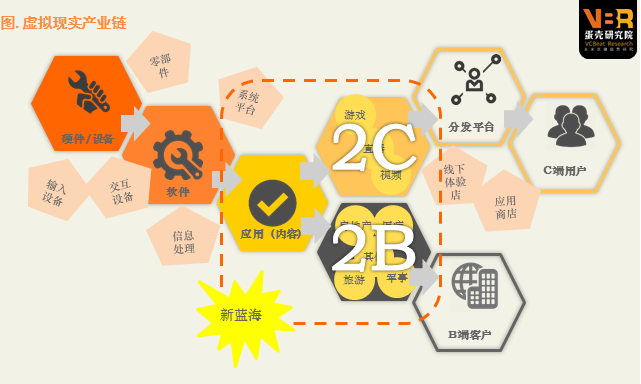
This report will focus on the application (content) section.
Applications (Content) Emerge as a New Blue Ocean
Upstream players are primarily internet giants and hardware manufacturers, which have leveraged their first-mover advantage to focus on hardware and system development. Consequently, this segment is currently the most mature part of the industry. The midstream is dominated by content providers offering industry-specific applications, a sector largely comprised of startups. At present, VR is mainly expanding into entertainment and consumer sectors, while AR is primarily focused on advertising and marketing. Downstream consists of distribution and marketing platforms, encompassing traditional online and offline channels as well as app stores.
Application development is driven by the industrial chain. A holistic comparison of the three major segments reveals that the intense focus of tech giants and capital on hardware/devices has created a top-heavy appearance across the entire industry chain. This severely imbalanced industrial structure has, in turn, spurred the development of applications (content), as hardware requires applications to enrich its value, while applications rely on hardware as their foundation.
Another driving factor lies in the inherent characteristics of VR/AR technologies, such as the immersiveness of VR and the interactivity of AR. These features transform traditional product or service experiences into more realistic and engaging ones, thereby stimulating users’ senses and effectively addressing their psychological barriers.
The application of VR/AR technologies is more focused on optimizing products or services, rather than bearing the mission of disrupting an industry at the slightest disagreement.
VR/AR Medical Applications: Seizing the Opportunity
Why are there so many opportunities, even an abundance of them? This is closely related to the inherent characteristics of the healthcare industry. The rudimentary nature of traditional equipment, scarcity of resources, regional disparities in medical standards, and shortage of professional talent have all contributed to the current situation, while also serving as a double-edged sword that drives the adoption of new technologies. The entry point for emerging technologies such as VR/AR lies in their ability to optimize traditional workflows, improve medical outcomes, and alleviate the workload of healthcare professionals.
According to Goldman Sachs’ estimates, the market size for VR and AR will reach $80 billion by 2025. Within this, the healthcare sector is expected to have approximately 3.4 million users by 2025, with a market size reaching $5.1 billion.
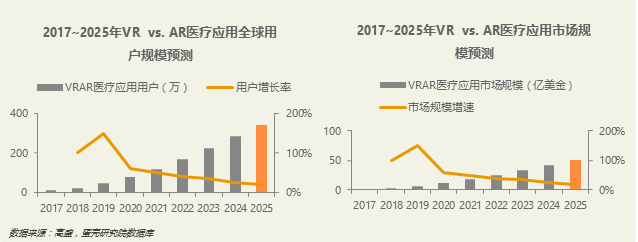
From the perspective of expected trends, the number of users and market size for VR/AR healthcare applications are projected to peak by 2019, indicating that the industry landscape has already taken shape. Consequently, the industry will focus on continuous product upgrades and service optimization. Future growth will be driven by advancements in other emerging technologies that foster innovation in VR/AR medical applications.
Furthermore, based on an analysis of the financing activities of 138 VR/AR application companies with disclosed funding data both domestically and internationally by VCBeat (detailed in Part III), gaming is the most favored sector among venture capitalists in VR applications, while advertising and marketing are the most preferred in AR applications. Notably, healthcare ranks second in VR applications and fifth in AR applications. This indicates that capital markets hold a favorable attitude toward VR/AR healthcare applications.
Six Major Application Scenarios of VR/AR in Healthcare
Compared with VR/AR industry applications in entertainment and consumer sectors, healthcare applications are currently fewer in number but hold the greatest potential for large-scale adoption. For instance, virtual reality can treat psychological disorders by recreating environments to enhance presence and immersion; realistic virtual environments provide a platform for physicians and medical professionals to simulate surgeries and other delicate procedures; and augmented reality enables doctors to more accurately identify the precise location of lesions within patients’ bodies and assess potential functional impairments.
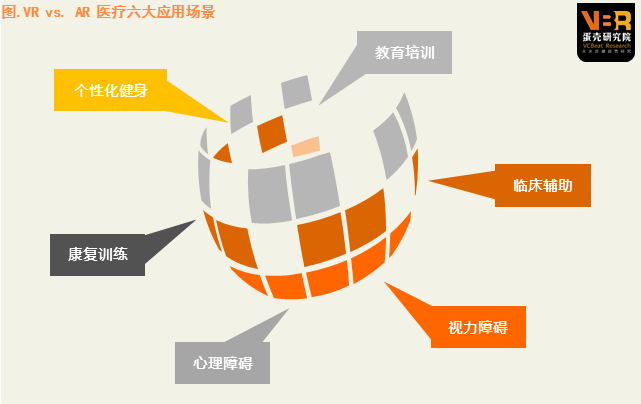
According to VCBeat’s collection and curation of global VR/AR healthcare application projects, there are currently over 80 such projects. The number of VR projects is approximately five times that of AR projects. These projects span 12 major subfields, with a primary concentration in four key areas: personalized fitness, education and training, clinical assistance, and psychological disorders (each of these fields has more than 10 projects, with personalized fitness having the highest number at 25).
Based on a comprehensive review of global VR/AR applications in the healthcare sector, and considering market size, current adoption status, and investor interest across various healthcare subsectors, we will focus on the following six key application scenarios:Education and Training, Personalized Fitness, Psychological Disorders, Rehabilitation Training, Visual Impairment, Clinical Assistance。
Scenario Example — Vision Impairment

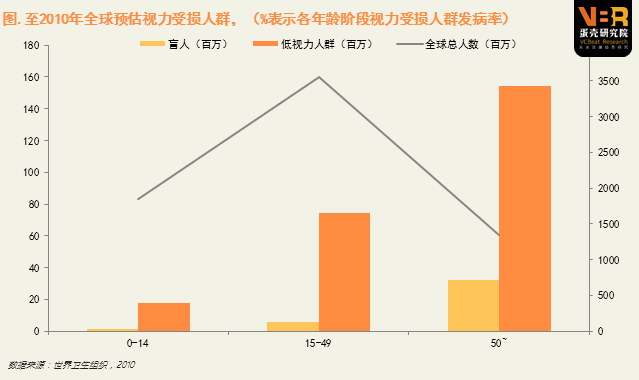
Visual impairment is a major global challenge. According to the World Health Organization’s 2010 Global Data on Visual Impairment report, approximately 246 million people worldwide had low vision (prevalence rate: 3.65%), and 39 million were blind (prevalence rate: 0.58%). In China, 67.264 million people had low vision (prevalence rate: 27.3%), and 8.248 million were blind (prevalence rate: 20.9%). It was projected that, without intervention, the global number of blind individuals would rise to 75 million by 2020.
To address this issue, the current market primarily provides patients with visual aids, enabling them to achieve maximum independence in daily life through appropriate training. However, such products have limitations: patients cannot freely participate in external activities and often require multiple assistive devices for different tasks, such as screen readers for reading and white canes or guide dogs for mobility. Furthermore, these devices tend to be bulky or have stringent usage requirements. Recently, mobile app-based solutions have emerged, but they generally offer limited functionality. Imperfect user experiences coupled with growing consumer demand have spurred the development of new products that leverage wearable devices to assist with mobility and apply VR/AR technologies for the treatment or assistance of vision impairment.

Applications of VR/AR technologies in the field of visual impairment primarily rely on VR’s interactivity and AR’s integration of virtual and real elements along with its interactivity. VR influences patients’ brain perception by creating virtual spaces, thereby improving visual impairment. AR mainly utilizes AR devices such as Google Glass or self-developed solutions to provide services akin to automotive navigation systems, guiding patients through hotel lobbies and commercial districts while accessing information on dining, transportation, and more.
VR/AR applications for visual impairment are still in their early stages. According to public information and data collected by the VCBeat Research Institute database, four startups are currently active in this field globally: Israel’s OrCam, the UK’s VA-ST, and the US-based Aira, all of which leverage augmented reality (AR) technology to “enhance” vision, as well as Vivid Vision, a US company that applies virtual reality (VR) technology.
For example, OrCam has developed a camera-based augmented reality system that relies on a head-mounted display and portable accessories, enabling individuals with visual impairments to read and navigate independently. A camera, attached to the eyeglass frame via magnets, is connected by a thin cable to a pocket-sized portable computer. Meanwhile, bone-conduction speakers clearly deliver the interpreted content—such as newspapers, street signs, traffic lights, and faces—to the user.
Another noteworthy product is the Smart Specs augmented reality glasses from VA-ST. These glasses primarily utilize depth sensors to simplify and highlight nearby objects and human figures. Users can switch between four modes—black, white, gray, and color—though the device is specifically designed for blind individuals with residual vision.
Supported VR Device: Oculus Rift
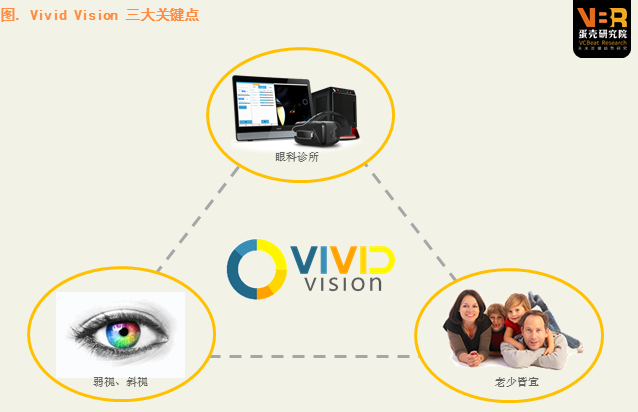
This company was founded in 2014 and applies VR technology to treat amblyopia and strabismus.
The game “Vivid Vision” it developed leverages virtual reality (VR) to influence patients’ brain perception through visual stimuli, continuously training unused or dormant extraocular muscles to achieve therapeutic effects. Currently, the product is available only at 41 ophthalmology clinics in North America and requires a physician’s prescription for access; it is expected to be launched in international markets later this year.
The product is currently applying for FDA certification. The software was priced at $400 when announced in 2015, and the current price has not yet been updated.
Finally, to borrow a quote from Darwin’s On the Origin of Species, “It is not the strongest of species that survive, nor the most intelligent, but those most responsive to change.“VCBeat expects that the changemakers in this industry will also innovate products/services that meet user needs and have distinctive features while seizing opportunities.
For more detailed scenario analyses and case studies, please click the link below to purchase: The World’s First Innovation Report on VR/AR Applications in the Healthcare Industry. Entrepreneurs, investors, and industry professionals are welcome to contact us for discussions and exchanges.
※※※For more detailed scenario explanations and case studies, please click the link below to purchase:The World’s First Report on Innovative Applications of VR/AR in the Healthcare Industry, entrepreneurs, investors, and industry professionals are welcome to contact us for discussions.

By VCBeat. Please credit the WeChat Official Account when reposting:VBResearch2016
↓↓↓