

Baoguanjia Files IPO Prospectus: Enhancing Medical Experience Through Visualized Clinical Communication System

In July 2016, Premier Li Keqiang of the State Council pointed out at an executive meeting of the State Council that critical illness insurance for urban and rural residents is an important component of the socialist medical security system with Chinese characteristics, and integrating social security with commercial insurance represents a major innovation in the continuous deepening of healthcare reform.
The role of insurance extends beyond mere claims settlement; more importantly, it facilitates resource linkage and enhances efficiency. By acting as a third party to improve communication between doctors and patients, it further elevates the quality of medical care.
Baoguanjia is precisely such a third-party service provider dedicated to improving the healthcare experience. Leveraging its independently developed visual disease communication system and a professional medical service team, it delivers reasonable, convenient, and effective services to clients.
Bao Guanjia was established in 2014, when China was implementing critical illness insurance. At that time, the Shanghai Municipal Health and Family Planning Commission sought to promote a third-party notification model for doctor-patient communication to alleviate information asymmetry between doctors and patients. Driven by government demands and the development trends of commercial insurance, Bao Guanjia emerged as a result.
Enhancing Transparency in Medical Processes to Alleviate Doctor-Patient Conflicts
Wei Jian, Founder and CEO, recalled that in 2014, Baoguanjia’s first business initiative was to provide third-party cost disclosure services for nearly one million government-sponsored critical illness insurance beneficiaries in Shanghai, on behalf of Ping An Pension Insurance, then China’s largest pension insurer. The company employed a team of full-time nurses who were dispatched to Grade 3A hospitals to conduct medical assessments whenever insured individuals required assistance. Patients were thoroughly informed about available treatment options for their specific conditions, the costs associated with each option, the consumables and medications likely to be used during treatment, and which items were out-of-pocket versus reimbursable. Upon completion of this consultation, a tripartite disclosure form was generated, with copies retained by the patient, the physician, and Baoguanjia respectively. This approach effectively provided patients with an advocate, reduced information asymmetry between doctors and patients, helped set realistic treatment expectations, and thereby minimized medical disputes. Data further indicated that patient adherence to physicians’ recommendations improved significantly, leading to a corresponding reduction in overall medical expenses.
As its business has accumulated and deepened, Baoguanjia has found that, in addition to third-party notifications, patients have other service demands. Typically, patients do not fully understand the medical terminology used during preoperative discussions; they need more than just linguistic communication—they also wish to participate in clinical decision-making.。2016The annual stewardship has undergone further upgrades, with Shanghai'sTop-tier tertiary hospitals have jointly developed a proprietary visual disease communication system, through which physicians can present disease conditions and treatment plans to patients.of3DModels help patients understand the etiology and treatment options. For instance, in oncology cases, this system provides intuitive visualizations of tumor location, its impact on blood vessels and nerves, surgical resection strategies, and potential complication risks.
Currently, this system has been applied to20Multiple Grade-A Tertiary Hospitalsand clinical departments, facilitating communication between doctors and patients regarding medical conditions, helping patients participate in and understand the treatment process, reducing information asymmetry between doctors and patients, improving patient compliance, and ultimately achieving the goal of enhancing healthcare quality.
To address the current shortage of in-hospital service personnel at tertiary hospitals, Baoguanjia provides services such as patient condition communication and follow-up tracking through its self-employed nurse team, helping medical staff better focus on clinical diagnosis and treatment.
Meanwhile, Bao Guanjia is also launching“HospitalCustomized Insurance”Concept: Directing patient referrals to hospitals and physicians in a targeted manner. The company mandates that physicians must provide patients with reasonable treatment plans through customizedInsurance covers the corresponding service fees, which can significantly enhance customer satisfaction and thereby create a virtuous cycle. Moreover, patients referred through insurance channels are pre-screened, making them ideal candidates for physicians.
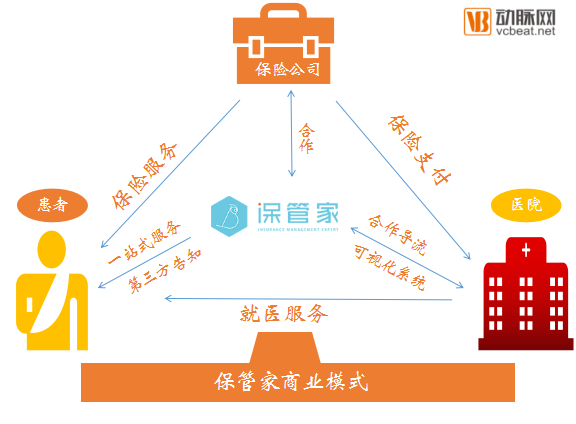
A system, a team of nurses, and a suite of insurance products. Through insurance, Care Stewards deliver multi-dimensional services to patients, enhance transparency in the medical care process, alleviate doctor-patient conflicts, and improve patients’ healthcare experience.
Meticulous Services, Extending Across Prevention, Medical Care, and Rehabilitation
“But these are still far from enough,” said Wei Jian, who told VCBeat (WeChat:VCBeat) A reporter shared a story about his friend:
This friend’s father was unfortunately diagnosed with liver cancer. His first action was to search online for literature related to liver cancer and instruct his secretary to locate treatment guidelines worldwide. This is a clear signal that the patient wishes to participate in the treatment process rather than blindly comply with the physician’s decisions. After considerable effort to secure medical care, the elderly father’s sole wish was simply to enjoy a plate of twice-cooked pork. Wei Jian told a reporter from VCBeat (WeChat ID: vcbeat), “For patients with certain diseases, beyond therapeutic interventions, they actually need comprehensive services such as compassionate life care and pain management. Doctors and nurses lack the additional time and energy to meet these basic patient needs, and there is no one providing specialized services for nutritional management and pain management.”
A decade ago, patients’ healthcare experience was largely characterized by waiting, enduring, and suffering. As economic conditions and living standards have improved, more patients are willing to pay for enhanced services; unfortunately, this process still faces several challenges. First, family members of patients often lack the necessary professional knowledge to provide the most appropriate care. Second, market-based services lack standardized protocols, and some disruptive practices even violate industry norms, resulting in unsatisfactory experiences for patients, their families, and medical staff. Currently, most health management companies focus on pre-hospital services such as appointment registration, leaving the specific and fragmented tasks during hospitalization and offline care largely unaddressed. In light of this, Wei Jian aims to create a win-win in-hospital service model through Baoguanjia that satisfies the government, hospitals, clinical departments, and patients alike.
Professional Team: Customer Satisfaction Is the Only Competitive Edge
Wei Jian also revealed to a reporter from VCBeat (WeChat ID: vcbeat) that Baoguanjia has invited the former head nurse of an overseas-funded clinic in Australia to serve as the company’s Chief Nursing Officer (CNO). In this role, she will guide the company’s nursing staff in implementing world-class medical record management standards to better serve clinical departments and patients. Meanwhile, the company plans to appoint the director of medical affairs from a Grade 3A hospital as its Chief Medical Officer (CMO). Baoguanjia also recognized that offline healthcare services require an executive well-versed in IT infrastructure to oversee offline operations. Consequently, another co-founder, formerly the head of Baidu’s mobile search division, is gradually transitioning from the role of Chief Technology Officer (CTO) to Chief Operating Officer (COO), with the aim of structuring and standardizing service delivery as much as possible.
Custodian this year4The company secured a round of financing in May, raising over RMB 10 million, with Puhua Capital as the investor. Notably, the fundraising process proceeded very smoothly, taking approximately two weeks from start to finish. Regarding the financing, Wei Jian stated that he maintains a balanced perspective: “Regardless of the amount raised, the company should continue with its core operations. The only priority is to ensure customer satisfaction, which constitutes the company’s core competitiveness.”
The company has also partnered with insurance firms such as Ping An and China Taiping to launch enhanced insurance offerings, including genetic testing, medical consultation services, and end-to-end insurance coverage. It is expected that this year12Launched in [Month].
Vision: Starting from the perspective of a third party between doctors and patients, to achieve a win-win situation for all parties involved.
Wei Jian is acutely aware of the pain points and core issues in healthcare reform. The greatest challenge lies in finding a balance acceptable to all stakeholders. In reality, there is no direct intersection between medical providers and payers; the only connecting link is the patient-physician relationship. Baoguanjia aims to approach this from the perspective of a third party in the patient-physician dynamic:
At the physician level, Baoguanjia aims to establish a genuine consortium of virtual doctors. In the early stages, this will provide patients with enhanced services; in the long term, it will help increase transparent physician compensation and standardize industry practices.
At the departmental level, Baoguanjia provides advanced department management technologies to facilitate end-to-end patient management.
At the hospital level, it helps hospitals enhance precision marketing and patient acquisition, improve patients’ healthcare experience, and alleviate doctor-patient conflicts;
At the national level, Baoguanjia aims to help China achieve standardization and normalization in healthcare by providing third-party evaluations and data support to hospitals.
Baoguanjia aims to integrate health insurance into the medical care process through multi-dimensional services, thereby promoting clinical standardization and national cost containment, ultimately achieving a win-win outcome for patients, physicians, hospitals, departments, and the government.