

Episona Launches At-Home Epigenetic Sperm Test Seed to Enhance Male Fertility Insights
Falling in love, getting married, and having children are life experiences that most people go through. Establishing a family and having one’s own children are rights endowed to every individual by nature. Conception and gestation constitute a complex and serious process involving physiological, psychological, nutritional, and other aspects.
Today, many couples are unable to conceive naturally due to various reasons. For the sake of having children, they exert efforts hundreds of times greater than those of typical couples, shuttling between clinics and laboratories. Conventional semen analysis can assess sperm count, morphology, and motility; however, such information alone is often far from sufficient.
Recently, Episona, based in Pasadena, California, announced its next-generation sperm testing service, ushering in the era of Sperm Testing 2.0. VCBeat (WeChat ID: vcbeat) has compiled research findings from Episona and several other startups in this field.
Traditional Semen Analysis Fails to Meet Patient Needs
According to data from the Centers for Disease Control and Prevention (CDC), approximately 5 million men in the United States suffer from infertility. Among infertile couples, male factors account for 30% of cases, and male-related issues contribute to approximately 50% of infertility cases, as about 30% of men experience unexplained or “idiopathic” infertility.
Traditional semen analysis has faced intense criticism in recent years, partly due to the high subjectivity of its results. In conventional testing, technicians evaluate samples under a microscope, focusing on sperm count and motility as key metrics. However, the causes of infertility are highly complex and cannot be adequately explained by these two parameters alone. For instance, many men with low sperm counts or abnormal sperm morphology remain fertile. Conversely, many men receive normal test results despite having significant underlying fertility issues.
James Golembowski is an ordinary resident of New Jersey. His decade-long journey to conceive has given him a profound understanding of the importance of diagnostic data. Since he and his wife got married, they have embarked on a long and arduous path to parenthood, yet even after 11 years, they have not succeeded. Conventional semen analysis merely indicated azoospermia (the absence of sperm) but failed to identify the underlying cause. Furthermore, attempts to retrieve sperm directly from his testicles were unsuccessful. These experiences underscore the need for more advanced sperm testing methods to help patients pinpoint the root causes of their infertility.

Episona CEO Alan Horsager (left) and Clinical Operations Manager La-Toya Williamson (right)
Episona is an epigenetic data company focused on improving reproductive health outcomes. In response to the limitations of traditional semen analysis, Episona and other startups have developed next-generation sperm tests to generate more comprehensive data. These advancements aim to help individuals better understand their fertility and explain why some men with normal sperm counts still struggle to conceive with their partners.
Episona named the test “Seed” and officially launched it on October 24 at the American Society for Reproductive Medicine’s annual meeting in Salt Lake City. The epigenome is a collection of chemical compounds that varies among individuals. It records a series of chemical modifications to an organism’s DNA and histones, which can be transmitted to its offspring. Alterations in the epigenome can lead to changes in chromosome structure and gene function.
Seed conducts testing by analyzing 480,000 regions of the epigenome. Alan Horsager, founder of Episona, collaborated with geneticists, sperm specialists, and computer scientists to develop this test, aiming to fill a “significant gap” for men suffering from infertility. In his view, the diagnosis and treatment of infertility require more comprehensive information on male reproductive health.
Seed is sold through physicians’ offices at a price of $895. Its outer packaging is a sleek black box adorned with bright blue chromosomes, and its superior design and texture make it resemble an iPhone box more than a medical kit. The product includes a funnel, a collection bottle, and a prepaid return shipping label, allowing users to collect samples at home (without refrigeration) and mail them to the laboratory. Seed is highly efficient, enabling users to access their test results online shortly after the sample is received.
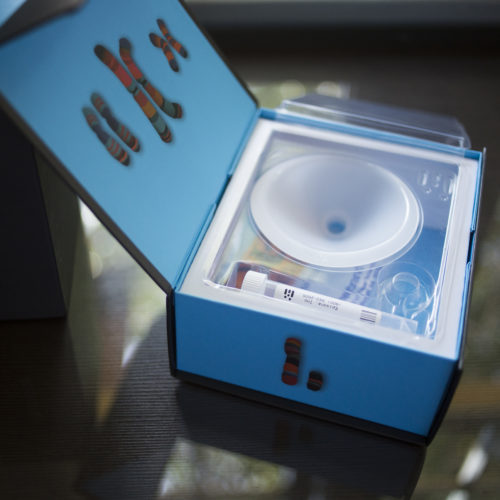
The product contains a funnel, collection bottle, and return mailing label.
Barbara Collura, President and CEO of RESOLVE: The National Infertility Association, believes that Seed offers a significant advantage by enabling users to collect sperm samples at home, particularly for men who are reluctant to provide samples in a laboratory setting.
Richard Scott, a fertility specialist in New Jersey, helped Episona validate Seed’s technology and serves on Episona’s Scientific Advisory Board. In Dr. Scott’s view, having children is a fundamental right, and when this right is denied, individuals deserve to know what has gone wrong. However, previous generations of semen analyses failed to explain the causes of infertility, leaving clinicians frustrated and patients despairing.
Fortunately, the landscape will change with the advent of Seed. Like several other 2.0 diagnostic tools currently under development, it can help patients whose sperm appear normal under microscopy understand the underlying causes of their infertility. Of course, identifying the cause does not necessarily guarantee a definitive solution. While physicians may recommend lifestyle modifications such as weight loss or smoking cessation to improve patients’ epigenetic profiles, no specific therapeutic regimen has been established to date.
In addition to helping people understand the causes of infertility, sperm testing in the 2.0 era can also provide patients with much-needed reassurance. Upon receiving their test results, patients will come to terms with the fact that they are indeed unable to conceive under current medical conditions. This awareness can encourage couples to consider using a sperm bank or adopting children, rather than enduring repeated disappointment after investing substantial time and financial resources into in vitro fertilization (IVF).
Doug Carrell, co-founder of Episona and an endocrinologist at the University of Utah specializing in sperm epigenetics, deeply understands this struggle: many couples undergo arduous rounds of in vitro fertilization (IVF) yet struggle to obtain healthy embryos. After experiencing failure, they must regroup emotionally and embark on another attempt, pinning their hopes on the next embryo. The purpose of the Seed test is to help such couples gain a better understanding of their physiological condition before initiating IVF, thereby avoiding placing hope in futile endeavors.
Aytu BioSciences, headquartered in Englewood, Colorado, markets a laboratory test called MiOXSYS in Europe and the Middle East. The test detects oxidative stress in sperm, a known factor that can contribute to certain cases of male infertility. The company is currently seeking FDA approval to sell the test in the United States.
New York-based Androvia Life Sciences is developing a sperm test to assess the ability of sperm to penetrate and fertilize an egg, as well as to withstand the series of physiological changes that occur during this process.
Sandstone Diagnostics, a startup based in the San Francisco Bay Area, has launched a new test called Trak. Priced at $200, the testing device uses a small desktop centrifuge to measure sperm count. The advantage of Trak is that patients can easily perform the test at home without the hassle of visiting a clinic; however, compared to Episona’s Seed, it only offers the same parameters as traditional methods.
Matthew Wosnitzer, a fertility specialist at the Yale New Haven Health System, is confident in this new generation of sperm tests. Although the test results do not yet provide solutions to the problem, gaining more insights into the causes of infertility is equally valuable. This is particularly significant given the limited number of male fertility tests currently available on the market; therefore, obtaining as many data points as possible is certainly beneficial.