Lightweight and Low-Cost Gait Rehabilitation Robots: A Promising Future Built on Deep Understanding of Human Locomotion Mechanics
The World Medical Robot Conference (WMRC), hosted by the World Medical Robotics Association, is scheduled to convene in Shenzhen. Prior to the conference, Professor Li Jian’an, Chair of the International Society of Physical and Rehabilitation Medicine and a member of the U.S. National Academy of Medicine, made a special visit to the ROBO “Master Lecture Series” to deliver an academic presentation titled “Medical Kinesiological Mechanisms and Analytical Methods of Human Gait.”
HeA deep understanding of human walking mechanisms is considered a prerequisite for developing superior new products, and the market prospects for next-generation lightweight, low-cost assistive gait rehabilitation robots tailored to individual users are promising.
Liu Jian'an currently serves as a member of the U.S. National Academy of Medicine,President of the International Society of Physical and Rehabilitation Medicine、Chairman, Chinese Society of Physical Medicine and Rehabilitation, Chinese Medical Association、Director, Department of Rehabilitation Medicine, Jiangsu Province People's Hospital, Dean of the School of Rehabilitation Medicine at Nanjing Medical University. He specializes in exercise and rehabilitation therapy for cardiovascular diseases, basic and clinical research on motor control disorders, nerve blocks, and rehabilitation therapy for spinal cord injury. He led the establishment of China’s first fully equipped gait analysis laboratory in a general hospital, pioneered nerve block therapy for muscle spasticity in China, and promoted its widespread application.
So far,Li Jian'anHas supervised 15 PhD graduates and 45 master’s graduates; currently supervising 1 postdoctoral fellow, 9 PhD candidates, and 7 master’s students. Serves as a visiting professor at multiple institutions, including Zhejiang University, West China School of Medicine of Sichuan University, Xinjiang Medical University, Shanghai University of Traditional Chinese Medicine, Fujian University of Traditional Chinese Medicine, Heilongjiang University of Chinese Medicine, Shanghai University of Sport, and Nanjing Sport Institute.
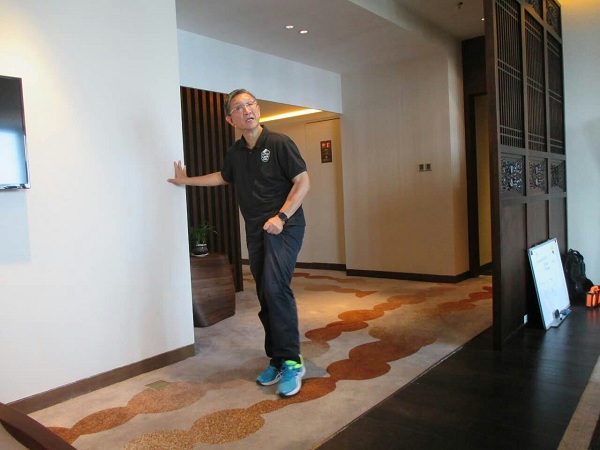
Li Jian’an Demonstrates “Gait”
For patients who have unfortunately suffered a stroke or traumatic brain injury, the ability to regain normal walking function is often their most cherished goal. Some physical therapists have patients attempt walking on a treadmill while manually assisting them in moving their lower limbs to achieve a normal gait pattern. Ambulatory rehabilitation robots can help alleviate the caregiving burden on family members.
Walking rehabilitation robots integrate traditional walkers with knowledge from rehabilitation medicine and physiology, as well as robotic technologies such as motion control. They provide power assistance and physical support to users, enabling assisted walking. Targeting gait impairments in the elderly and paralyzed patients, these robots facilitate walking rehabilitation training, helping users overcome issues such as decreased muscle strength and reduced coordination.
Li Jian’an believes that an in-depth understanding of the mechanisms underlying human walking is a prerequisite for developing high-quality assistive gait rehabilitation robots. He points out that assistive gait rehabilitation robots can only mimic human walking movements, but not human gait; “gait” refers to the behavioral characteristics of walking movements, and robots are incapable of replicating human gait. SubsequentlyLi Jian'anThis article introduces the mechanism of human gait from an anatomical perspective, describes the status and functions of the hip, knee, and ankle joints as well as their corresponding muscle groups during the gait cycle in normal adults, and explains how modern scientific technologies are utilized to collect and analyze kinematic and kinetic data of human walking.
When Li Jian'an discussed the development direction of next-generation assistive walking rehabilitation robots with the audience present.Li Jian'anTypical rehabilitation robot products currently available on the market, such as Switzerland’s Lokomat gait training robot and Israel’s ReWalk exoskeleton robot, feature complex structural designs and control systems, resulting in high costs. In contrast, next-generation lightweight, low-cost assistive walking rehabilitation robots designed for individual consumers will possess greater market competitiveness and broader application prospects.
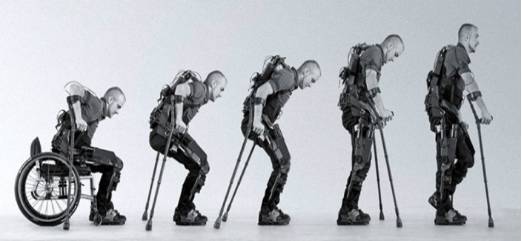
ReWalk Robotics
Israel’s tech company ReWalk is the global leader in civilian exoskeleton systems. Currently, ReWalk Robotics offers two products: ReWalk Personal and ReWalk Rehabilitation. The former is primarily designed for individual users, suitable for use in home, work, or social settings. It enables patients to stand, walk, and climb stairs through sensors and monitors. The latter targets institutional users for clinical rehabilitation, providing physical therapy for paralyzed patients. Benefits include alleviating limb pain and muscle spasms caused by paralysis, aiding bowel and digestive function, and accelerating metabolism.
ReWalk received CE marking in the European Union in 2012 and obtained approval from the U.S. Food and Drug Administration (FDA) in 2014, becoming the first robotic exoskeleton system to receive such approval.This progress boosted optimism about ReWalk Robotics’ prospects, leading to its initial public offering on the NASDAQ in September 2014. The company raised over $50 million, with its share price surging from $13.6 to $25.6 on the first day of trading—a 113.33% increase. Its market capitalization climbed to $200 million, making it a standout performer in the U.S. stock market that week.
Lokomat is one of HOCOMA’s flagship products. It is a gait training robot that provides real-time feedback and assessment, delivering effective rehabilitation outcomes for patients with neurological disorders such as stroke, spinal cord injury, traumatic brain injury, and multiple sclerosis. Currently, Lokomat nearly monopolizes the high-end rehabilitation robotics market in China.
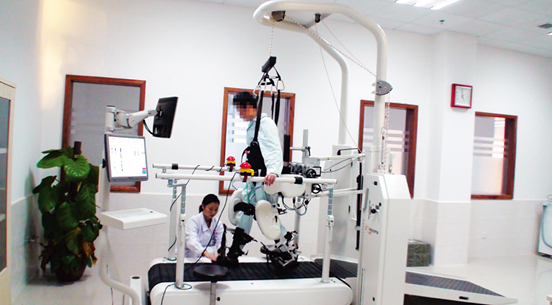
Lokoma
HOCOMA, founded in 1996, collaborates with universities across Europe and the United States to develop high-end rehabilitation therapy and training products. As an internationally renowned medical rehabilitation robotics company, it possesses advanced technologies in numerous fields, including ergonomics, electronic sensors, computer hardware and software, and artificial intelligence.
In addition to Lokoma, the company has three other main products:Armeo、Erigo、Valedo
Armeo is an upper-limb rehabilitation robot that provides real-time feedback and assessment, supporting comprehensive kinematic chain therapy from the shoulder to the fingers. It automatically adjusts assistance based on the patient’s condition, enabling even patients with severe symptoms to undergo high-intensity early-stage rehabilitation.
Erigo is an integrated tilt robot system designed for early neurorehabilitation training in long-term bedridden patients.
Valedo Series: Designed for the treatment of back pain, the series includes three products—Valedoshape, Valedomotion, and Valedo—for spinal assessment, clinical treatment, and home-based therapy, respectively.
ROBO "Master Lecture Series"After the event,Li Jian'anNamely, it signed a cooperation agreement with ROBO (ROBO Healthy Institute) and appointed him as the Chief Scientist for RHI’s rehabilitation program. It is reported that Li Jian’an will also attend the inaugural World Medical Robot Conference, to be held in Shenzhen, China, on October 29–30 this year, where he will engage in exchanges and discussions with other attendees on the rehabilitation robotics industry.
The “2016 World Medical Robot Conference,” hosted by the World Association of Medical Robotics, is scheduled to take place in Shenzhen, China, on October 29–30. This inaugural global summit integrates scientific research, clinical practice, and industry development in the field of medical robotics. More than 20 academicians from various countries will attend the conference, alongside dozens of directors from renowned hospitals worldwide and clinical experts who will deliver reports and participate in discussions. Experts and scholars from prestigious domestic and international institutions—including the Swiss Academy of Technical Sciences (SAWT), the UK Royal Academy of Engineering, the Chinese Academy of Sciences, the Singapore Academy of Medicine, and the ROBO Medical Robotics Institute—will share insights on global application trends and research directions in medical robotics. They will conduct thematic discussions centered on the conference theme: “Technology Transforms Healthcare, Health Leads the Future.”

Venue: OCT Harbour, Shenzhen, China - Lanying Bay Resort Hotel
No. 2018, Binhai Avenue, Nanshan District, Shenzhen City
Conference Dates: October 29–30, 2016

Click the link below or scan the QR code to register. For investment and sponsorship inquiries, please contact Peipei at VCBeat (WeChat ID: xiaopeiling185025).