

Generic Insulins on the Horizon: Potential to Curb Soaring Insulin Prices
The insulin market, dominated by established pharmaceutical companies such as Sanofi and Novo Nordisk, is witnessing more intense competition than the broader diabetes drug sector. However, the insulin market is currently undergoing some changes. The first biosimilar insulin for diabetic patients, akin to generic versions of synthetic drugs, is expected to launch this December, offering significantly lower costs while maintaining essentially identical active ingredients.
In the coming years, a series of new generic insulin products will be launched sequentially, featuring protein structures identical to those of brand-name pharmaceutical companies’ products. Experts predict that these new insulins will lead to lower prices; however, it remains uncertain whether they will ultimately reduce overall costs amid fierce competition in the insulin market.
There is no doubt that this high-stakes approach is of great significance: in the United States, approximately 6 million people suffer from diabetes, a chronic condition that requires treatment with insulin alone or in combination with other oral medications. In 2013, the annual cost of insulin reached $736 per patient, three times higher than in 2002. According to pharmacy managers at Express Scripts, the largest pharmacy benefit manager in North America, diabetes medications, including insulin, rank as the second most expensive prescription drugs.
Why Are Insulin Prices So High, and What Changes Can We Expect in the Market? VCBeat (WeChat: vcbeat) Provides an Overview.
The vast majority of patients with diabetes maintain a long-standing, fixed list of preferred insulin brands. These insulins are primarily sourced from three different pharmaceutical manufacturers: Novo Nordisk, Sanofi-Aventis, and Eli Lilly. Some are long-acting insulins requiring once- or twice-daily injections, while others are short-acting insulins administered via pump as needed. Additionally, many patients use premixed insulin formulations.
Some new products, such as Novo Nordisk’s Tresiba and Sanofi’s Toujeo, are long-acting insulins that have been on the market for only a short time and have not yet been widely used. However, other insulin products have typically been available for at least ten years and are sold at approximately $250 per vial (although the actual prices paid by consumers and insurers are usually much lower).
Only a small proportion of patients with diabetes use lower-priced brands of human insulin, which are manufactured to mimic the insulin naturally produced by the human body. For example, Walmart commonly sells a brand called ReliOn, priced at less than $25 per vial. As for specific sales figures, no official Walmart spokesperson has currently responded to inquiries regarding retail sales volume.
According to the general laws of a market economy, competition should drive down prices, but this has not occurred in the insulin market. If you track the list prices of the best-selling brands and medications in recent years and use “shadow pricing” methods to forecast and analyze insulin prices, several significant trends become evident: the prices of these directly competing brands have continued to surge, with their increases occurring in near-perfect synchrony.
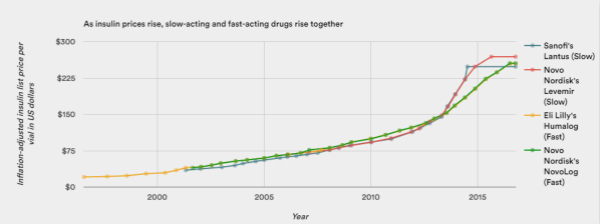
Price Increase Curves of Long-Acting and Short-Acting Insulins from Sanofi, Novo Nordisk, and Eli Lilly
So why did this happen? Experts explain that multiple factors are at play. Pharmaceutical manufacturers have stated that while they do not collude with other drug companies on pricing in advance, they do match price increases when their competitors raise prices.
They pointed out that the net price of insulin (the revenue obtained from each sale) has been rising quite moderately, a view consistent with a recent report in The Wall Street Journal.
List prices have been soaring, partly because intermediaries between manufacturers and patients, such as pharmacy benefit managers, are demanding larger rebates. “There is no doubt that competition on insulin prices is intense, but this is happening at the net price level,” said Mike Mason, Vice President of Eli Lilly’s U.S. diabetes business.
Another key factor is that, unlike with other drug classes such as cholesterol-lowering or pain-relieving medications, it is not uncommon for patients and physicians to switch between insulin brands. “These products are not perfectly substitutable, manufacturers hold significant pricing power, and thus they exercise monopoly-like control over pricing,” said Rena Conti, a health economist at the University of Chicago. Additionally, insulin prices have not declined because demand has continued to rise, regulatory requirements for the manufacturing process have become increasingly stringent, and costs have naturally increased accordingly. Dr. William Herman, an internist at the University of Michigan, noted that the cumulative effect of many incremental price hikes “catches people off guard”; before you know it, prices have risen again.
Insulin has been around for nearly a century, but developing generic versions has proven difficult, and the lack of significant incentives over a long period has done little to compel such efforts.
The key distinction here lies between synthetic drugs, such as statins, and biologic drugs derived from biological materials, such as insulin. It is relatively straightforward to develop chemically equivalent generic versions of the former, whereas biologic drugs like insulin exhibit greater variability, making their manufacturing process significantly more complex.
Patents also play a significant role in this matter. For a long time, insulin manufacturers have been able to make incremental improvements to their branded drugs, thereby extending the patent protection for their products. However, for certain insulins, this “minor tactic” has reached its limit. The patent for Sanofi’s drug Lantus, known scientifically as insulin glargine, expired last year. Meanwhile, the composition and formulation patents for Eli Lilly’s short-acting insulin, marketed as Humalog, expired in 2013 and 2014, respectively.
As patents expire, some manufacturers devise workarounds, such as developing “generic” versions of their competitors’ branded insulins. For example, Eli Lilly has produced a biosimilar to Sanofi’s Lantus, marketed under the name Basaglar (long-acting). Naturally, the two companies have engaged in prolonged litigation over patent issues, each attempting to extend the drug’s patent protection.
Specifically, the generic drug Basaglar enables diabetic patients to maintain long-term blood glucose control between meals or overnight. The company stated that Basaglar shares the same amino acid sequence as currently marketed insulin glargine products, representing a significant step forward by providing an important option for diabetic patients in the United States who require basal insulin therapy.
Eli Lilly’s biosimilar insulin, Basaglar, will enter the market on December 15. The company has not yet set a price, but analysts expect Basaglar to be priced 10% to 20% lower than Lantus, at approximately $250 per vial.
Both CVS and Express Scripts have stated that they will include Basaglar on their new formularies. (Notably, CVS will no longer cover Lantus.) Industry experts believe that the launch of Basaglar does not mean patients will see a dramatic drop in costs; however, it may significantly reduce the rebates received by middlemen operating within the “black box” of drug pricing channels.
“For uninsured patients or those facing high deductibles or copayments, ‘I don’t think they will see significant improvement,’ said Dr. Irl Hirsch, an endocrinologist at the University of Washington.”
It is not yet time to jump to conclusions, although this may save some costs for patients.
The most likely follow-on drug to Basaglar is Merck’s follow-on glargine product. The pharmaceutical manufacturer submitted an application for approval to the FDA (U.S. Food and Drug Administration) in August, and Doris Li, a spokesperson for Merck, stated that the company expects to receive a final decision in the first half of next year.
According to Anna Robin, a spokesperson for Sanofi, the company is also developing a follow-on insulin designed to mimic Eli Lilly’s Humalog, a drug currently in late-stage clinical trials. Generic pharmaceutical manufacturer Mylan also has several biosimilar insulin products under development.
Meanwhile, experts believe that the innovation of insulin pills has also introduced some variables into the insulin market. For example, Novo Nordisk aims to provide an oral pill. This Danish diabetes care giant is investing at least $2 billion to develop a robust pill capable of bypassing the body’s natural defense mechanisms and delivering long-acting insulin into the bloodstream. The pill can withstand the highly acidic environment of the stomach, pass directly through the intestines into the bloodstream, and then release insulin.
However, oral insulin pills cannot completely replace injections, as they may only be suitable for patients who still retain some endogenous insulin production. Currently, the development of insulin pills is still in its early stages.
Will Insulin Prices Continue to Rise?
Probably not. In fact, there are already signs that their prices are gradually decreasing. A data report from Express Scripts shows that the unit cost of Lantus dropped by nearly 14% last year. Manufacturers are beginning to feel the industry shifts related to insulin pricing.
However, the core issue of how to properly price diabetes treatments remains unresolved. What is the value of insulin? How can it be priced reasonably? After all, for patients, it is a lifeline essential for survival—how can such value be measured by the market!
The development of insulin has undergone three stages: animal insulin, recombinant human insulin, and insulin analogs. Currently, sales growth of recombinant human insulin has gradually stagnated following the emergence of third-generation products, with its market share declining from 90% in 2000 to 14% in 2015. Correspondingly, insulin analogs have entered a phase of stable growth after experiencing rapid expansion between 2000 and 2010, with a growth rate of approximately 10%. In 2015, insulin analogs accounted for 86% of the insulin market, holding an absolutely dominant position.
Eli Lilly and Novo Nordisk were the two giants that first entered the insulin market. In 2000, the insulin market evolved from a duopoly to a triopoly. That year, Sanofi began to capture market share from the two incumbents with its product Lantus. By 2015, Sanofi’s global market share had approached 40%, and it even became the market leader in this field in 2013. Under Sanofi’s intense competition, Eli Lilly’s market share declined from 38.00% in 2000 to 16.50% in 2015, due to its lack of long-acting insulin analog products.
Currently,Novo NordiskMarketed insulin products include insulin analogs such as insulin aspart (NovoRapid, rapid-acting), insulin detemir (Levemir, long-acting, with expired patent), premixed insulin NovoMix, and the full range of recombinant human insulin products. Also featured is the blockbuster glucose-lowering drug, the glucagon-like peptide-1 (GLP-1) analog Victoza. In 2015, Novo Nordisk’s insulin sales reached $11.192 billion.
SanofiMarketed insulin products include the insulin analogs Lantus (insulin glargine, ultra-long-acting, patent expiry in February 2015), Apidra (insulin glulisine, ultra-short-acting), and the recombinant insulin Insuman. In 2015, Sanofi launched Toujeo, an upgraded version of Lantus, which generated €164 million in sales. That year, Sanofi’s global insulin sales reached $9.387 billion.
Eli LillyMarketed insulin products include the insulin analog Humalog (patent expired), recombinant human insulin Humulin, and the Humalog Mix series of premixed formulations. Due to the long absence of new products entering the competitive landscape, Eli Lilly’s current market position has fallen behind.