WeDoctor Completes Strategic Investment in Beilian to Launch China's First Internet Maternal & Child Hospital and Achieve Industry Closure
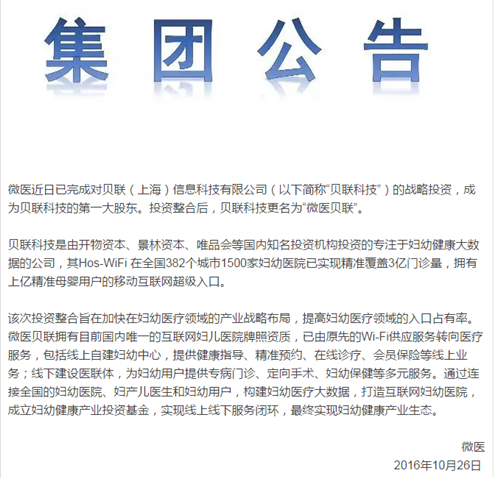
On the evening of October 26, VCBeat (WeChat ID: vcbeat) learned from WeDoctor’s official channel thatWeDoctorAnnounced the completion of a strategic investment in WeDoctor Beilian (Shanghai) Information Technology Co., Ltd. (hereinafter referred to as “Beilian Tech”), becoming its largest shareholder. Following the investment and integration, Beilian Tech was renamed “WeDoctor Beilian.”
Since February this year, news of WeDoctor’s investment in Beilian has been reported on platforms such as the healthcare sector media, 36Kr, and investment circles. With the establishment of “WeDoctor Beilian,” the matter has finally been settled.
The newly formed “WeDoctor Beilian” has once again joined forces with WeDoctor, aiming to establish China’s first internet-based maternal and child health hospital and become the world’s largest platform for such services. How will these two industry giants engage in deep collaboration? How will resources be shared? What are their future plans?
Since the birth of the Wuzhen Internet Hospital, “Internet hospitals” have sprung up across China like mushrooms after rain, with BAT companies actively partnering with renowned Grade 3A hospitals nationwide to establish their own Internet hospitals.
For instance, Alibaba Health and Wuhan Central Hospital established the Alibaba Health Online Hospital; The First Affiliated Hospital of Zhejiang University School of Medicine founded the FAHZU Internet Hospital; and WeDoctor partnered with Gansu Provincial Second People’s Hospital to establish the Gansu Internet Hospital. According to statistics from China.org.cn Finance, 17 internet hospitals have been officially launched this year.
To date, since founding WeDoctor in 2010, Liao Jieyuan has built Guahaowang, WeDoctor, and Internet Hospitals. He has been committed to driving transformation in China’s healthcare industry through information technology, connecting hospitals, physicians, and patients via the internet to facilitate efficient information sharing among them. By providing leading and highly trusted mobile medical services, he aims to establish a nationwide internet-based tiered diagnosis and treatment platform, as well as a mutually beneficial ecosystem for medical services and the health industry.
Through this collaboration with Weiyi Beilian, both parties aim to build the world’s largest maternal and child hospital platform and create the most extensive maternal and infant ecosystem by leveraging a business matrix centered on “maternal and infant health as the foundation and maternal and infant medical care as the core.”
In fact, Weiyi Beilian (Hangzhou) Maternal and Child Health Service Technology Co., Ltd. was established through the merger of the former Beilian (Shanghai) Information Technology Co., Ltd. and the maternal and child health division of Weiyi (formerly Guahaowang). Leveraging Hos-WiFi’s coverage of 300 million outpatient visits across 1,500 maternal and child health hospitals in 382 cities nationwide, it serves as a super-entry point for mobile internet access to hundreds of millions of precise maternal and infant users, effectively addressing the challenges of acquiring new users and mitigating the periodic churn of existing users in maternal and infant internet products.
It is reported that Weiyi Beilian has obtained the qualification for China’s sole internet license for maternal and child health hospitals. By leveraging Weiyi’s extensive resources of obstetricians, gynecologists, and pediatricians, along with its robust backend system for internet hospitals, Weiyi Beilian effectively connects maternal and child health hospitals, specialists, and expectant mothers. This strategy rapidly aggregates a large base of highly engaged users and medical experts. Capitalizing on its internet maternal and child health hospital platform, the company secures a dominant position and exclusive resources in the vertical sector of maternal and infant health, while achieving a true online-to-offline closed-loop ecosystem. Seizing this opportunity, it aims to capture diverse commercial opportunities across all segments of the maternal and infant business, including medical services, health consultations, e-commerce for pharmaceuticals and maternal/infant products, O2O services, online insurance, and mobile advertising targeted at parents.
Leveraging the scarcity of internet licenses for maternal and child health hospitals and precise online entry points for mother-and-infant services, both parties will directly enable WeDoctor Beilian to break through two major bottlenecks in corporate development—user acquisition and access to medical resources—thereby rapidly establishing a closed-loop ecosystem and achieving scalable expansion.
With the implementation of the “universal two-child” policy, the development of maternal and child health has been presented with rare opportunities as well as new challenges. The increase in the number of births and the rising proportion of advanced maternal age pregnancies have further exacerbated the contradiction between the total supply of maternal and child health service resources and the shortage of high-quality resources. Technologies such as the internet and big data are playing an increasingly important role in the fields of life sciences and healthcare.
Seizing this opportunity, WeDoctor Beilian established China’s first internet-based maternal and child health hospital. Adopting a “hub-and-spoke” model, it provides interactive health education, precise appointment scheduling, off-site waiting, one-stop in-hospital payment, online consultations, online follow-up visits, and shared health records for maternal and child health institutions and women and children across China. Here, the “hub” refers to China’s first internet-based maternal and child health hospital, while the “spokes” refer to local maternal and child health hospitals where patients reside. Leveraging WeDoctor’s platform and through centralized infrastructure development and open service delivery, it serves as an uninterrupted “digital bridge” linking maternal and child health institutions nationwide with hundreds of millions of women and children, thereby demonstrating the internet’s capacity to balance medical resource allocation and enable cross-regional healthcare services.
Previously, the predecessor of WeDoctor Beilian, Beilian Technology, whose full name was Beilian Technology (Shanghai) Information Technology Co., Ltd., was a maternal and infant health service platform. Established in February 2014, it targeted expectant mothers aged 25–40, starting from scenarios in maternal and child hospitals and addressing Wi-Fi needs, with the ultimate aim of tapping into the broader female consumer market.
Creating a mobile healthcare environment by deploying the HOS-WiFi commercial Wi-Fi system in maternal and child health hospitals. In 2015, Beilian Technology cumulatively signed contracts with 1,156 institutions, completed infrastructure construction in 940 hospitals, and achieved network connectivity in 662 hospitals.
To date, WeDoctor has connected with more than 1,900 key hospitals across China, serving over 117 million real-name authenticated patients and engaging more than 220,000 registered and contracted physicians, with cumulative service encounters exceeding 800 million.
WeDoctor Beilian possesses resources from offline physical hospitals specializing in obstetrics and pediatrics, while WeDoctor holds online expert resources. This merger essentially integrates the maternal and child health segments of Beilian and WeDoctor. By leveraging Beilian’s existing Wi-Fi coverage in obstetric and pediatric medical institutions and integrating it with WeDoctor’s Hospital Information System (HIS), the aim is to establish deeper connections with maternal and infant users. This strategy addresses the challenges of the Wi-Fi business being too asset-light, difficult to monetize, and unable to penetrate the clinical care process, thereby paving the way for future revenue streams in healthcare services, pharmaceuticals, insurance, and advertising.
Meanwhile, by leveraging mobile internet entry points, we connect three key user groups—pregnant and postpartum women, children, and women in general—to facilitate precise doctor-patient matching in the field of maternal and child health for maternal and child hospitals across China, based on region, symptoms, and needs. We are building an integrated internet platform for women’s and children’s healthcare, offering services such as online consultations, e-prescriptions, medication delivery, maternal and child health management, and doctor-patient relationship management, with the aim of becoming the world’s largest internet-based maternal and child healthcare platform.
On the physician side, build an online platform for team collaboration and consultations among doctors, where top experts provide genuine guidance to grassroots physicians to establish efficient collaborative teams and consultation mechanisms. This will facilitate the creation of a national map of obstetricians and pediatricians, a national maternal and child health records system, a national tiered diagnosis and treatment platform for women and children, and a maternal and infant industry chain platform.
Establish long-term follow-up health records for users. This involves creating pregnancy registrations, pre-conception examinations, delivery records, postpartum follow-ups, and newborn registrations from pregnancy through early childhood, as well as maintaining continuous health records of the newborn’s growth. These records facilitate precise, targeted health education and enable the real-time, interactive integration of large-scale health big data across China.
What advantages do these powerhouse alliances hold over other internet hospitals in the competitive landscape?
First, based on the signing of an exclusive strategic partnership, WeDoctor Beilian will receive priority access to WeDoctor’s maternal and infant traffic, along with strategic support including appointment registration resources, physician groups, expert resources, and internet hospitals; as well as system support for remote diagnosis and treatment and consultation systems, electronic prescription and online medical order systems, prescription review systems, electronic medical record systems, and settlement systems.
Second, establish a closed-loop service system and integrate an entire industry chain platform. From entry point to platform, user acquisition to transaction, achieve a comprehensive closed loop; based on the internet-based maternal and child health hospital, build a full industry chain service for mothers and infants.
Third, for precise C-end user coverage, targeting the exact maternal and infant population across China's Maternal and Child Health Hospitals and Women and Children's Hospitals, covering a total of 30 provinces, 380 cities, and 1,500 Maternal and Child Health Hospitals;
Fourth, it benefits from government support and multiple collaborative channels. For instance, it holds the only national license for an internet-based maternal and child health hospital, serves as the exclusive partner for the national “Initiative to Create High-Quality Waiting Environments,” and has established partnerships with numerous government and social institutions.
Fifth, Online-Offline Integration: The First Internet Hospital for Women and Children + The Premier Professional Medical Service Platform for Maternal and Infant Users + Providing Mobile Medical Services Throughout the Entire Outpatient Process. Leveraging extensive offline advantages, including partnerships with numerous hospitals and a robust ground promotion team, WeDoctor has over 10 million registered users in women’s and children’s health. It has established close connections and collaborations with more than 800 maternal and child health hospitals across China, contracted 40,000 obstetricians, gynecologists, and pediatricians, and provides online consultations with 10,000 specialists in these fields. The platform has facilitated 6 million online appointments and 1 million consultations in obstetrics, gynecology, and pediatrics.
Furthermore, it has access to expert resources, including Chief Physician Hua Keqin from the Obstetrics and Gynecology Hospital of Fudan University and Tian Qinjie from the Department of Obstetrics and Gynecology at Peking Union Medical College Hospital, and collaborates with five institutions such as the Women’s and Children’s Health Center of the Chinese Center for Disease Control and Prevention, the Maternal and Child Health Research Association, and the Chinese Midwives Alliance.
By integrating high-quality resources from both parties, the first Internet-connected Maternal and Child Health Hospital was established, along with an Internet-based Maternal and Child Health Hospital Platform, which is now being promoted nationwide. The initiative rapidly entered key regions including Shanghai, Beijing, Guangzhou, Sichuan, and Hunan, enabling 300 key maternal and child health hospitals to connect to the Internet-based Maternal and Child Health Hospital Platform.
Its revenue model primarily consists of five components: healthcare services, pharmaceuticals, insurance, membership, and advertising. Specifically, this includes medical service revenue from internet-based maternal and child health hospitals, such as online consultation fees, e-prescription issuance, and medication delivery charges; revenue sharing from prescription drug sales, along with sales of maternal and infant products and health supplements; health insurance operations and health data services; tailored diagnostic and treatment service packages and disease management solutions for members; and advertising placement and traffic distribution for maternal and infant brands, e-commerce platforms, and O2O services, leveraging big data in the maternal and infant sector.
Over the next 2–3 years, leveraging initial pilot models as a foundation, we will rapidly expand into third- and fourth-tier cities, bringing the total number of affiliated maternal and child health hospitals on board to 1,000. We will establish the first internet-enabled maternal and child health hospital and build an online platform for such institutions, promoting it nationwide. Our primary focus will be on entering the obstetrics and gynecology departments of public hospitals, integrating domestic public healthcare OB/GYN services onto the internet-based maternal and child health platform. In later stages, we will introduce more premium medical services to these hospitals by focusing on overseas healthcare and high-end medical products, thereby serving a broader target user base.