

Tencent Unveils Internet + Healthcare Ecosystem Strategy Focused on End-to-End Patient Journey
If the entire patient journey is divided into three stages—pre-consultation, during consultation, and post-consultation—Tencent and its partners are gradually building a comprehensive online healthcare service system, with the goal of establishing an efficient medical resource distribution platform.
On October 27, the 2016 National “Internet + Healthcare” Innovation and Entrepreneurship Conference, co-hosted by the Chinese Health Information Association and the Sichuan Provincial Health and Family Planning Commission, was held in Chengdu.Chen Guangyu, General Manager of Tencent’s Internet Plus Cooperation Business Unit, provided a detailed explanation of Tencent’s Internet Plus Healthcare strategy at this conference, which gathered leading authorities in China’s Internet Plus healthcare industry. The strategy focuses on building foundational capabilities in medical cloud computing, big data, and artificial intelligence; leveraging Tencent’s proprietary platforms—including WeChat Official Accounts, City Services, and WeChat Pay—to drive the implementation of mobile healthcare solutions; and fostering an Internet Plus healthcare ecosystem through three key dimensions: investment and collaboration, support for innovation and entrepreneurship, and open, win-win partnerships.
Tencent in the Internet+Our medical objective is to collaborate with partners to improve patient experience, enhance healthcare efficiency, and support the tiered diagnosis and treatment system.,” said Chen Guangyu.
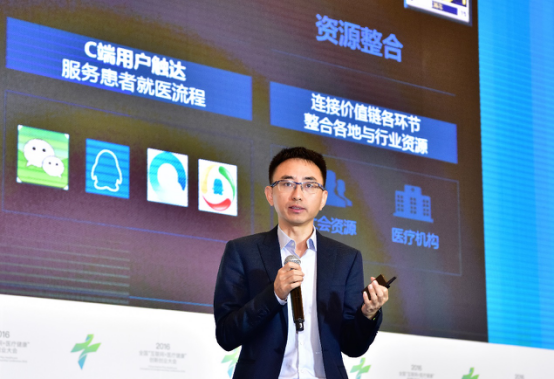
Chen Guangyu, General Manager of Tencent’s Internet Plus Cooperation Business Unit
Driven by the “Internet Plus” strategy, Tencent has accelerated its deployment in the “Internet Plus Healthcare” sector over the past year. In addition to launching its proprietary Tang Daifu blood glucose meter and Teng Ai Doctor platform to facilitate chronic disease management for diabetes and enhance doctor-patient communication, Tencent entered into a comprehensive strategic partnership on “Internet Plus Healthcare” with the Sichuan Provincial Health and Family Planning Commission in June this year. Subsequently, it collaborated with West China Second University Hospital of Sichuan University, a benchmark maternal and child health hospital in China, to establish an “Internet Plus Smart Hospital.”
Milestone Tencent “Internet + Healthcare” service platforms, including online appointment registration and medical insurance payment services, have also been gradually launched and put into operation this year. Coupled with strategic collaborations with partners such as Zhuojian, WeDoctor, Medlinker, DXY, ZhongAn Insurance, and JD Health, Tencent’s footprint in the “Internet + Healthcare” sector is taking shape.
Chen Guangyu pointed out that, driven by the dividends from the implementation of national policies such as the “13th Five-Year Plan” and “Healthy China 2030,” China’s Internet+ healthcare industry has entered a golden age, yet opportunities coexist with challenges. “The mismatch between supply and demand for medical resources, uneven levels of informatization coupled with fragmented data, and variable quality with low accuracy of medical information—these three issues represent the current pain points of the industry.” Chen Guangyu stated that Tencent aims to leverage its proprietary big data capabilities, user reach, and Internet+ resource integration strengths to collaborate with partners in building an efficient healthcare distribution platform.
According to reports, Tencent’s online appointment registration platform and medical insurance payment solutions have been implemented across China. Meanwhile, through collaborations with partners such as Zhuojian, WeDoctor, Medlinker, DXY, ZhongAn Insurance, and JD Health, Tencent is progressively enabling patients to access services including triage and referral, appointment scheduling, online consultations, commercial insurance payments, and medication purchases. By integrating chronic disease management via the Tang Dafu glucose meter and facilitating doctor-patient communication through Teng Ai Doctor, Tencent’s “Internet + Healthcare” strategy is gradually evolving into a healthcare distribution platform that covers the entire patient journey.
Chen Guangyu emphasized that Tencent will focus on its core strengths, empowering the “Internet Plus Healthcare” ecosystem through “connectivity.” In addition to forging deep collaborations with select investment firms via capital operations, Tencent will also promote the development of the “Internet Plus Healthcare” ecosystem by supporting innovation and entrepreneurship and fostering open, win-win partnerships. Notably, Tencent’s Makerspace will soon be established in Chengdu. In collaboration with the Sichuan Provincial Health and Family Planning Commission, Tencent will launch a targeted incubation program aimed at nurturing medical startup projects, with the goal of incubating ten outstanding entrepreneurial teams in the “Internet Plus Healthcare” sector each year.
Data shows that nearly 20,000 verified hospital official accounts operate on the WeChat public platform, with close to 100 million patients accessing professional medical services and information through these accounts. Among the more than 1,200 Grade A tertiary hospitals in China, over 80% have launched WeChat official accounts, and 60% further offer appointment and consultation services. Through WeChat Pay, thousands of hospitals across China provide convenient payment services to nearly 500,000 patients daily, significantly reducing queueing wait times. Tencent’s online registration service platform has covered 1,443 hospitals in 156 cities nationwide.
Chen Guangyu stated, “Behind these staggering figures lies immense potential for growth. By leveraging the foundational capabilities and solutions on the Tencent platform, our partners have joined us in creating numerous innovative models of ‘Internet Plus Healthcare.’”
Below is the original text of Chen Guangyu’s keynote speech at the conference:
It is widely recognized that Tencent is an internet company and a highly influential enterprise both in China and globally. Traditionally, Tencent has focused on social networking, media, and entertainment, while also pursuing extensive explorations in emerging technologies. However, there is limited public awareness of our endeavors in the healthcare sector. Today, I will share Tencent’s capabilities in healthcare and our efforts in building a comprehensive “Internet + Healthcare” ecosystem.
As we can see, relevant departments from the central to local governments attach great importance to the development of the future health industry, with public health becoming a focal point of societal concern. We also recognize that this sector still faces numerous pain points and significant public dissatisfaction. For instance, there is an imbalance between supply and demand, exemplified by the “three longs and one short” problem encountered when patients seek hospital care: long waiting times for registration, long queues, prolonged periods for payment and medication pickup, and short consultation/treatment times. This situation often stems from traditional resource allocation models; managing resources through such conventional approaches makes it difficult to achieve more effective distribution of medical resources, particularly at the primary care level.
Furthermore, in the information sector, we observe uneven levels of digitalization and persistent information silos. Data remains fragmented across various institutions and entities, failing to deliver genuine convenience for public services. Meanwhile, the internet is saturated with misinformation, making it difficult for patients to access truly valuable content. Current systems lack the intelligence required to provide personalized information tailored to individual patient needs, rendering such access still highly challenging.
▌ Can Tencent’s ecosystem address such issues?
Let us first examine how Tencent’s capabilities can facilitate the development of the “Internet + Healthcare” ecosystem. Traditionally, we have focused on social networking; however, through the accumulation of our business operations, Tencent has become the largest data platform in China’s internet sector. What kind of data does Tencent possess? As many may use products such as QQ, WeChat, and Qzone daily, 600 billion messages are sent via Tencent’s products each day. Meanwhile, 20 billion targeted internet ad recommendations are delivered through the Tencent platform daily, and over 1 billion images are shared, disseminated, and stored on the platform every day. These figures represent only Tencent’s internal data.
Meanwhile, we have numerous partners and investment firms that possess even more massive datasets. For instance, Tencent has invested in JD.com, a major player in China’s e-commerce sector; we have also invested in New Meituan-Dianping, Didi Chuxing, and 58.com.
On June 16 this year, Tencent released China’s “Internet Plus” Index, which serves to assess the status of “Internet Plus” integration across various sectors, cities, and provinces nationwide. This assessment is made possible primarily by our vast amount of macro-level data, enabling us to analyze the development level of “Internet Plus” capabilities in each industry and region.
Certainly, we can also extend this capability to the healthcare sector, empowering the industry to leverage internet and big data technologies for enhancement and transformation.
▌ What other capabilities do we have?
We also have tools that directly reach users. Why is it that when implementing tiered diagnosis and treatment and two-way referrals, patients often find them inconvenient to use? Hospitals have invested significant effort in promoting their own apps and developing tools for patient use, but these initiatives have not generated substantial market response.
Often, the reason is that it is already difficult for patients and users to re-engage with or download an app solely for a single, low-frequency function, learn how to use it, link their bank cards, and cultivate payment habits. All of these capabilities are readily available on the Tencent platform. We have already aggregated 800 million users on the WeChat platform and 800 million users on the QQ platform, along with over 400 million active users of WeChat Pay. These constitute a highly advantageous foundation and capability for engaging users in the future and fostering their adoption of the “Internet + Healthcare” industry.
We also possess the advantage of resource integration. In the healthcare sector, we observe extensive participation from a wide range of stakeholders, including medical institutions, developers, pharmaceutical and medical device companies, as well as patients and physicians, forming a highly vibrant ecosystem. This necessitates robust connectivity across all segments of the value chain, an area that internet platform companies like Tencent are actively exploring.
What can we achieve with these capabilities, and what value can we deliver to patients? Our goal is to enhance the patient care experience, reduce waiting times in hospitals, and provide more comprehensive services. What do we aim to accomplish for the industry? We seek to create opportunities for resource integration, helping more healthcare institutions and the broader medical sector improve efficiency by leveraging internet-based tools to manage internal data and resources.
We have a growing ecosystem of partners, including pharmaceutical companies and developers, who have been deeply engaged in this industry for years. They require access to Tencent’s shared capabilities and seek our empowerment—leveraging WeChat Pay, WeChat Official Accounts, and Tencent’s big data solutions. By opening up these capabilities to more industry practitioners, we aim to jointly foster a thriving ecosystem.
▌What professional capabilities within Tencent’s internet ecosystem can be opened up to partners?
Tencent has built up certain capabilities and made exploratory efforts, such as opening up its payment infrastructure. We have launched a medical insurance payment product on WeChat for our partners, enabling them to leverage WeChat’s platform of over 400 million users to facilitate convenient payment of medical insurance expenses.
Pilot programs are currently being rolled out at full speed in cities such as Shenzhen and Chengdu. We hope that in the near future, more users will not only be able to pay their out-of-pocket expenses via WeChat but also use their basic medical insurance to cover medical costs. Achieving this requires close collaboration with local Health and Family Planning Commissions, Departments of Human Resources and Social Security, and hospitals, leveraging our system development capabilities to enhance user experience.
Meanwhile, we are also exploring and experimenting in the field of medical AI. Internationally, we have observed that companies such as Amazon, IBM, and Google are making similar efforts. In China, we believe that companies like Tencent have the capability to develop AI products and capabilities truly suited to the Chinese market by leveraging China’s unique characteristics and conditions. We are also collaborating with local enterprises in Sichuan Province to conduct such explorations and trials.
We have also pursued numerous other initiatives, such as opening up the capabilities of WeChat’s City Services to allow more third-party companies to leverage our infrastructure. This enables them to extend their appointment scheduling services to a broader patient base on WeChat. Patients can now access more direct appointment booking services through Official Accounts or the City Services entry point on WeChat. This approach eliminates the need for patients to arrive at hospitals early in the morning to secure appointments with reputable hospitals, thereby reducing long waiting times for both registration and subsequent consultation, which could previously extend up to two hours.
By making such capabilities available to the public, we now enable many patients to easily schedule appointments from home and visit hospitals at their designated times. We have opened up our appointment scheduling platform and payment infrastructure. Meanwhile, we are also exploring a family doctor system built around chronic disease management, doctor-patient communication, and primary care services. In addition, Tencent has invested in numerous specialized companies, such as DXY and WeDoctor Group, which serve as key components of Tencent’s future open healthcare ecosystem.
Therefore, we emphasize empowering the pharmaceutical ecosystem, adhering to Tencent’s longstanding principle of openness. In the past, Mr. Ma has consistently stressed that Tencent entrusts half of its lifeline to its partners. We aim to rebuild a new Tencent through openness. Over the years, we have seen developers earn more than RMB 10 billion in revenue from the Tencent platform annually.
In the future, we believe that in broader sectors such as healthcare, education, and finance, more developers will achieve greater returns through the Tencent platform. This is our vision for the future. We will open up WeChat’s capabilities, payment solutions, big data analytics, and cloud computing services to ecosystem partners and developers across industries in need, enabling them to leverage these capabilities more effectively.
Within the entire Tencent ecosystem, we currently observe nearly 20,000 certified hospitals that have launched official accounts on WeChat and QQ to connect with patients. Approximately 100 million patients utilize these hospital official account services on Tencent platforms such as WeChat and QQ. Furthermore, 80% of Grade A tertiary hospitals across China have established their own official accounts, with 60% of these accounts already offering practical features and services such as appointment registration, electronic medical record inquiries, and point-of-care payment. Additionally, we see 500,000 patient visits per day on Tencent platforms using WeChat Pay and QQ Pay for medical expenses, eliminating the need for traditional offline queuing for payments.
Meanwhile, we have also observed that 1,433 hospitals across 156 cities in China have enabled appointment registration capabilities on WeChat. By leveraging WeChat City Services to open up appointment slots, patients can directly access registration services within the WeChat City interface.
This dataset appears massive, but what is even more impressive is the ecosystem behind it: tens of thousands of hospital WeChat Official Accounts, several thousand Grade A tertiary hospitals, hundreds of thousands of daily payment transactions, and over a thousand hospitals offering city services via WeChat. Underpinning this is a vast developer industry comprising numerous development firms, vendors, and independent developers. Through their own efforts and by leveraging WeChat’s open platform and APIs, they contribute to the prosperity of this ecosystem. Meanwhile, many hospitals are utilizing capabilities provided by Tencent to deliver more convenient services to patients.
West China Second University Hospital in Chengdu is a strategic partner that Tencent has just signed. After adopting Tencent’s WeChat products, the hospital has achieved a 40% rate of online patient registration, with the daily number of users registering via the Tencent platform reaching 3,000 to 4,000. This represents a future-oriented trend.
We discuss how to empower the industry and the “Internet Plus” ecosystem, with Tencent having conducted numerous beneficial explorations in Sichuan Province. Over the past year or so, we have collaborated with the Sichuan Provincial Health and Family Planning Commission and medical institutions at all levels in Sichuan to implement Tencent’s various initiatives in the province. For instance, we piloted a big data platform for chronic disease management in Sichuan. Additionally, West China Second University Hospital established an Enterprise WeChat account and a WeChat-based management platform, enabling its physicians to conduct online consultations with patients through the Enterprise WeChat account.
It is not only through our third-party platform that internal information management can be achieved; it can also be realized via the hospital’s own enterprise account. For instance, doctors at West China Second University Hospital can use its enterprise account to order food delivery, make meal reservations, clock in for performance evaluations, submit expense reimbursements, and more. This shifts the hospital’s entire information system toward a lighter, more open platform, leveraging such capabilities to help hospital informatization reach a new level.
We are continuing to explore various avenues of collaboration with Sichuan Province, including the launch of a targeted incubation and acceleration program for medical industry innovation and entrepreneurship at Tencent’s Makerspace in Chengdu. Several companies have already joined our startup platform. We aim to provide not only capabilities but also tangible support to these enterprises, helping more players in the “Internet + Healthcare” sector build expertise and gain experience, thereby fostering the collective prosperity of this ecosystem.
Tencent’s foray into the “Internet + Healthcare” sector is just beginning, with much left to explore and achieve. We aspire to rise to the occasion and inject new momentum into “Internet + Healthcare” and the Healthy China initiative.