

The Affordable Care Act at Six Years: Outcomes and Challenges (Part II)
In late October 2016,Federal FundsReleased research findings on the Affordable Care Act (ACA). The study aimed to compare the growth in costs of employer-sponsored health insurance before and after 2010, when the ACA was enacted, and to contrast these cost changes with changes in employee income. The article collected and analyzed data from the Medical Expenditure Panel Survey (MEPS) published between 2006 and 2015, summarizing cost trends over this ten-year period.
The Commonwealth FundIt is a private foundation in the United States, founded in 1918, and has been active in fields such as healthcare policy since its establishment. Its mission is “to promote high-performance healthcare systems, focus on socially disadvantaged groups and the elderly, achieve higher health insurance coverage, and improve the quality and efficiency of medical care.”
VCBeat (WeChat ID: vcbeat) has compiled the key findings of this study to provide insights into the achievements and shortcomings of U.S. healthcare reform. Due to the extensive content, the article is published in two parts. In Part I, we observed that following the passage of the Affordable Care Act (ACA), the growth rates of contributions to health insurance plans by both employers and employees slowed down. Meanwhile, the share of premium payments in individuals’ income relatively increased. Below, let us examine in detail the changes in health insurance deductibles before and after the enactment of the ACA.
Through this report, you will gain key insights into the following perspectives:
1. Six years after the implementation of the ACA, although the goals of the act have not yet been achieved, has the ACA still caused businesses and employees to face higher premiums and deductibles? Has the cost of healthcare across the nation decreased since the implementation of the ACA?
2.Why Do Many Insured Americans Still Find Healthcare Costs Prohibitively High?What Are the Fundamental Drivers of Premiums in the Health Insurance Market?
3. Since more Americans obtain health insurance coverage through their employers, how have employer-sponsored premiums changed since the implementation of the ACA? What is the situation in each state?
4. What is the rate of increase in premiums paid by employees, and are employees required to pay more for family health insurance? Has the premium growth rate declined in most states?
5. Among which income group in the United States has the health insurance deductible grown the fastest? What is the proportion of household health insurance out-of-pocket maximums and deductibles relative to income?
Over the past decade, both the number of employer-sponsored health insurance plans with deductibles and the size of these deductibles have increased. In 2015, 85% of single-coverage health insurance plans included a deductible, compared to only 66% in 2006 (see Table 3).
In 14 states (Alaska, Idaho, Indiana, Iowa, Kansas, Missouri, Minnesota, Montana, Nebraska, North Dakota, Oklahoma, South Carolina, South Dakota, and Washington), 95% or more of individual health insurance plans include deductible provisions. Hawaii is an exception in this regard; in 2015, only 44% of health insurance plans in the state included deductibles.
Table 3. Percentage and Average Amount of Deductibles in Single-Coverage, Employer-Sponsored Health Insurance Plans Across States in 2006, 2010, 2013, 2014, and 2015

Note: Deductible data are sourced from insurance policies held by employers in the U.S. private sector.
*Indicates a statistically significant difference from the national average (p < 0.05).
Data source: Medical Expenditure Panel Survey—Insurance Component, 2006, 2010, 2013, 2014, and 2015.
High deductibles are the norm for employer-sponsored health insurance plans. In 2015, the average deductible for single-coverage health insurance plans nationwide reached $1,541, more than double the $714 recorded in 2006 (see Figures 6 and 7, and Table 3). In 2006, the average deductible in every U.S. state was below $1,000; however, by 2015, all states except Hawaii ($986) had average deductibles exceeding $1,000. The average deductibles in Maine and Montana even surpassed $2,000.
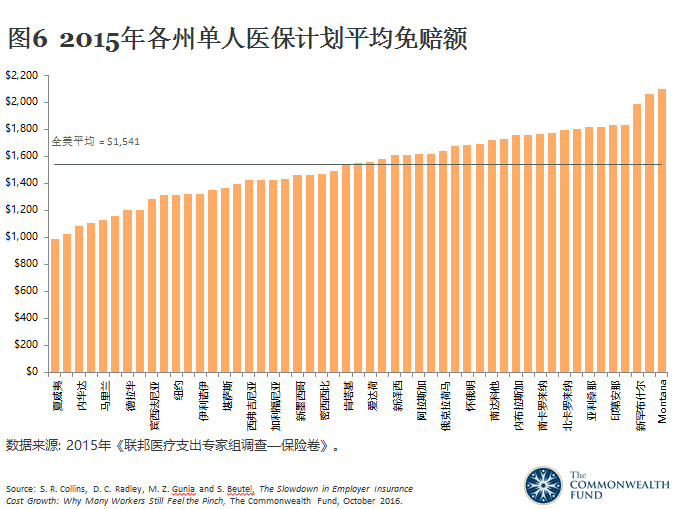
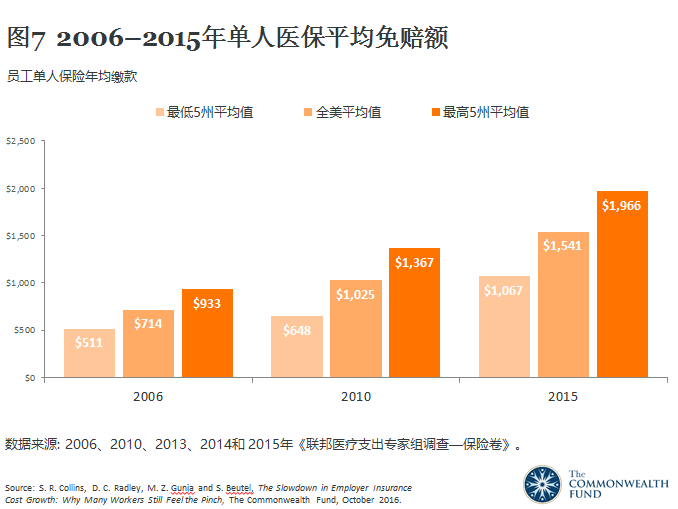
Nationwide, since 2010, although the average annual growth rate of deductibles has slowed compared to the five years prior to the enactment of the Affordable Care Act (ACA), the actual figures remain high. Between 2010 and 2015, the average annual growth rate of deductibles for individual health insurance plans was 8.5%, whereas it was 9.5% between 2006 and 2010 (see Figure 1, Table 3).
In 27 states, deductibles grew more slowly in the five years following the passage of the Affordable Care Act (ACA) than in the five years preceding it, while in 22 states and the District of Columbia, their growth accelerated. There was substantial variation across states over this decade. For example, although Hawaii had the lowest deductibles for single-person health insurance plans nationwide, it experienced a shift from an average annual decline of 4% between 2006 and 2010 to an average annual increase of 13.7% between 2010 and 2015. In contrast, Maryland’s deductibles grew at an average annual rate of 17.1% before the ACA, but slowed significantly to a 4% annual increase after its passage.
Similar to premium contributions, deductibles are accounting for an increasing share of employee income. In 2015, the average deductibles for single and family health insurance coverage accounted for 4.2% of the median household income in the United States, nearly double the 2.3% recorded in 2006 (see Figure 5 and Table 5 in the previous section). That year, the deductible as a percentage of median income ranged from 2.3% in Maryland to 5.7% in Mississippi. There were 11 states where this proportion was 5% or higher: Arizona, Florida, Georgia, Indiana, Maine, Montana, New Mexico, North Carolina, South Carolina, Tennessee, and Texas.
When adding premium contributions and deductibles, the average potential out-of-pocket medical cost burden for U.S. families with employer-sponsored health insurance was $6,422 in 2015, significantly higher than the $3,531 recorded in 2006 (see Figure 8, Table 4). This means that in 2015, middle-income households spent 10.1% of their income on health insurance and medical care, whereas this figure was only 6.5% ten years earlier (see Figure 5, Table 5).
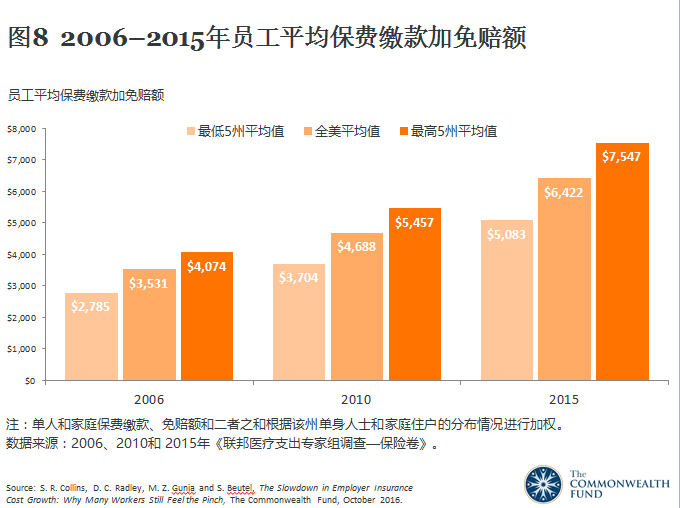
Table 4 Average Employee Health Insurance Expenditures in 2006, 2010, and 2015: Premium Contributions + Deductibles

*Individual and family premium contributions, deductibles, and the sum of both are weighted based on the distribution of single-person households and family households in the state.
Data sources: “Insurance Cost Sharing” from the Medical Expenditure Panel Survey–Insurance Component (2006, 2010, and 2015); “Distribution of Household Types and Income” from the Current Population Survey (2006, 2007, 2010, 2011, 2014, 2015, and 2016).
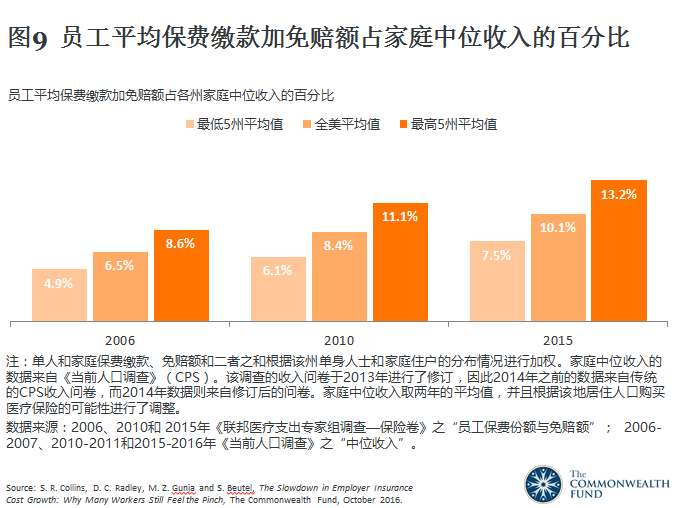
In 2015, the combined share of premiums and deductibles relative to income was 12% or higher in seven states (Arizona, Florida, Mississippi, New Mexico, Oklahoma, Tennessee, and Texas). Employees in Mississippi bore the highest average burden, at 14.7% of median income; households in the District of Columbia and Massachusetts had the lowest costs, at 6.8% and 7.3%, respectively (see Table 5).
Over the past decade, disparities in health insurance across states have gradually widened, exacerbating inequalities in household medical cost burdens. In 2006, the difference between the five states with the highest burdens and the five states with the lowest burdens, in terms of the proportion of premium contributions and deductibles to median household income, was 3.7 percentage points (8.6% vs. 4.9%) (see Figure 9, Table 5).
By 2015, this disparity had widened to 5.7 percentage points (13.2% vs. 7.5%). Among the states with the highest burden in 2015—Arizona, Florida, Mississippi, Oklahoma, and Texas—all except Arizona were located in the Southeastern or Southern United States. In contrast, the states with the lowest burden—Hawaii, Maryland, Massachusetts, Pennsylvania, and the District of Columbia—were distributed across various regions of the country.
The Five States with the Heaviest Medicare Burden: Arizona, Florida, Mississippi, Oklahoma, and Texas
Households in states with the highest financial burden tend to share two characteristics: fewer generous health insurance plans (Table 3) and lower incomes (Table 6). Although total premiums across states are at or below the national average (Tables 1a and 1b), employees’ contribution shares for both single and family coverage exceed the national average, with the exception of single coverage in Arizona (see Tables 2a and 2b).
Therefore, with the exception of Arizona, the five states with the highest burden all rank among the top eight nationwide in terms of household premium contributions, with Oklahoma ranking second nationally (Table 2b). Four of these five states (Arizona, Florida, Oklahoma, and Texas) also rank among the highest in the nation for individual health insurance deductibles (see Table 3), while having below-average household incomes; Mississippi, in particular, has the lowest household income in the nation (see Table 6).
Table 6 Median Household Income by State in 2006, 2010, and 2015
 * Data on median household income are sourced from the Current Population Survey (CPS). The income questionnaire of the CPS was revised in 2013; therefore, data prior to 2014 are derived from the traditional CPS income questionnaire, while the 2014 data are based on the revised questionnaire. Median household income is calculated as the two-year average and adjusted for the likelihood of residents in the area having health insurance coverage.
Data source: Current Population Survey, 2006, 2007, 2010, 2011, 2014, 2015, and 2016.
States with the Lowest Medicare Burden: District of Columbia, Hawaii, Maryland, Massachusetts, Pennsylvania
For the states with the lightest burden, the situation is exactly the opposite: health insurance plans are more generous, and median household incomes are higher. Among four of these jurisdictions (Maryland, Massachusetts, Pennsylvania, and the District of Columbia), three rank among the highest in the nation for median household income (see Table 6). Meanwhile, the average individual deductible for health insurance in all five of these states is below the national average (see Table 3), with three states (Hawaii, Massachusetts, and Pennsylvania) ranking among the lowest nationwide for family premium contributions (see Table 2b). However, in terms of the proportion of employee family premium contributions to income, Maryland ranks first in the nation at 35%.
Hawaii’s low-cost employee health insurance stems from a mandatory statute enacted in 1974, which requires employers to provide health insurance coverage for their employees. Regardless of company size, employers must offer insurance to all employees working more than 20 hours per week, with the employees’ share of health insurance costs capped at no more than 1.5% of their income. Consequently, the ratio of employee health insurance costs to income in Hawaii’s employer-sponsored health plans is the lowest in the United States.
Research findings explain why many insured Americans still perceive healthcare costs as prohibitively high. Although the growth rates of employee premium contributions and overall premiums have slowed in recent years, health insurance deductibles have continued to rise, with their annual growth rate significantly outpacing that of premiums. Furthermore, despite recent signs of recovery, median household income continues to lag behind the rising cost of health insurance.
Under these circumstances, middle-income families are compelled to allocate an increasing share of their household budgets to healthcare. The situation is even more severe for employees residing in regions with less generous health insurance plans and lower median incomes. If an employee’s health insurance deductible exceeds their income, they will struggle to access necessary medical services; even if they do receive such care, the resulting medical bills will quickly surpass their asset levels.
In the future, sustained income growth will help alleviate the health insurance burden on low- and middle-income households; meanwhile, innovative designs within health insurance plans themselves can encourage individuals to access the medical services they need. Furthermore, public policy solutions addressing current issues—such as “inadequate family health insurance coverage” under the Affordable Care Act (ACA)—can also mitigate the problem of excessive out-of-pocket costs in individual health insurance plans.
Ultimately, the fundamental driver of premiums in the health insurance market is the growth rate of underlying medical costs; therefore, slowing the growth of system-wide healthcare expenditures is critical to alleviating the health insurance burden on the government, businesses, and individuals.
Please refer to the tables in this article in conjunction with Part I.
Related Reading:
In-Depth Report: Six Years of the U.S. Affordable Care Act—Successes and Failures (Part I)