

CEC Softinfo CEO You Xiaoming: The Future Healthcare Industry Will Surpass Real Estate in Value
At the 2016 National “Internet + Healthcare” Innovation and Entrepreneurship Conference, hosted by the Chinese Health Information Association and the Sichuan Provincial Health and Family Planning Commission,The Provincial Health and Family Planning Commission, the China-US Health Summit Organization, Sichuan Provincial People's Hospital, and Proactive Healthcare Management Co., Ltd. formally signed the "Strategic Cooperation Agreement on Promoting a People-Centered Proactive Health Service Model," followed by the Provincial Health and Family Planning Commission, the China-US Health Summit,China Electronics Technology Software & Information Service Co., Ltd. and Sichuan Railway Investment Information Technology Industry Investment Co., Ltd. also signed the "Strategic Cooperation Agreement on Promoting Active Health Big Data,"The signing of the two agreements marksChina's First Proactive Health Industry Alliance.
Sichuan has become a national hub for medical innovation and entrepreneurship in China. From the Sichuan Provincial Committee of the Communist Party of China and the Sichuan Provincial People’s Government, to state-owned enterprises, local companies, capital investors, and international experts, all have converged in Sichuan. The Active Health Alliance serves as a key driver of medical innovation and entrepreneurship in the province.
It is understood that the Proactive Health Alliance is committed to innovating Sichuan’s local healthcare model. By studying and integrating advanced transformation experiences from both domestic and international sources, the Alliance actively advocates for institutional, model, and technological innovation. Adhering to principles of openness, integration, co-construction, and sharing, it aims to build a forward-looking “Proactive Health” service system, thereby supporting the development of the health industry in Sichuan and across China.
Taking this opportunity, VCBeat(WeChat ID: vcbeat)A series of related articles will be launched, providing in-depth coverage of the Proactive Health Industry Alliance, its member companies, and experts, to maintain ongoing attention on the progress of medical innovation and entrepreneurship in Sichuan. Please continue to follow VCBeat.
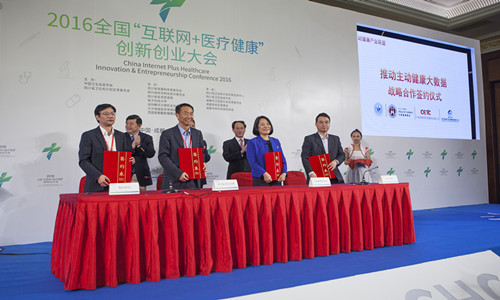
Signing Ceremony of the Proactive Health Industry Alliance
China Electronics Technology Software & Information Services Co., Ltd. has consistently fulfilled its responsibilities as a central state-owned enterprise and a high-tech military-industrial company, leveraging its strengths in controllable information and information security. By selecting healthcare innovation as a strategic breakthrough, the company aims to provide reliable family doctors for the general public and deliver proactive health services to the entire population, thereby embarking on a new journey in proactive health characterized by international cooperation, service innovation, and technological innovation.
So, what major initiatives has CETC Software & Information Service Co., Ltd. (hereinafter referred to as “CETC SoftInfo”) undertaken since joining the Active Health Industry Alliance? What contributions has it made to medical innovation in Sichuan Province?
VCBeat (WeChat ID: vcbeat) conducted an exclusive interview with You Xiaoming, General Manager of Dianke Ruanxin, discussing the company’s strategic layout in the healthcare sector and its applications of big data.
As more enterprises and capital enter the “Internet + Healthcare” sector, local governments are also actively working to improve the healthcare experience for residents. You Xiaoming, CEO of Dianke Ruanxin, told reporters that his company has long focused on the healthcare sector and is primarily deploying and penetrating the health industry through the following two areas.
First, we proactively introduce international resources and deepen international cooperation. Since 2012, CETC Software & Information (CETC SoftInfo) has collaborated with leading international institutions such as the China-US Health Summit, the University of Utah, and Harvard Medical School. We have introduced a patient-centered home healthcare service model that has been successfully promoted in North America for over 40 years, and have established a mechanism for the continuous research and translation of primary healthcare service transformation.
Secondly, drawing on international experience, we have vigorously promoted service and technological innovation. Since 2013, CETC Software & Information Technology has launched pilot programs in Chengdu, Shanghai, Dalian, and other cities, fully integrating advanced international concepts and service models. Through integrated innovations in systems, services, and technology across areas such as tiered diagnosis and treatment, family doctor contracting, health management, chronic disease management, patient activation, health insurance cost containment, and traditional Chinese medicine (TCM) robotics, the initiative has effectively improved the quality and efficiency of healthcare services provided by medical institutions. It has also enhanced residents’ health outcomes and sense of gain, while boosting physicians’ professional identity and income levels. As a result, it has achieved widespread influence and rapid replicability across China.
Although Dianke Ruanxin has accumulated years of practical experience in the healthcare sector and achieved certain results in specific areas, thereby meeting some health-related needs, the healthcare industry encompasses an exceptionally broad scope. In a sense, its level of informatization lags significantly behind that of other sectors such as finance. Furthermore, the industry’s value chain is extensive, making it impossible for any single institution or enterprise to address all requirements independently. Instead, it demands the convergence of top talents, innovative collaboration, and coordinated development.
Therefore, by joining the Proactive Health Industry Alliance, we will work together to build a proactive health ecosystem that encompasses international technology transfer, training and education, consulting services, pharmaceuticals, medical devices, and next-generation information technologies—particularly medical artificial intelligence centered on big data. Together, we will construct a GBC (Government-Business-Consumer)-centric healthcare industry internet ecosystem serving governments, industries, and residents, thereby stimulating societal vitality and better meeting the nation’s health needs.
The "Strategic Cooperation Agreement on Promoting Big Data for Proactive Health" essentially establishes an industrial alliance focused on big data, with members including the Sichuan Provincial Health and Family Planning Commission, the China-US Health Summit, Sichuan Railway Investment Group, and Sichuan Unicom. These parties share resources to jointly advance the development of the Proactive Health Industry Alliance. For instance, the China-US Health Summit primarily facilitates the integration of Chinese and American healthcare resources; Sichuan Railway Investment Group serves as an investment entity; and Sichuan Unicom provides support for information network infrastructure.
According to You Xiaoming, the establishment of the Active Health Alliance was achieved through concerted multi-party efforts to jointly build a GBC-based foundational platform. In this context, “G” refers to the government, which provides historical data; enterprises mine these data and integrate them with real-time generated data, thereby enabling data flow and interaction. Only by unlocking the fluidity and interactivity of data can we effectively enhance data intelligence and truly address underlying issues. This approach offers significant reference value for the government, and indeed the entire nation, in formulating health and healthcare policies, including healthcare reform policies, allocation and scheduling of medical resources, and cost containment within medical insurance schemes.
However, the government’s role in this context is to guide and leverage resources, requiring collaboration from enterprises—referred to as “B.” This approach is industry-oriented, with hospitals serving as the primary entities in the healthcare sector. The ecosystem revolves around hospitals, encompassing pharmaceuticals, medical devices, and industries that supply high-tech products to hospitals. Technologically, it leverages new and powerful computing capabilities—cloud technology—to support various information processing tasks, particularly image data processing, including data integration, cleaning, and transformation. This enables the restructuring of healthcare service models, improving healthcare quality and compensating for the shortage of medical professionals.
“We hope that the GBC model can profoundly transform or facilitate the transition of the traditional healthcare industry.”
Globally, the healthcare sector lags in health informatization, with data silos persisting across hospitals. For instance, medical images taken at Sichuan Provincial People’s Hospital may not be accepted for diagnosis by West China Hospital. Given the numerous urgent challenges in healthcare, signing the “Strategic Cooperation Agreement on Promoting Big Data for Proactive Health” not only aligns with China’s national Healthy China strategy but also leverages the complementary resource advantages of participating enterprises.
How to Enhance the Analytical Capabilities of Healthcare Big Data?In You Xiaoming’s view, the key lies in improving the algorithms used for healthcare big data. From a data research perspective, synthetic data can be employed to simulate and evaluate the fundamental capabilities of these algorithms. From a data application standpoint, collaboration with data holders is essential. For instance, by partnering with West China Hospital and obtaining access to their data for secondary development, one can pursue a dual approach: conducting algorithmic simulations using synthetic data, while simultaneously collaborating with hospitals or health institutions to analyze user-generated data and address user needs. This strategy not only helps solve practical problems but also serves to validate the authenticity and reliability of the algorithms.
Medical data refers to the information generated throughout the diagnosis and treatment process, including patient demographics, electronic medical records (EMR), clinical data, medical imaging data, healthcare management and economic data, as well as data from medical devices and instruments. Centered on patients, it has become a primary source of healthcare information. The ongoing digitization of this information not only expands hospital database capacity but also plays a significant role in disease and patient management, control, and medical research, thereby delivering substantial value.
These medical big data primarily play a positive role in the following aspects:
(1) Serving Residents. The Resident Health Guidance Service System provides precision medicine and personalized health care guidance, ensuring continuity of services across hospitals, communities, and online platforms. For instance, it offers intervention, management, health early warning, and health education (including subscription to and push notifications for healthcare plans) for chronic diseases such as cardiovascular diseases, cancer, hypertension, and diabetes. Meanwhile, it reduces patient hospital stays and emergency department visits, while increasing the proportion of home-based care and outpatient appointment bookings with physicians.
(2) Services for Physicians. Clinical decision support, such as medication analysis, adverse drug reactions, disease complications, correlation analysis of treatment efficacy, and antibiotic utilization analysis; or the development of personalized treatment plans.
(3) Supporting scientific research. This includes disease diagnosis and prediction, statistical tools and algorithms for improving clinical trial design, and the analysis and processing of clinical trial data, such as identifying disease-susceptibility genes and extreme phenotype populations for major diseases, and providing optimal treatment pathways.
(4) Service Management Agencies. Standardized medication evaluation, management performance analysis; prevention and intervention measures for epidemics and acute diseases, along with their evaluation; public health monitoring, payment (or pricing), optimization of clinical pathways, etc.
(5) Public Health Services. This includes monitoring and early warning of health hazards, online platforms, and community services.
As a populous province with abundant medical resources and significant radiating influence across western China, Sichuan is poised to become one of the leading provinces in China for healthcare transformation.
In 2015, while studying healthcare informatization in China, Dianke Ruanxin discovered that a robust service model was essential to fully realize the value of healthcare IT. An analysis of the domestic landscape revealed a significant lack of theoretical frameworks in this area.
You Xiaoming introduced that Dianke Ruanxin had drawn on the patient-centered home healthcare model, which has a development history of over 40 years in North America and has been successfully promoted there. The company aimed to introduce this model to China and integrate it with innovations in the national primary healthcare system. At that time, there were only 10 pilot programs nationwide for the transformation of general practitioner service models, and Wuhou District in Chengdu was one of them.
“After about a year of discussions with the leaders of the Wuhou District Government and the Health and Family Planning Commission, they also recognized that U.S. healthcare experience offers valuable insights for China’s next stage of medical development, so we chose to launch our initiatives in Wuhou District.”
Meanwhile, in terms of information technology innovation, CETC’s strategic allies include IBM and NantHealth, a U.S.-based electronic healthcare platform service provider. The company is currently preparing to invest in the construction of a first-class domestic industrial base for the transformation of primary healthcare services in Wuhou District. The Wuhou model for primary healthcare services is a municipal-level model that will be replicated in other prefecture-level cities and eventually expanded nationwide.
In fact, in Dalian, they also established the first information service platform for a medical consortium in the southern Liaoning region, pioneering a model within the tiered diagnosis and treatment system known as “1+13+X.” This model comprises one tertiary Grade A hospital, 13 regional hospitals, and X community health service centers, forming a medical consortium that covers a population of approximately 2 million. This serves as the foundation for the entire tiered diagnosis and treatment system.
In addition, according to You Xiaoming, the development of the TCM robot is being conducted in collaboration with Shanghai University of Traditional Chinese Medicine. The TCM robot, developed by Dianke Ruanxin using big data technology, primarily aims to standardize traditional Chinese medicine practices in the four diagnostic methods: inspection, auscultation and olfaction, inquiry, and palpation.
It is well known that every TCM practitioner or graduate of a TCM program requires years of clinical experience to achieve a high level of therapeutic proficiency. With the aid of TCM robots, standardized diagnostics can be achieved, reaching the competency level of attending and associate chief physicians. Furthermore, TCM can be leveraged for health management, including post-operative and post-consultation rehabilitation care. This represents a significant breakthrough: once TCM is standardized and quantified, it becomes more accessible and beneficial to patients. Therefore, Dianke Ruanxin’s strategy in the TCM sector involves a dual approach: developing TCM robots while simultaneously building a professional TCM team to establish a cognitive TCM platform grounded in data and knowledge.
In fact, certain sectors of internet healthcare have already begun to yield benefits, with its output value projected to exceed RMB 16 trillion by 2030. Its industry prospects and economic value surpass those of any other sector, even outperforming real estate. This is because it will connect numerous industries in the future, optimize industrial structures, allocate resources across various social sectors more rationally, alleviate social contradictions, and enable the general public to truly experience many high-tech products, which holds significant importance!