

Gene Testing Meets Insurance: A Win-Win Model for Personalized Health Protection
The penetration of the internet into the healthcare sector has fostered exchange and collaboration across various healthcare subfields. On another front, with national economic growth and rising consumption levels, health awareness has intensified, leading more people to embrace commercial insurance. Meanwhile, as gene technology rises and develops, the public is no longer content with merely “passive diagnosis” but increasingly seeks proactive “risk prediction.” In response, a new insurance model—combining genetic testing with insurance—has emerged. Currently, more than a dozen companies have partnered to launch this innovative model. Below are the relevant collaboration formats that VCBeat (WeChat ID: vcbeat) has learned from biomedical mutual-aid platforms:
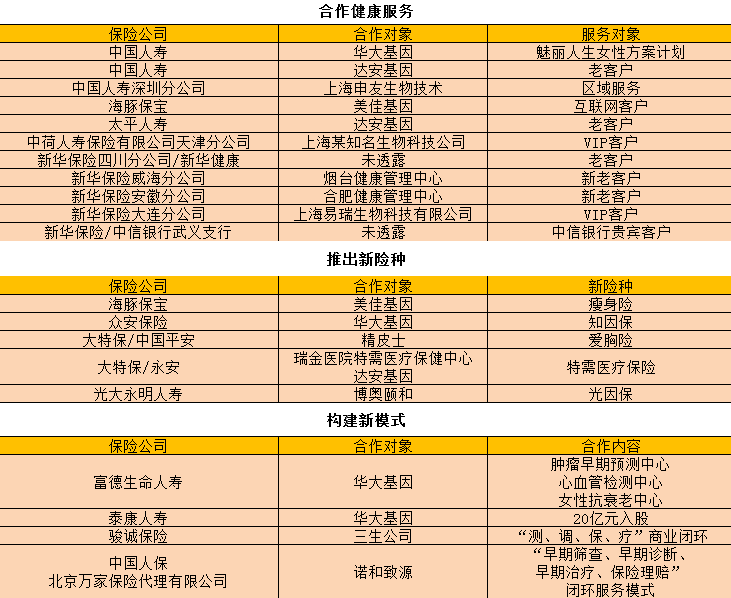
Additionally, iGene has partnered with companies such as Shenzhen Ciming Health Checkup, Pacific Insurance, and People’s Insurance Company of China to promote the establishment of a new health model in China. Ping An Health Insurance will also collaborate with BGI Genomics.
How the "Genetics + Insurance" Model Operates
To understand how this model works, a VCBeat (WeChat ID: vcbeat) reporter interviewed Zheng Xiaolei, Director of the Health Management Division at Datebao. Using Datebao as a case study, this article analyzes the operational mechanics of the “genetics + insurance” model.
Zheng Xiaolei told a reporter from VCBeat (WeChat ID: vcbeat), “This testing model allows users to place orders online and conveniently complete genetic testing at home without leaving their houses. They can also receive electronic test reports and detailed interpretations online, making it a purchasing and experience model that is quite popular among internet users.”
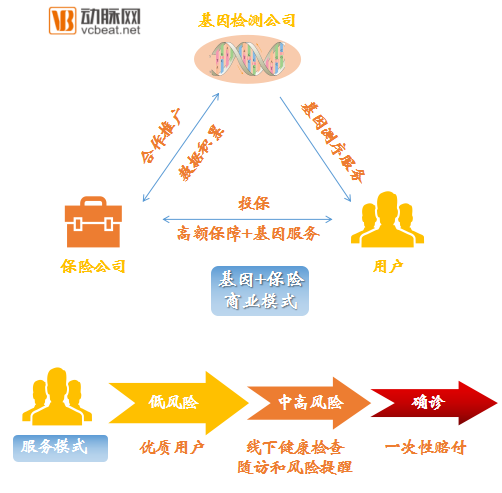
Genetic sequencing companies leverage advanced technologies to provide genetic testing services, while insurance companies offer user platforms. By combining insurance coverage with genetic testing programs, a substantial benefit package is provided to users upon confirmed diagnosis. Meanwhile, the insurer covers the intermediary costs of genetic testing, allowing users to obtain both an authoritative genetic test and high-coverage insurance protection at a relatively low price.
Zheng Xiaolei introduced VCBeat’s (WeChat ID: vcbeat) service model to its reporter, noting that for users with different risk profiles, Datbao provides tailored follow-up services.
1. Low-risk users: These users are also considered high-quality by insurance companies. The risk of illness is relatively low, and the probability of claims is correspondingly lower. In the future, these users only need to maintain a healthy lifestyle and undergo regular health check-ups on schedule;
2. Medium- to High-Risk Users: For users identified as medium- to high-risk, Dataibao also provides offline health examinations. For instance, with the breast cancer insurance plus genetic testing product, if a user’s test results indicate a medium- to high-risk status, Dataibao will provide a complimentary specialized women’s health examination, including tumor marker testing and other items. If the test results are normal, the company will conduct follow-ups with the user and provide comprehensive reminders on risk prevention.
3. High-Risk Users: The company provides users with expert referral services, directly arranging one-on-one consultations with specialists. If a diagnosis is confirmed and the user meets the insurer’s claims policy, the company will provide a lump-sum payment based on the coverage amount of the previously purchased insurance.
Guiding users from start to finish in identifying issues, providing proper direction, and helping them overcome challenges and find solutions. Zheng Xiaolei stated, “Treating these types of diseases is quite challenging, requiring patients to adopt a proactive attitude.” The company has progressively advanced from preventive screening to comprehensive medical diagnostics. In the future, it will gradually launch health management services to enable proactive interventions, encouraging users to lead healthier and better lives.
Facilitating Insurance Company Involvement in the Medical Process
Zheng Xiaolei stated, “For insurance companies, the emergence of this model will offer a stronger selling point while also enhancing interaction between insurers and policyholders.”
For traditional insurance, customers typically interact with insurers only when filing claims. From the customer’s perspective, purchasing an insurance policy simply provides additional coverage, with minimal ongoing engagement with the insurer, leaving insurers unable to effectively manage customers’ health. However, by incorporating genetic testing, customers can gain a better understanding of their individual disease risks, enabling insurers to provide tailored follow-up services based on risk stratification. In other words, insurers can become actively involved in the health management process. If genetic testing reveals a higher-than-average probability of developing certain diseases, insurers will advise customers to adopt healthier lifestyles, undergo routine disease screenings, and enhance their awareness of personal health risks.
Users can make corresponding adjustments to their future diet and lifestyle based on their awareness of disease risks. Insurance companies also hope that users will make adequate preparations once they are aware of these risks, gradually fostering a habit of self-managed health care.
“Gradually instilling this mindset may require a process,” Zheng Xiaolei told a reporter from VCBeat (WeChat ID: vcbeat). “Currently, user acceptance appears to be relatively high. The product’s positioning and pricing have been determined through extensive multi-party research. Users can purchase one year of coverage at a modest cost.”

Meanwhile, the involvement of insurance companies can play a managerial role by stratifying and classifying risks, and providing differentiated services tailored to distinct risk populations.
Zheng Xiaolei also told VCBeat (WeChat ID: vcbeat) that user information and test reports would be strictly protected for privacy, with no further disclosure to third parties. When purchasing insurance, users sign an authorization agreement; upon obtaining user consent, their data is de-identified and used for analytical research related to the test results. From the perspective of genetic testing, such analysis can contribute to the refinement of genetic databases. For insurance companies, it can be used to calculate the proportion of medium- and high-risk individuals and assess claims risk.
The primary function of insurance is to facilitate resource linkage and enhance efficiency, rather than simply processing claims. For insurance companies, high-quality commercial and health insurance products serve as a key entry point; by purchasing insurance, users gain access to protection and services, with insurers providing solutions when challenges arise. While talented individuals are common, those who can recognize and nurture them are rare. Similarly, high-quality resources often lack suitable users. Therefore, how to effectively integrate these resources has become a major strategic focus for insurers today.
Genetic Testing: Not Just Promotion, Deep Integration Is the Way Forward
Wei Jian, founder of Baoguanjia, told VCBeat (WeChat ID: vcbeat), “When two distinct industries converge, the goal is either to enhance customer satisfaction and experience or to create unique value—it is by no means a mere simple addition of channels.”
He believes that genetic testing companies are not aiming to promote individual products or sequencing services alone, but rather to further advance precision medicine through deep integration with insurance providers, clinical practices, and physicians. Currently, the genetic testing industry is in a stage of development and widespread adoption, with a wide variety of market offerings; however, most services remain limited to providing test results. Critical questions—such as how to assess risks after testing and how to respond once risks are identified—remain unresolved. Hospitals, genetic testing companies, and patients currently operate in isolation from one another.

Similar to a previous precision medicine DNA testing project jointly launched by a genetic testing company and a hospital, physicians received no financial incentives after performing sequencing, which discouraged them from promoting the technology among patients, ultimately resulting in suboptimal resource utilization.
Wei Jian believes that this situation can be avoided through insurance. For instance, if users purchase precision medicine insurance, the costs of genetic sequencing will be covered by the insurance company, which also pays a portion of the service fees to physicians. Meanwhile, insurance companies can play a monitoring role. This approach not only meets patients’ treatment needs and facilitates access to genetic sequencing services, but also leverages the management and regulatory functions of insurers while increasing physicians’ income, thereby creating a win-win scenario for all parties involved.
The four-dimensional integration of insurance, genomics, management, and healthcare experience may well represent the future direction and trend of precision medicine. Wei Jian stated that the future development of precision medicine will involve in-depth clinical management, hospital administration, and close alignment with healthcare reform, particularly in the field of oncology.