

Fosun Pharma's Chen Qiyu: Medical Innovation Is Inevitable; Precision Medicine and AI Are the Future of Healthcare
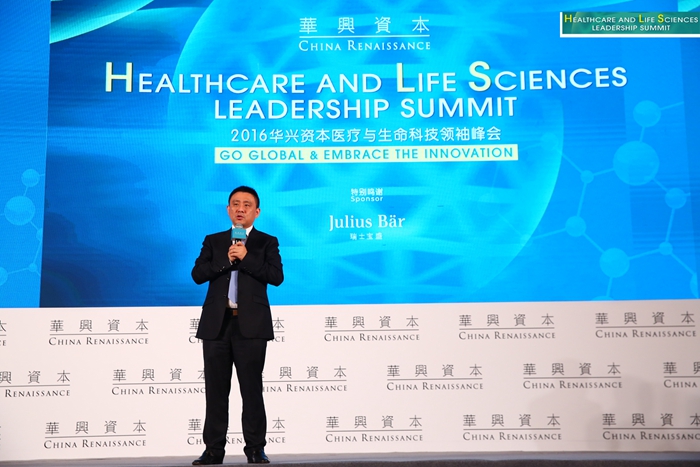
Chen Qiyu, Chairman of Fosun Pharma
On October 28, the Healthcare and Life Sciences Leaders Summit hosted by China Renaissance concluded in Shanghai. Nearly 400 top scientists, corporate CEOs, and investors from the healthcare and life sciences sectors in China and the United States attended the summit. Chen Qiyu, Chairman of Fosun Pharma, delivered a keynote address at the event, focusing on the challenges to business models facing the healthcare industry, the globalization of new drug development, and two key directions for future corporate innovation. Below is a summary of the highlights curated by VCBeat (WeChat ID: vcbeat).
Over the past decade, particularly since 2007, China’s healthcare industry has entered a period of high growth. The pharmaceutical sector, in particular, sustained an annual growth rate of 20% through 2013, rapidly emerging as a prominent segment within the broader healthcare landscape.
Currently, although China’s healthcare industry has become the second-largest market globally in terms of various scale indicators, it has yet to produce companies that match its market size and stature. Among major global corporations, firms like Johnson & Johnson boast market capitalizations nearing $300 billion, whereas Chinese healthcare companies are considered large-scale with market capitalizations of only $10–20 billion.
In other words, we have a leading market with global influence, but no top-tier enterprises with global standing. Against this backdrop, the question that needs to be considered is,How Can Chinese Healthcare Companies Participate in the Market Competition Currently Dominated by U.S., Japanese, and Indian Firms?
It is evident that the Chinese market faces both development opportunities and bottlenecks. With policy changes, such as the national requirement for pharmaceutical companies to conduct quality and efficacy consistency evaluations for generic drugs and to participate in competitive bidding, the previously dominant business model centered on generic drugs will face significant challenges, including competition in terms of cost and pricing. On one hand, with economic growth, the costs for Chinese healthcare enterprises, particularly labor costs, have risen significantly. The market demands lower prices for generic drugs, while pharmaceutical companies’ costs continue to increase, resulting in limited profit margins. On the other hand, from a global perspective, the average per capita pharmaceutical expenditure is $150, whereas China has nearly reached $120 per capita. In this context, Chinese pharmaceutical companies are increasingly turning toward innovation.
Through dialogue, it has become evident that innovation is nearly a shared direction of exploration among leading pharmaceutical companies. As the Chinese market continues to advance, there is clear consensus on the types of medicines that are lacking.The market is not short of generic drugs, but lacks high-value oncology therapeutics and medications that truly address major diseases.
Currently, the United States is a hotspot for drug research and development (R&D) and innovation. Many pharmaceutical companies, including Fosun Pharma, have established their innovative R&D institutions in the U.S., enabling us to align with and absorb resources from global innovation centers, thereby enhancing our reach and resource acquisition capabilities.
Fosun Pharma has two innovative pharmaceutical R&D companies in San Francisco, California. In addition, in 2015, Fosun Pharma, together with several Chinese enterprises including Hopu Investment Management, China Everbright Limited, and WuXi AppTec, jointly acquired Ambrx, a U.S.-based innovative biotechnology company focused on the development of monoclonal antibodies for targeted cancer therapy. Through a series of investments, Fosun Pharma has not only connected and integrated cutting-edge innovative resources but also enhanced its ability to attract top talent.
Fosun Pharma’s innovative exploration has continued since 2007, navigating challenges while accumulating experience and achieving progress. As a first-tier player in the domestic manufacturing of biosimilars, Fosun Pharma has six products with ten indications approved for clinical trials in China. In the area of monoclonal antibodies, its first monoclonal antibody has been approved this year to undergo clinical trials in Taiwan.
Drawing on Fosun Pharma’s past experience, we have been contemplating how to forge a path that integrates Chinese and U.S. approaches—an innovative route targeting the Chinese market while leveraging global resources, particularly those from the United States. Looking ahead,Our innovation efforts should be centered on precision medicine and the advancement of artificial intelligence, leveraging U.S. technology and the Chinese market, with a focus on therapeutic areas including oncology drugs, tumor diagnosis, and treatment.
IBM established its Watson Health division in 2015. The Watson computing system has been deployed in numerous treatment centers across the United States and has begun to take root in China through partnerships. It is believed that deep learning robots in the healthcare industry will not be limited to Watson alone. Currently, beyond innovative pharmaceuticals, high-quality physicians represent a critically scarce resource in the healthcare sector. The future model of care may involve collaborative practice between physicians and medical AI robots, which is expected to significantly alleviate the current supply-demand imbalance for premium medical resources.
Driven by advances in human genomics and artificial intelligence, the healthcare industry is poised for profound transformation. Innovation may provide China’s healthcare sector with a springboard for significant growth over the next five to ten years. By continuing to capitalize on the Chinese market today and actively engaging in cutting-edge global medical technology innovation to build competitive advantages, Chinese healthcare enterprises will be better positioned to navigate future changes with confidence.