

HuaDian Cloud Files for IPO: Building a Clinical-Focused Bioinformatics App Store for NGS Data
With the increasing adoption of second-generation genetic testing technology, also known as next-generation sequencing (NGS), sequencing efficiency has improved dramatically (by a factor of 100,000), while sequencing costs have been significantly reduced. This market is substantial in size; according to a report by Markets&Markets, the global market for second-generation gene sequencing reached $2.5 billion in 2014 and was projected to reach $8.7 billion by 2020, representing a compound annual growth rate (CAGR) of 23%.The development of sequencing technologies has enabled the generatedDNAThe surge in data has driven significant breakthroughs in technology and healthcare. However, challenges related to the analysis, storage, and compression of such massive datasets have become increasingly prevalent.
Huadian Cloud is a biotechnology company dedicated to developing clinical-oriented, high-throughput sequencing solutions. Its independently developed CelLoud platform is a bioinformatics cloud platform designed for high-throughput sequencing (NGS) data, integrating bioinformatics analysis tools and resources. Designed and developed to address the urgent needs of clinicians, the platform enables users to upload data and automate operations with simplified workflows, delivering professional, clear, customizable reports that align with clinical practice standards in an extremely short timeframe.
Chen Jie, Partner of Products and Operations at Huadian Cloud, stated that the CelLoud platform was launched in 2012. Through continuous accumulation of experience and consolidation of advanced technologies, it was formally established as a company and commenced operations in 2013. CelLoud provides high-quality bioinformatics application products for clinical use and offers partners comprehensive application solutions based on next-generation sequencing (NGS) and bioinformatics technologies. It is one of the earliest domestically developed bioinformatics cloud platforms to be applied in clinical settings in China.
Misunderstandings are inevitable in the development of emerging technologies. Bioinformatics cloud platforms are no exception:
Limitations in the Definition of Roles for Bioinformatics Personnel in Bioinformatics Application Development:
1. Bioinformaticians are simply programmers;
2. Bioinformatics is just about running pipelines;
3. Bioinformatics is the study of advanced algorithms.
There are also some divergences in the acceptance of people's bioinformatics cloud platforms:
1. Cloud platforms are insecure; it is necessary to build your own computing platform;
2. The cloud-based workflow is not user-friendly;
3. Unreasonable cost calculation.
Currently, there are some contradictions in the application of bioinformatics:
1. There is a clinical need for new and effective applications;
2. The quality of applications is judged solely by industry professionals based on their experience, with no unified evaluation standard;
3. Users desire a comprehensive, all-in-one platform for process customization, enabling them to design whatever they need on their own.
Chen Jie stated: “Huadian Cloud has always placed great emphasis on its R&D capabilities. Its core R&D team comprises dozens of interdisciplinary professionals, spanning fields such as biology, molecular biology, computer technology, system integration, network technology, big data analytics, bioinformatics, public health, statistics, and clinical medicine, thereby forming a ‘technology chain’ of talent that extends from clinical practice to cloud platforms and cloud computing.”
To realize the practical application of genetic technologies and unlock the clinical value of data, the primary challenge to address is bridging the gap between scientific research and clinical practice—that is, translating basic research findings and scientific achievements into clinical applications. To this end, Huadian Cloud aims to build a bridge between research technologies and clinical applications through a focused, efficient, and open cloud platform, thereby accelerating the translation of scientific achievements into clinical practice to benefit a broad patient population.
To achieve efficient and secure processing of genomic big data, it is essential to equip it with the “wings” of the Internet.
By leveraging the “Internet Plus” model, the analysis and application of post-sequencing genomic data are encapsulated into a mobile application and deployed on a cloud platform dedicated to bioinformatics analysis. This approach establishes a fully automated solution capable of handling large sample sizes, massive datasets, and intensive computational tasks. The final output is delivered to hospitals in the form of customized, visualized reports that are intuitive and easy for physicians to adopt. In this process, in addition to bioinformatics expertise, cloud computing technologies are essential to enhance computational performance, optimize information workflows through efficient data processing, storage, and management, and ensure the reliability and security of information. This is precisely what Huadian Cloud is currently undertaking.
Chen Jie stated: Huadian Cloud focuses on addressing challenges in clinical applications and refining cloud computing services to be more precise, standardized, and user-friendly. The company does not serve end users directly, but rather the service providers for end users, primarily including:
a. Manufacturers of diagnostic test kits (IVD);
b. Third-party medical laboratories;
c. Hospitals with independent sequencing capabilities;
d. Companies providing high-throughput sequencing technology services.
Bioinformatics Cloud Platform: Cloud Technology as the FoundationPublic cloud technologies offered by international companies such as Google, Amazon, and DNAnexus, as well as domestic providers like Alibaba Cloud, Huawei Cloud, and Baidu Cloud, are highly mature. Therefore, there is no need for bioinformatics cloud initiatives to expend substantial time and resources on “building” a separate foundational IT cloud platform. Instead, collaborating with third-party cloud platforms can accelerate industrialization.
Meanwhile, Chen Jie stated that all core bioinformatics technologies of the CelLoud platform have been independently developed by the company and are patent-pending. However, as the company continues to pursue technological optimization—a process with a relatively long in-house development cycle—Huadian Cloud aims to incorporate advanced domestic and international technologies, such as bioinformatics data compression, and directly integrate research achievements into the platform to facilitate their translation into specific commercial applications.
The generation of reports is not entirely dependent on the platform; it also focuses on clinical needs. Chen Jie further stated, “Huadian Cloud emphasizes practical application scenarios, specifically whether there are active users and whether the solution is usable.” To enter clinical practice, it is first necessary to engage in more professional communication with physicians and laboratory personnel in specific testing departments to ensure the practical applicability of the reports.
Our understanding of the association between genes and disease risk is continuously evolving; therefore, genetic testing reports are dynamic documents that require ongoing enrichment as interpretation deepens. However, in China, there is a severe shortage of certified genetic counselors capable of providing professional report interpretations. While many people are familiar with management consulting, psychological counseling, and legal consulting, few have heard of genetic counseling.
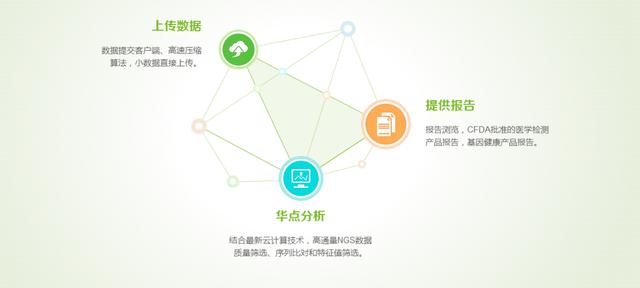
Hospitals or medical laboratories upload genetic testing data to the CelLoud cloud platform. CelLoud analyzes and interprets the data using algorithms tailored for specific applications, then provides practical, reliable, and easy-to-understand clinical reports back to the hospitals or medical laboratories. Physicians can refer to these reports for disease assessment and the formulation of treatment plans.
Chen Jie stated that a good clinical report is not defined by its perceived authority, but rather by its usability and reliability, enabling physicians to make accurate disease assessments.
Moving forward, Huadian Cloud aims to collaborate with more research institutes and enterprises serving clinical practice to jointly enhance clinical service capabilities. Meanwhile, the company seeks to build an alliance with partners through its biotechnology cloud platform, thereby increasing the platform’s influence in the healthcare industry. The ultimate goal is to create an App Store-like model that helps address clinical challenges.
Gene testing will have more application scenarios in the future. As a bioinformatics cloud platform for gene testing, Huadian Cloud has greater room for imagination with the vision of “making gene interpretation easier.”