

Amid the Funding Winter, Star Medical Projects and Hot Sub-sectors Gain Strong Investor Favor
Data Source and Compilation: FellowData
Article by: Lianhe Fund
Starting in the second half of 2015, China entered a new cyclical “capital winter.” The overall environment for innovation and entrepreneurship cooled sharply, with media outlets increasingly focusing on reports of startup “bankruptcies” and “layoffs” amid this capital downturn. As a previously hot sector, digital healthcare was not spared—news such as the rumored collapse of Chunyu Yisheng (Spring Rain Doctor) and large-scale layoffs at Haodafu (Good Doctor) and Xunyi Wenyao (Ask Doctors) frequently made headlines. However, as a typical counter-cyclical industry, healthcare has traditionally served as a safe haven during capital winters. Is the reality truly as grim as portrayed by the media?
FellowData, the database under FellowPlus, has partnered with Lian Fund to conduct an in-depth analysis of venture capital and private equity big data in the digital healthcare sector. This sector is defined broadly to encompass internet-based healthcare and includes sub-sectors such as health and wellness, specialized medical services, patient navigation and diagnosis/treatment, healthcare informatics, medical hardware, integrated healthcare services, pharmaceutical e-commerce, biotechnology, physician services, and other medical services. The resulting report presents the most comprehensive and authentic overview of the current investment and financing landscape in the digital healthcare industry.
Macro Funding in Venture Capital Continues to Grow Rapidly, with Healthcare as a Key Investment Sector
From a macro perspective, the digital health sector is not as cold as it may seem. We believe that two medium- to long-term macroeconomic factors are driving the sustained growth of venture capital investment from a macro funding standpoint: the increasing proportion of equity investments in domestic social asset allocation, and policy support for innovation and entrepreneurship as one of the core top-level design reforms promoted by the current government to facilitate economic transformation and upgrading.
According to incomplete statistics, the proposed fundraising amount for publicly launched healthcare-related funds since the second half of 2015 (after the stock market crash in July 2015) has exceeded RMB 10 billion.
Private Equity Fund Assets Under Management (AUM) Growth Far Outpaces Public Funds, Expected to Surpass Public Fund AUM by Year-End: Private equity funds recorded a month-on-month growth of 6.7% and a year-on-year growth of 90%, significantly exceeding the 3.5% month-on-month and 32% year-on-year growth rates of public funds. The AUM of private equity funds reached RMB 8.6 trillion, approaching the RMB 8.8 trillion held by public funds.
Primary Market Private Equity Funds Have Become the Dominant Force in the Private Equity Sector: Unlike secondary market funds, primary market capital invests directly in unlisted enterprises, serving as a major driver for innovation and entrepreneurship. Currently, the paid-in capital of private equity (PE) and venture capital (VC) funds exceeds RMB 3.9 trillion, accounting for nearly 60% of the total paid-in capital of all private equity funds, surpassing the scale of traditional secondary market securities-focused private funds.
The healthcare sector has always been a capital- and technology-intensive industry. The national target of RMB 8 trillion in output value by 2020 (with a compound annual growth rate of nearly 15%) has attracted significant investment from various types of capital. According to incomplete statistics, since the second half of 2015 (following the stock market crash in July 2015), newly raised healthcare-related funds disclosed publicly have involved multiple entities, including government bodies, professional investment institutions, listed companies, and startups, with proposed fundraising exceeding RMB 10 billion. Typical examples include the National Emerging Industry Venture Capital Guidance Fund with a scale of RMB 140 billion (launched in Hangzhou in September 2016 to support seven strategic emerging industries, including pharmaceuticals and medical technology); the Puhua Capital–Jingxin Guzhou Health Industry Fund, which plans to invest RMB 5 billion over three years; the Yinyue Venture Capital Phase II Healthcare Fund with a scale of RMB 1 billion; the Lepu–Minhe Global Precision Medicine Innovation Investment Fund worth USD 100 million; and the Vivo PANDA Fund, a USD 100 million venture capital fund focused on the healthcare industry.
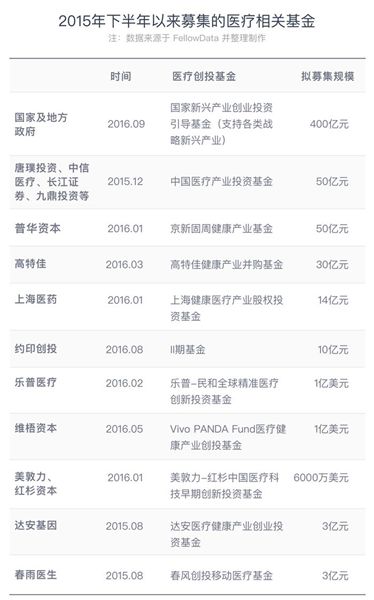
Amid the capital winter, healthcare remains “warm.” So where is the chill felt by entrepreneurs coming from?
The Startup Boom Begins to Cool, with a Pronounced “Matthew Effect” Among Star Companies
Internet healthcare in China began to grow rapidly in 2011, marked by the establishment of Chunyu Doctor, a purely mobile-based medical consultation platform, in July 2011. The innovation drive in this field stemmed from the development of mobile internet technology since 2009 and its penetration into the healthcare sector. Stimulated by the “Internet Plus” investment theme, it has continued to attract entrepreneurs to enter the space.
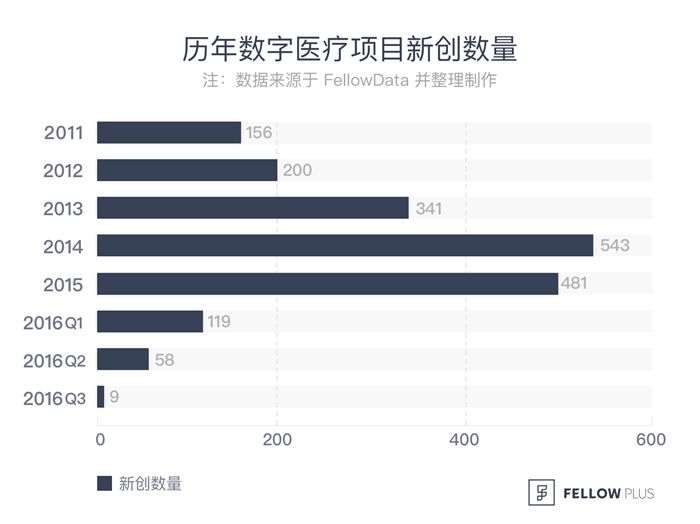
We tracked the annual number of newly established digital health projects from 2011 to Q3 2016 (see chart above). Starting with 156 companies in 2011, the sector peaked in 2014 and 2015, with 543 and 481 new projects launched respectively. For a time, thousands of innovative initiatives, exemplified by the “Internet + Healthcare” model, sprang up across the country.However, by 2016, the number of new startups became unsustainable and declined sharply. Only 186 were recorded in the first three quarters, with single-digit figures in Q3 alone, signaling a retreat in innovation within the digital health sector.
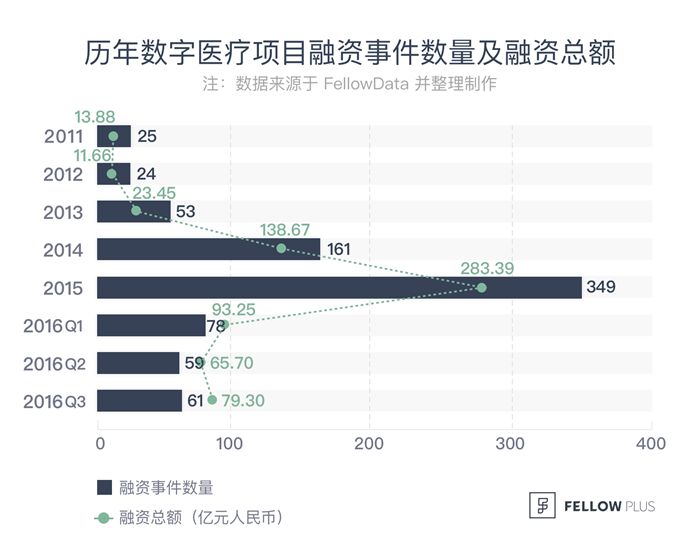
Statistics on the financing side also support the conclusion that the peak has passed (see chart above). In 2011 and 2012, an average of only slightly more than 20 projects publicly secured financing each year, with the total annual financing amount merely reaching the scale of over RMB 1 billion. The period from 2013 to 2015 witnessed an investment boom, during which both the number of financed projects and the total financing amount grew rapidly at annual rates exceeding 100%, peaking in 2015 with 349 financed projects and a total financing amount of RMB 28.3 billion. Interestingly, although the number of financing deals dropped significantly, the total financing amount still saw a slight increase, suggesting that the industry had begun to “separate the wheat from the chaff.” Data for the first three quarters of 2016 reveal a diverging trend: there were 198 financing deals (with an estimated full-year total of 264, representing a 24% decline), and the total financing amount reached RMB 23.8 billion (with an estimated full-year total of RMB 31.7 billion, reflecting a 12% increase).
The number of new digital health startups and financing deals has shown a gradual downward trend., reflecting the growing caution among innovators and capital in this sector. The slight upward trend in total financing aligns with the broader macro-level easing of funding conditions mentioned above.Further combined with the aforementioned downward trend in quantity, this highlights the concentrated investment direction of capital toward digital health projects.
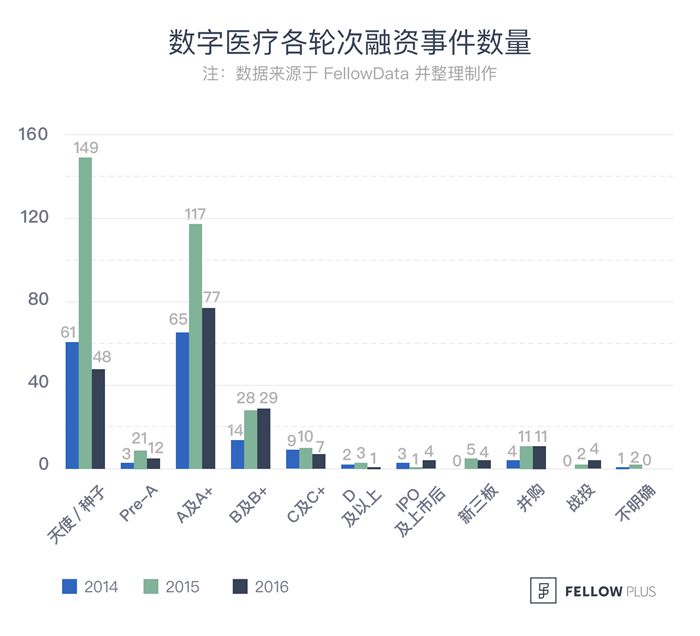
FellowData has conducted a more in-depth statistical analysis of the number of digital health financing events by round during the third quarter of 2014–2016. A clear trend is that more mid-to-late-stage projects have secured funding (see chart above). We classify Angel/Seed, Pre-A, A, and A+ rounds as early-stage projects, and Series B and subsequent rounds as mid-to-late-stage projects. Statistics show that the total number of early-stage financings in 2014, 2015, and the first three quarters of 2016 were 129, 287, and 138, respectively (with an estimated full-year total of 184 for 2016), indicating a decline after a peak. However, the total number of mid-to-late-stage financings were 31, 60, and 61, respectively (with the full-year 2016 total projected to reach 80), hitting a new high this year.
The corresponding statistics on the proportion of early-stage project financing are also consistent with the aforementioned trend of concentration in mid-to-late stages (see figure below). In 2014, 2015, and the first three quarters of 2016, the proportions of total early-stage project financing were 80%, 82%, and 69%, respectively, while those for mid-to-late-stage project financing were 19%, 17%, and 31%, respectively.
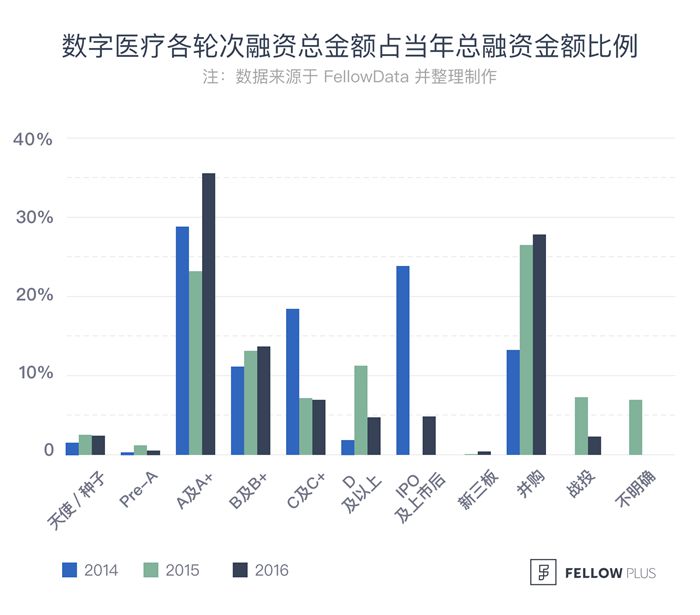
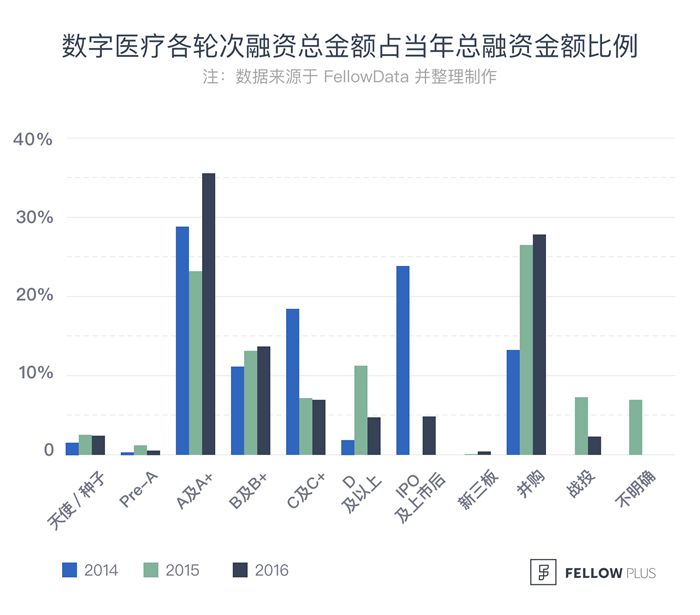
Statistical data on the funding amounts and proportions across various rounds do not show a clear trend (see the two charts below). However, the most notable observation is the significant increase in both the amount and proportion of Series A and A+ round financings. This is primarily attributed to the substantial impact of Ping An Good Doctor’s $500 million Series A financing, which demonstrates the “Matthew effect” in capital allocation for star projects. In addition to Ping An Good Doctor, we have compiled other publicly disclosed large-scale financings this year: Chunyu Yisheng secured RMB 1.2 billion in its Series D round; 111.com raised RMB 1 billion in its Series D round; Meiyou obtained RMB 1 billion in its Series E round; Health.cn raised $100 million in its Series A round; Gushengtang secured $70 million in its Series C round; Gengmei raised RMB 345 million in its Series C round; Xikang.com obtained $64 million in its Series B round; So-Young raised $50 million in its Series C round; Apricot Forest secured $32 million in its Series C round; and Quyi Network raised $30 million in its Series B+ round, among others.
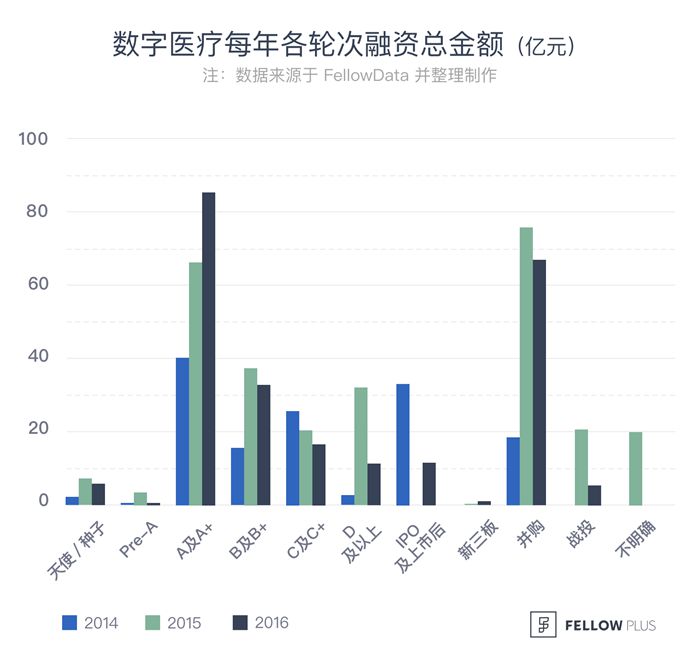
Based on the above data, we can conclude:Compared with 2015, entrepreneurs and investors have entered the digital health sector more cautiously, with capital becoming more selective and concentrating on star companies. This is the real reason behind the “winter” in digital health.
Specialized Services in Niche Fields and Patient Navigation for Diagnosis and Treatment Are Hotspots for Capital and Innovation
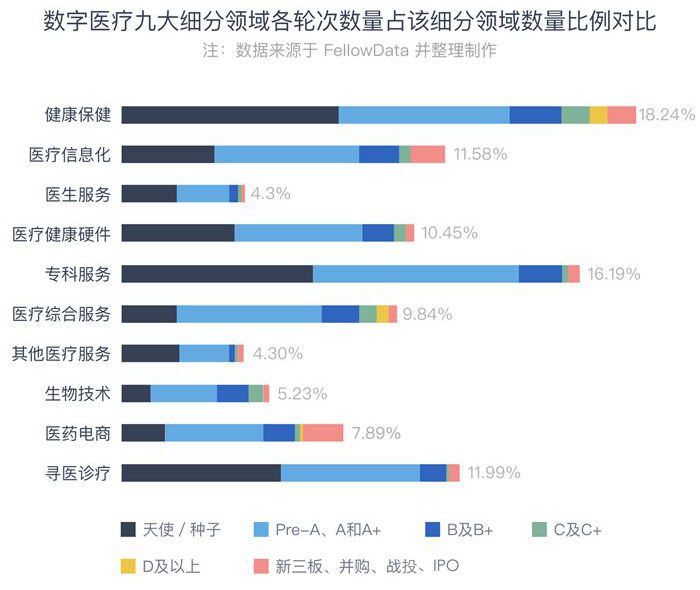
In addition to the trend of capital concentrating on star projects, we also attempt to identify the latest hotspots in digital health sub-sectors from macro-level investment and financing data. We have defined two indicators: Capital Hotspots and Innovation Hotspots.
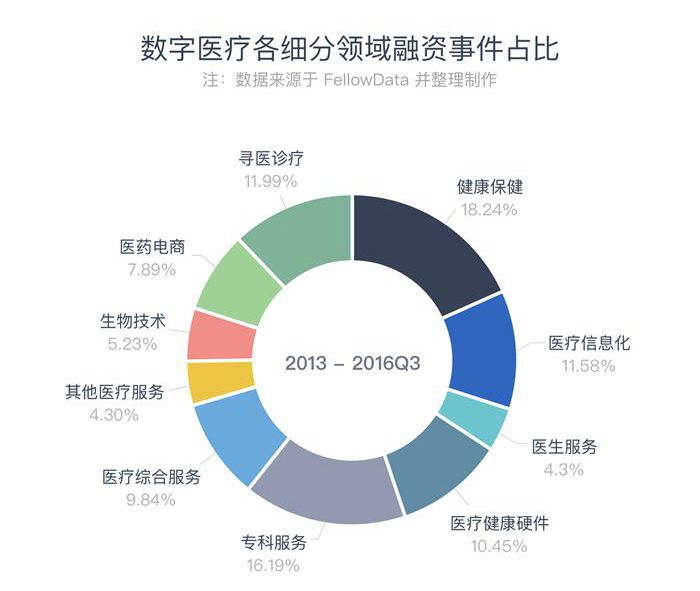
Among the various sub-sectors, from a capital perspective, health and wellness, specialized services, online medical consultation, and healthcare informatization have emerged as the four major hotspots. From 2013 to Q3 2016, their respective shares of financing deals were 18%, 16%, 12%, and 12%, collectively accounting for half of the total (see chart above). Representative companies in these sectors include Meiyou, Gushengtang, Chunyu Doctor, and Zhuojian Technology, among others.
We define sectors where pre-Series B financing accounts for more than 80% of the total financing within their respective sub-sectors as innovation hotspots. From 2013 to Q3 2016, the sub-sectors exceeding this 80% threshold were physician services (88.1%), medical consultation and diagnosis (88.0%), specialized care services (86.7%), and digital health hardware (81.4%) (see figure below).
From the combined perspective of capital and innovation, specialized services and medical consultation and diagnosis are the most sought-after.
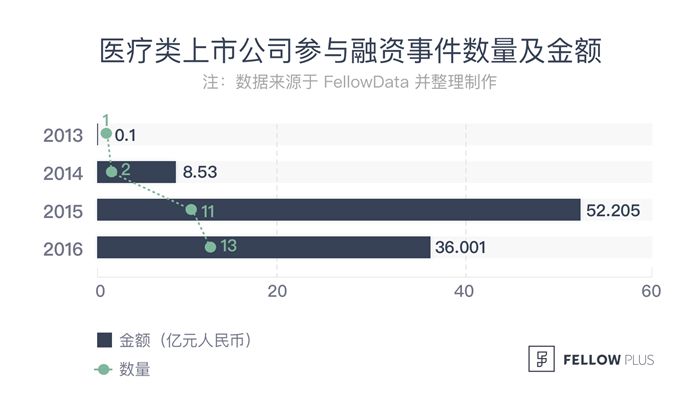
Meanwhile, the latest trend in 2016 for these two sectors, in terms of business logic, is a deeper integration of online and offline operations. Digital health companies are expanding into offline services, while traditional pharmaceutical and healthcare enterprises are making strategic investments in online businesses. Examples of the former include WeDoctor’s Internet Hospital and General Practice Medical Centers, as well as DXY’s Dingxiang Clinics; examples of the latter include Aier Eye Hospital’s “Ai Yan e-Station” and Topchoice Medical’s Cunji Network Hospital. Statistical data show that by the third quarter of 2016, the number of digital health financing events involving domestically listed pharmaceutical and healthcare companies had already surpassed the total for the entire year of 2015. The total financing amount for the full year is also estimated to be close to that of the previous year (see chart above), maintaining the scale seen during the 2015 peak. Listed companies are continuously increasing their investments in this field, which will undoubtedly have a positive impact on innovation and capital exit opportunities across the industry as a whole, particularly in specialized care services—a segment where most listed companies are leading players.
In summary, the healthcare sector remains resilient despite the capital winter. While caution among innovators and investors has led star companies to conserve cash and attract funding, the deep online-offline integration in specialized services and medical consultation/treatment has emerged as a new hotspot for innovation and capital.