

Immune Checkpoint Inhibitors to Maintain Dominance in the Booming Tumor Immunotherapy Arena
In recent years, numerous Chinese pharmaceutical companies have established or begun to establish their presence in the research and development (R&D) of oncology immunotherapies. The pressing challenge lies in how to successfully develop these agents and, more importantly, how to accurately predict the competitive landscape five years down the line. This is crucial to ensure that R&D investments in oncology immunotherapies do not lead to saturation in highly competitive “red ocean” markets, and to devise strategies for coping with the large-scale influx of generics following the expiration of patents on early-to-market immunotherapies.
In the field of cancer immunotherapy, current research hotspots are primarily focused on immune checkpoint inhibitors (such as anti-CTLA-4 and anti-PD-1/PD-L1 agents), cell therapies (such as CAR-T), and cancer vaccines. Among these, the development of immune checkpoint inhibitors is the most prominent area of interest. It is projected that immune checkpoint inhibitors will continue to dominate the market over the next 5–10 years, with the global market for cancer immune checkpoint inhibitors expected to reach $24 billion by 2024. Meanwhile, other forms of immunotherapy, including immunomodulatory small molecules and oncolytic viruses, are also offering new hope.
By comparison, progress in cancer vaccine research has been sluggish. Currently marketed therapeutic cancer vaccines mainly include the HPV vaccine and prostate cancer vaccines. Provenge, a therapeutic vaccine for prostate cancer approved by the U.S. Food and Drug Administration (FDA) in 2010, was once hailed as the first immunotherapy drug in history, but it ultimately failed due to limited efficacy, inadequate marketing, and the emergence of superior competing products. The achievements of CAR-T therapy in treating malignant hematologic tumors are widely recognized; however, significant bottlenecks remain in its application to solid tumors.
● Early leaders continue to maintain their advantage
Currently, among the successfully launched PD-1/PD-L1 inhibitors, Bristol-Myers Squibb’s Opdivo and Merck & Co.’s Keytruda are leading the market, with Roche’s Tecentriq closely following. Opdivo has the broadest range of indications, including melanoma, non-small cell lung cancer (NSCLC), renal cell carcinoma, and classical Hodgkin lymphoma. Keytruda is indicated for melanoma, NSCLC, and head and neck squamous cell carcinoma. Tecentriq received FDA approval in May 2016 for the treatment of advanced bladder cancer.
In the second quarter of 2016, Opdivo’s sales reached $840 million, far surpassing Keytruda’s $310 million. However, Bristol-Myers Squibb’s stock price plummeted after the company announced that its Phase III clinical trial for first-line treatment of non-small cell lung cancer (NSCLC) had failed to meet the primary endpoint. The study results also highlighted the necessity of PD-L1 testing in previously untreated patients with advanced NSCLC prior to initiating PD-1 monoclonal antibody therapy. Looking ahead, these three companies will continue to expand into new indications, carefully select target patient populations, and maintain their leading positions.
● Drug development for certain targets is relatively crowded
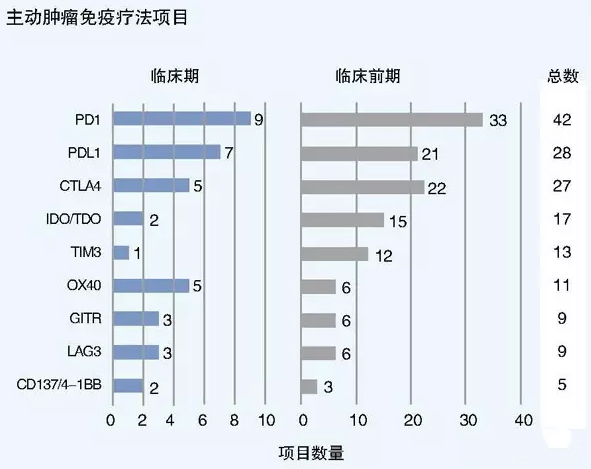
In addition to major pharmaceutical companies such as AstraZeneca, Pfizer, Novartis, and Celgene entering the research and development of immune checkpoint inhibitors for oncology, numerous emerging biopharmaceutical companies have also ventured into this field, including CureTech, Incyte, and Newlink Genetics. As shown in the figure on the right, there are more than 70 PD-1/PD-L1 drugs in clinical and preclinical stages, many of which are “me-too” drugs (proprietary drugs with efficacy comparable to that of similar breakthrough agents), resulting in a highly crowded landscape. Richard Pazdur, Director of the Office of Hematology and Oncology Products at the FDA’s Center for Drug Evaluation and Research, also pointed out in an interview at ASCO that there will be a surge in “me-too” oncology immunotherapy drugs.
● Combination therapy will become a research and development trend
One of the primary directions in the development of tumor immunotherapy drugs is to explore their potential for combination with chemotherapy agents or other tumor immunotherapies. Currently, the most significant challenge facing immunotherapy is how to improve response rates. Data from multiple clinical studies indicate that the two currently approved PD-1 antibodies, when used as monotherapy, achieve response rates of only around 20% across different tumor indications; combination therapies can further increase these rates by 10–15%. At the ASCO Annual Meeting, numerous combination trials have demonstrated promising results.
For example, the CheckMate 12 trial, which evaluated the combination of Yervoy and Opdivo, increased the overall response rate in non-small cell lung cancer (NSCLC) from 23% with monotherapy to 47%; PD-L1 therapy combined with MEK inhibitors demonstrated promising activity in colorectal cancer; and early data from combination trials involving OX40 and CD137 agonists indicated an improved safety profile.
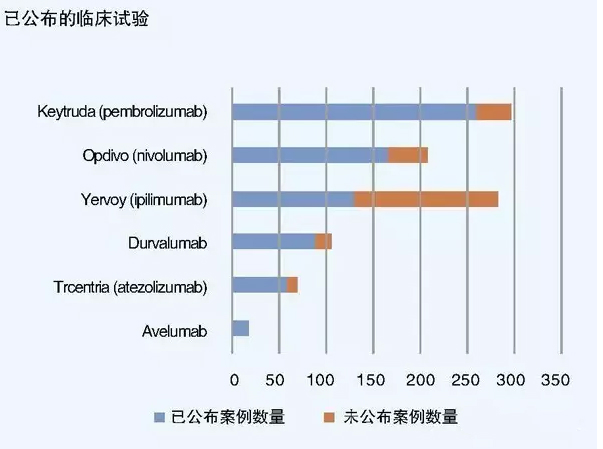
Based on the four currently approved immune checkpoint inhibitors and two late-stage oncology immunotherapy PD checkpoint programs, there are nearly 1,000 related trials, most of which are ongoing. Keytruda alone has nearly 300 related clinical trials, including combination therapy studies. These figures represent only publicly disclosed trials; it is believed that additional investigator-initiated trials by academic institutions have yet to be published.
● An increasing number of new drugs targeting different therapeutic targets will enter clinical trials
As of 2014, scientists had identified 20 to 35 ligands and receptors involved in immune responses; however, only CTLA-4 and the PD-1/PD-L1 pathway are currently used in clinical practice. In addition to these two major immune checkpoints, major pharmaceutical companies have also shifted their R&D focus toward developing new therapeutic targets, such as TIM-3, LAG-3, KIR, GITR, VISTA, IDO1, 4-1BB, and TDO2. For example, Bristol-Myers Squibb’s IDO-1 inhibitor for the treatment of multiple myeloma is in Phase III clinical trials, while a KIR inhibitor is in Phase II clinical trials. Additionally, a LAG-3 inhibitor for the treatment of melanoma, developed by the University of Lausanne (note: "Fudos" appears to be a mistranslation or error for Lausanne/UNIL, a leading institution in LAG-3 research), is in Phase II clinical trials. Cancer immunotherapy is flourishing in the field of biomedical oncology research, with more than 500 antibodies and 600 cancer vaccines currently in clinical development.
● Clinical applications in China lag behind international standards by at least five years
In the Chinese market, multiple foreign companies have entered or are about to enter the clinical trial stage in the field of PD-1/PD-L1 antibody drugs. Bristol-Myers Squibb has submitted four import drug clinical trial applications for Opdivo, one of which has received clinical trial approval; all six import drug clinical trial applications for Keytruda submitted by Merck & Co. are under review; all six import drug clinical trial applications for PD-1 and PD-L1 agents submitted by Roche are under review; the one import drug clinical trial application for a PD-1 agent submitted by AstraZeneca is under review; and the one import drug clinical trial application for a PD-L1 agent submitted by Novartis is under review.
In the PD-1 field, among domestic companies, Junshi Biosciences and Hengrui Medicine were approved in early 2016 to conduct Phase I clinical trials, while Beigene, Genor Biopharma, Yuheng, Innovent, and other companies remained in the review stage for clinical trial applications. In the field of PD-L1 antibody drugs, the clinical application submitted by Suzhou Alphamab Oncology is under review.
● Visionary companies in China are beginning to strategize around other targets
A considerable number of companies in China are still eyeing the PD-1/PD-L1 sector, planning to hop on the “bandwagon” of cancer immunotherapy through independent R&D or acquisitions in hopes of securing a share of the market. According to incomplete statistics, an estimated 70 to 120 companies in China are developing PD-1 inhibitors.
Notably, domestic companies such as Yiteng, Galaxy Bio-Pharma, and BeiGene have also begun to target LAG3, TIM3, OX40, and 4-1BB.
● Product variations exist; invest with caution.
For Opdivo and Keytruda, both PD-1 antibodies serve as foundational therapies in cancer immunotherapy. Increasingly clear signals suggest that they share similar characteristics, such as the potential need to define target patient populations based on PD-L1 expression levels. In addition to Opdivo, Keytruda, and Roche’s Tecentriq, can other latecomers—such as durvalumab, avelumab, and more than ten other PD-x inhibitors currently in clinical development—identify their own competitive advantages? Determining how to establish these advantages will be critical for their market promotion.
Most clinicians believe that Keytruda and Opdivo have similar efficacy, with only minor differences in dosing. Although these antibodies may differ slightly in aspects such as antigen epitopes, affinity, Fc function, and glycosylation—all of which can influence drug performance—such differences are difficult to predict in preclinical studies. Moreover, the complexity of disease is likely to obscure these subtle distinctions, necessitating large-scale clinical trials and substantial patient populations to determine their relative merits.
Given the large number of PD-1/PD-L1 drugs under development in China, if a candidate lacks a sustained competitive advantage, achieves only average efficacy, and does not possess exceptional marketing capabilities, breaking through in the market will pose a significant challenge—even if clinical trials are successful. From an investment perspective, caution is warranted for PD-1/PD-L1 candidates that remain in preclinical development at this stage.
● Develop other targets with the aim of achieving independent market approval
Other targets are not as crowded. For domestic pharmaceutical companies, rather than joining the crowded race of “me-too” drugs, it is better to take a step back, carefully evaluate current oncology immunotherapy targets, and strive for original innovation. From an investment perspective, invested companies must possess genuine competitive advantages, such as novel models, entirely new targets, or innovative approaches. Meanwhile, where feasible, they should also consider secondary objectives related to combinations with PD-1/PD-L1 inhibitors.
Based on the hypothesis, targeting two or more pathways, including two or multiple immune checkpoints, will be a more effective approach to combat diseases. For example, the immune checkpoints CTLA-4 and PD can be used in combination. Since the co-stimulatory factor signaling pathways do not functionally overlap, dual inhibition will yield dual or even synergistic effects. Currently, a large number of combination clinical trials being conducted abroad are basically based on PDx combinations. Therefore, early layout and combination with PDx will have significant market promotion value.
Furthermore, it is essential to carefully examine the patent protection status of relevant drugs held by foreign pharmaceutical companies to avoid potential patent disputes. Traditionally, patents have generally protected the antibody structure itself; in such cases, it is difficult to prevent later entrants from developing antibody drugs targeting the same antigen, which explains why dozens of companies have pursued the development of PD-1 antibodies. Increasingly, multinational pharmaceutical companies are filing patents for epitope-specific protection. The recent patent litigation between Amgen and Sanofi regarding PCSK9 primarily involved Amgen suing Sanofi for infringing upon Amgen’s epitope-specific patents. If epitope protection becomes the mainstream approach, patent protection for antibody drugs will become significantly more stringent, greatly increasing the challenges for later entrants and substantially raising the screening costs for “me-too” drugs.
It is important to note that novelty alone is insufficient for drug investment; preclinical translational medicine research is also required, along with early identification of strategies for combination with standard therapies, ideally demonstrated during the preclinical stage.
● Is there value in laying out generics?
The earliest patent expiration dates for Opdivo and Keytruda in China are in 2026, meaning biosimilars can only enter the Chinese market after 2026. Domestic PD-1 antibody drugs are expected to be launched and marketed between 2021 and 2023, creating a 3–5 year window of opportunity. Overall, the impact of biosimilars on originator drugs will not be significant.
However, compared with previous years, China’s biopharmaceutical R&D capabilities have improved significantly, enabling rapid follow-on development of foreign novel biologics. Within a relatively short timeframe, it is possible to develop products with distinct sequences from those of foreign counterparts and with independent intellectual property rights, bringing them to market earlier than traditional biosimilars. Consequently, the market space for biosimilars in China will continue to shrink. From a regulatory perspective, according to the Technical Guidelines for the Research, Development, and Evaluation of Biosimilars (Trial), developing biosimilars requires head-to-head comparisons with the reference product across most stages of development, along with similarity assessments. The costs and risks associated with biosimilar development are no lower than those for novel drugs; therefore, investing in biosimilars of tumor immunotherapy agents offers limited value.
In summary, tumor immune checkpoint inhibitors will continue to dominate the landscape over the next 5–10 years. However, as in any highly competitive field, there will be both winners and losers in the arena of cancer immunotherapy. It remains to be seen whether Chinese pharmaceutical companies can achieve a leapfrog advantage in this rapidly evolving sector. Meanwhile, in the domestic market, the ability of pharmaceutical companies to formulate differentiated R&D and marketing strategies will determine their fate, which is particularly critical for emerging biopharmaceutical companies in China.
By Cao Feng (Partner at Huayi Capital, Ph.D.)