Medidata Leverages Big Data to Reduce Clinical Trial Costs, Triples Client Base in Six Years

By Zhang Chen
Medidata Solutions is a U.S.-based technology company specializing in the development and marketing of cloud-based platform applications for clinical trials and data analytics processing.
The company provides clinical application, data analysis, and benchmarking services, offering state-of-the-art tools to participants in clinical trials—including pharmaceutical researchers, physicians, and patients—to plan and manage these trials, thereby shortening drug development cycles, reducing R&D costs, and mitigating development risks.
The specific technical areas covered by Medidata include protocol development, clinical site collaboration and management, trial randomization and supply management, patient data capture via web forms, mobile medical devices, laboratory reporting and imaging systems, quality monitoring and management, safety event capture, and business analytics.
The company is headquartered in New York and maintains 11 offices across the United Kingdom, Japan, South Korea, China, and Singapore, with a global workforce of over 1,500 employees (as of 2015).
Key clients include pharmaceutical companies, biotechnology firms, medical device manufacturers, academic and government institutions, contract research organizations (CROs), and other life sciences organizations. The Medidata platform currently serves more than 600 clients, supporting over 10,000 clinical trials and more than 2.7 million trial participants.
Generally, biopharmaceutical companies need to spend $500 million and 10 to 15 years to successfully develop a new drug. The high risk, long development cycle, and substantial costs associated with new drug development represent one of the most significant pain points for pharmaceutical companies.
Taking FDA requirements as an example, the process from discovering a new compound in the laboratory to developing a new drug with clinical efficacy involves the following stages:
Demonstrate the biological activity of a newly developed compound against a specific disease and evaluate its safety through laboratory and animal studies.
After completing preclinical trials, an Investigational New Drug (IND) application is submitted to the U.S. Food and Drug Administration (FDA). If the FDA does not issue a clinical hold within 30 days of submission, the IND application is deemed effective, and human clinical trials may proceed. The IND application must include: preclinical study data, the clinical trial protocol, trial sites, principal investigators, the chemical structure of the new compound, the route of administration, all toxicity findings observed in animal studies, and details regarding the manufacturing and production of the compound. The entire clinical development plan for the new drug must be reviewed and approved by an Institutional Review Board (IRB). Applicants are required to submit annual progress reports on the clinical trials to both the FDA and the IRB.
Clinical trials at this stage typically enroll 20–100 healthy volunteers. The primary objective is to ensure the drug’s safety, particularly by establishing the safe dosage range. Additionally, clinical trial data from this phase are collected, covering dimensions such as absorption, metabolism, excretion, and duration of pharmacological effect in the volunteers.
Clinical trials in this phase typically enroll 100–500 relevant patients for study. The primary objective is to determine the clinical efficacy of the drug.
Clinical trials in this phase typically enroll 1,000–5,000 outpatient and inpatient participants, with studies often conducted across multiple medical centers. Under strict physician supervision, further data are collected on the drug’s clinical efficacy, adverse reactions, and drug–drug interactions. These Phase III trials employ placebo-controlled, double-blind designs. Phase III clinical trials represent the most critical step in the entire new drug development process.
Upon completion of the three phases of clinical trials, an analysis of the accumulated data to demonstrate the safety and efficacy of the new drug allows for the submission of a New Drug Application (NDA) to the FDA. The NDA must include all previously collected data. Typically, an NDA dossier comprises approximately 100,000 pages. Although the FDA is required to complete its review within six months, delays are common due to the high volume of applications and the substantial documentation involved.
If the FDA approves a new drug for marketing, the drug may be commercially distributed for use by physicians and patients. However, relevant data, including information on adverse effects and quality management, must still be submitted to the FDA on a regular basis. For certain drugs, the FDA may also require continued Phase IV clinical trials to monitor potential long-term adverse effects.
Certain drugs continue to be monitored after they are marketed. The primary monitoring data focus on the clinical efficacy and adverse reactions observed when the new drug is used by a larger population. The medication guide will be revised accordingly based on the feedback from this phase. If serious adverse reactions not identified in previous studies are discovered during this phase—for example, if use of the drug significantly increases the incidence of atherosclerosis among users—the FDA will mandate its withdrawal from the market.
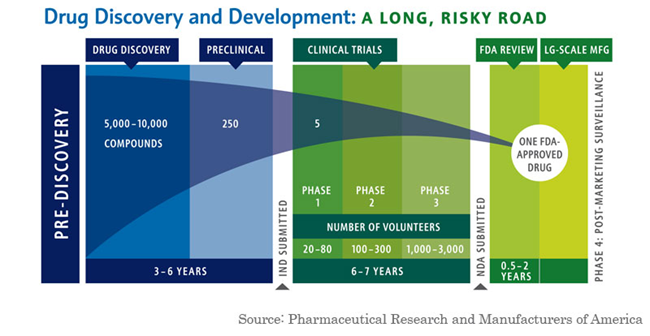
The above process highlights the lengthy timeline, high risks, and substantial costs associated with new drug development. Prior to Medidata, data collection and management across various stages of new drug development were typically conducted using paper-based methods, which significantly hindered the efficiency of pharmaceutical R&D.
Paper-based clinicalThe adverse impacts of clinical trial data collection and data management on the clinical trial itself fall into the following categories:
(1) The investment in new drug development is substantial, yet the success rate remains low. The primary approach involves extensive screening of candidate compounds while closely monitoring their efficacy and toxicity. If a compound is found to have any serious defects, development should be halted immediately to control R&D expenditures. Relying solely on paper-based methods for clinical trial data collection throughout the clinical trial process may delay the identification of issues by decision-makers, leading to avoidable financial waste.
(2) Given that study subjects must be representative and the total population is limited, many current new drug clinical trials are conducted simultaneously across multiple centers. This involves information exchange between different centers. Paper-based methods for clinical trial data collection result in high communication costs for horizontal coordination.
(3) When drug clinical trials enter Phase III and Phase IV, adverse reactions become the focus of monitoring. Paper-based information collection and communication may have negative impacts on both patients and the R&D process. In case of emergencies where doctors need to carry out rescue treatment, they must clearly know the patient’s pathology, medication history, allergic reactions, and contraindications. The paper-based information collection model is not conducive to timely emergency care.
Clinical trial data collection and management directly impact the quality of clinical trials in drug development. Enhancing informatization can effectively reduce the time required for drug development, streamline the process for new drug market approval, and thereby save associated costs.
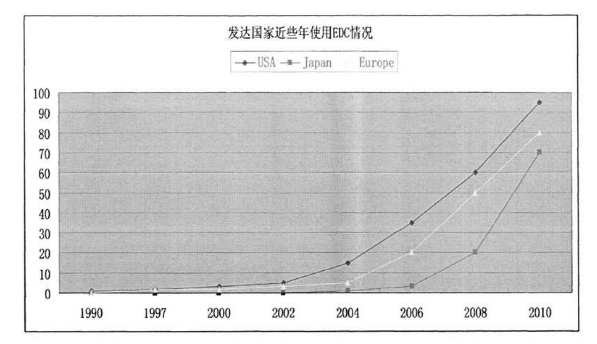
Since 1995, biopharmaceutical companies and Contract Research Organizations (CROs) in the United States, Japan, and Europe have gradually transitioned from traditional paper-based clinical data collection and management to electronic systems. Multi-stage data analysis based on Electronic Data Capture (EDC) enables faster decision-making, allowing researchers to adjust allocation ratios among different sample groups, re-estimate sample sizes, modify experimental arms, or terminate trials as needed. Furthermore, for volunteers, EDC facilitates more timely feedback on adverse events, thereby better safeguarding their health and safety.
Since 2002, the adoption of electronic clinical data capture and data management systems in advanced economies has surged dramatically. In recent years, the level of informatization in clinical trials in the United States has exceeded 90%. Medidata’s success is largely attributable to its accurate anticipation of the industry’s digital transformation trends, enabling it to gain a first-mover advantage and position itself at the forefront of this wave.
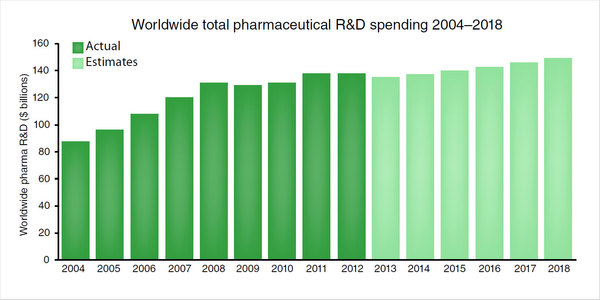
On the other hand, global pharmaceutical R&D funding has also maintained an upward trend, increasing from $83 billion in 2004 to an estimated $120 billion in 2016.Thus, how to control costs and systematically improve the efficiency of new drug R&D has become a shared concern among major pharmaceutical giants, contract research organizations (CROs), and scientific research institutions.
Medidata’s product portfolio spans all phases of clinical research, from initial planning, site engagement, and patient recruitment to later-stage study execution, analysis, and benchmarking. Its user base encompasses multiple stakeholders, including contract research organizations (CROs), research institutions, patients, and sponsors.
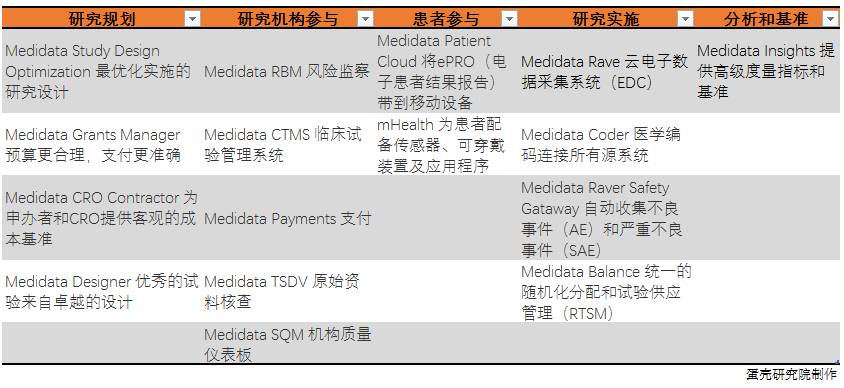
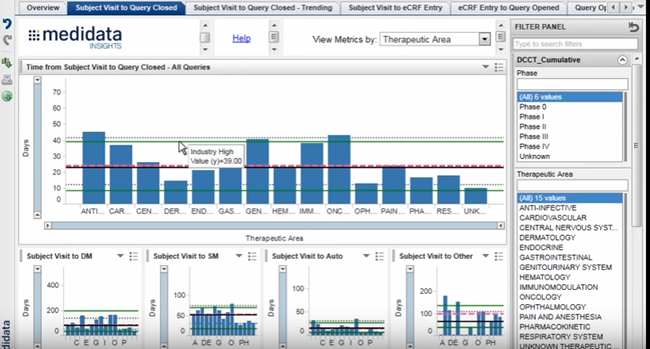
Among these, the core flagship product is Medidata Rave, currently the most popular comprehensive solution combining an Electronic Data Capture (EDC) system with a Clinical Data Management System (CDMS). The EDC system captures data from research sites worldwide and exports it in formats compliant with industry standards. Additionally, the EDC system continuously collects other types of data, such as Laboratory Information Management System (LIMS) data, electronic Patient-Reported Outcomes (ePRO), Interactive Voice Response Systems (IVRS), and Interactive Web Response Systems (IWRS).
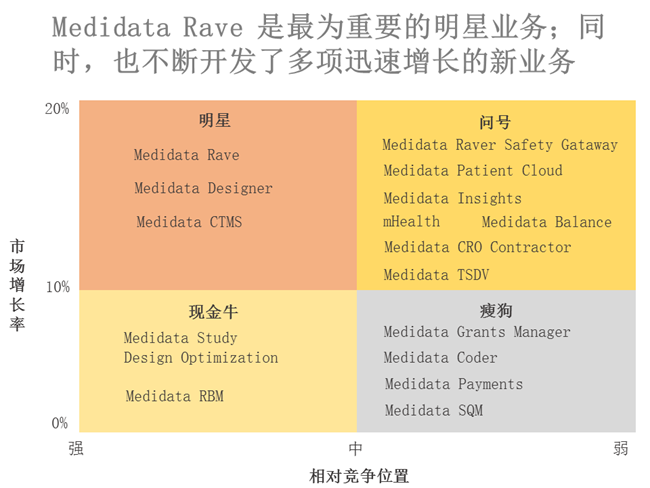
With Medidata Rave as its core product, Medidata has developed a suite of additional solutions. These include Medidata Study Design Optimization, which optimizes study design implementation; Medidata Grants Manager, which enables more rational budgeting and accurate payments; Medidata CRO Contractor, which provides objective cost benchmarks for sponsors and contract research organizations (CROs); Medidata CTMS, a clinical trial management system; Medidata Patient Cloud, which brings ePRO (electronic patient-reported outcomes) to mobile devices; and Medidata Rave Safety Gateway, which automates the collection of adverse events (AEs) and serious adverse events (SAEs). All of these products are compatible with Medidata Rave, and existing customers who are highly satisfied with Medidata Rave are more likely to adopt these new offerings.
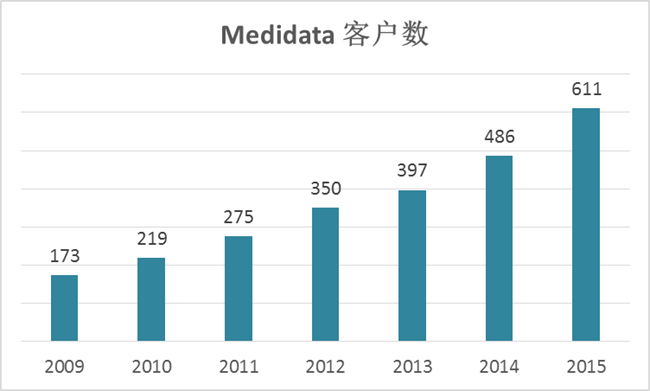
Medidata's revenue growth in recent years has been primarily driven by an increase in its customer base.From its IPO in 2009 to 2015, the number of clients increased from 173 to 611, with nearly 20% new client acquisition annually. The company’s major clients include pharmaceutical companies, large global biopharmaceutical giants, vaccine researchers, emerging biotechnology firms, specialty pharmaceutical companies, single-disease researchers, medical device manufacturers, and academic medical centers, among others. Notable clients include Johnson & Johnson and Takeda Pharmaceutical Co.
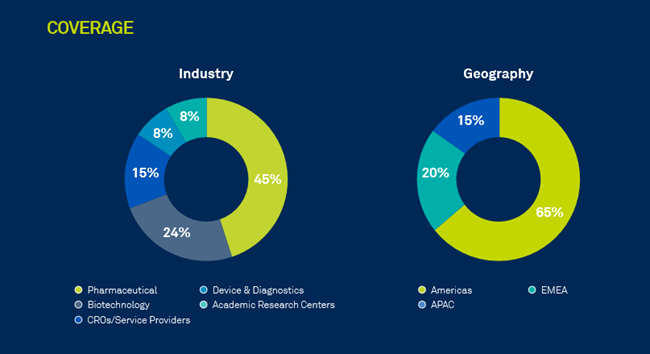
In terms of Medidata’s customer base, pharmaceutical companies account for 45%, biotechnology firms for 24%, CROs for 15%, and academic research institutions and medical device manufacturers each for 8%. Geographically, 65% of its customers are located in the United States, 20% in Europe, and 15% in the Asia-Pacific region. Medidata still has significant potential to substantially strengthen its customer development efforts in the Asia-Pacific region.
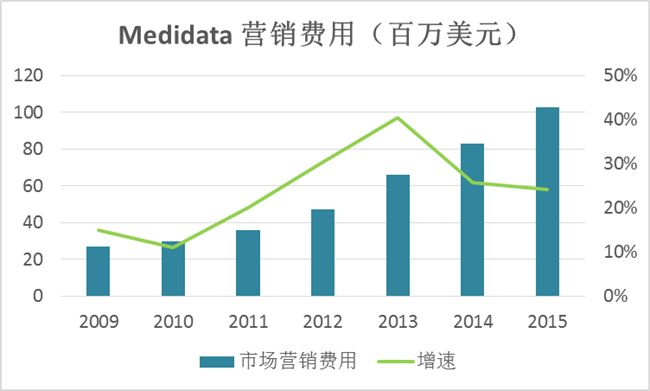
To sustain its rapid growth, Medidata has steadily increased its marketing expenditures and built a robust marketing team, which had grown to 287 members by 2015. The importance of marketing is on the rise relative to that of product development.
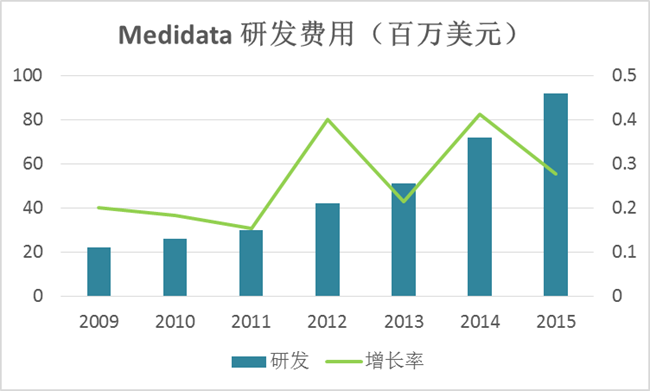
During the same period, Medidata’s R&D expenses also maintained rapid growth, increasing from $2.2 million to $9.2 million. Since 2013, the growth rate of R&D expenses has slowed, but by 2015, the R&D team had reached 420 members.
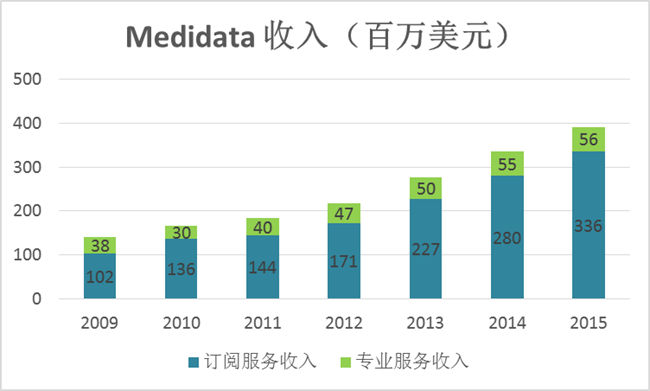
As Medidata’s enterprise user base continued to expand, its revenue increased significantly, rising from $140 million in 2009 to $392 million in 2015. During this period, the proportion of revenue derived from subscription services grew from 73% in 2009 to 86% in 2015, while the share attributable to professional services declined from 27% in 2009 to 14% in 2015.
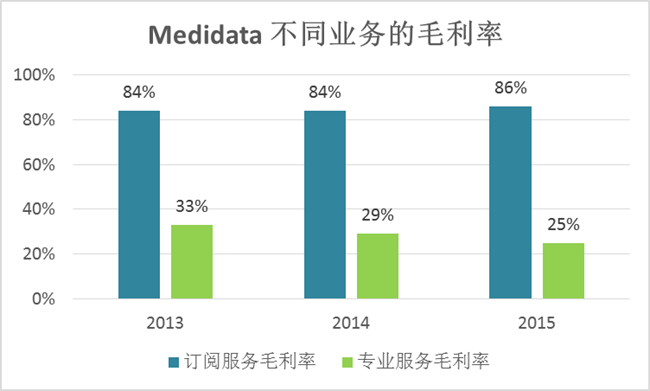
Over the past three years, the gross profit margins for subscription services were 84%, 84%, and 86%, respectively, while those for professional services were 33%, 29%, and 25%. The gross profit margin for professional services was significantly lower than that for subscription services.The business model centered on high-margin, fast-growing subscription-based services (Software as a Service) is the core of Medidata’s success.
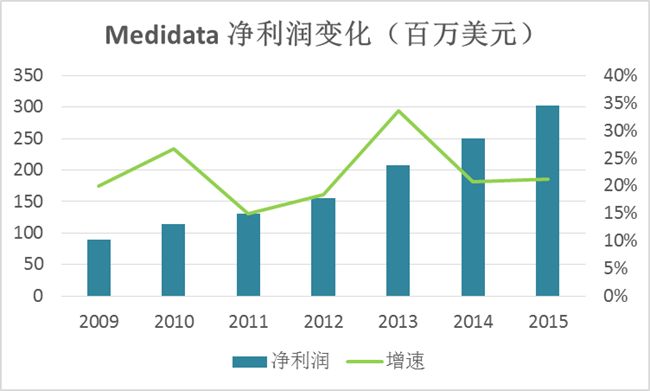
In terms of net profit, the initial figures were low. Although they have been steadily rising, there have been periodic declines in the net profit growth rate. One point worth noting is that, under the accrual basis of accounting, Medidata’s substantial R&D and marketing expenses are recognized as one-time charges, whereas its primary revenue stream from subscription services is recognized periodically. In short, the SaaS-driven business model makes accounting more complex, and net profit fails to fully reflect the company’s growth potential. This also explains why Medidata continued to attract investment even when its net profit growth once fell short of expectations.
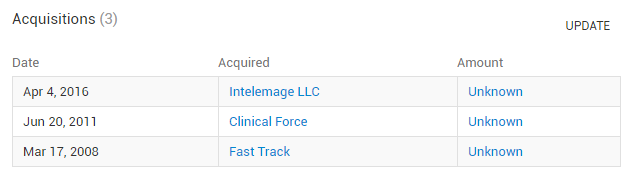
To sustain rapid growth, Medidata acquired three companies: Fast Track in March 2008, Clinical Force in June 2011, and Intelemage LLC in April 2016. All of these were horizontal acquisitions, primarily aimed at acquiring users and expanding market share.
In addition to SaaS, Medidata has also explored other decentralized innovations, such as collaborations with wearable devices. Leveraging wearables to collect real-time data from study participants and comprehensively capture their daily physiological metrics holds significant clinical value. In May 2015, the Nestlé Research Center initiated a clinical trial to investigate the combination of a nutritional product with a specific exercise regimen. All participants were required to wear Garmin’s vívofit fitness tracker to collect data on exercise and daily activities, while also using Medidata’s patient electronic record software to complete questionnaires conveniently on their smartphones or tablets. Data from the fitness trackers and daily records from Patient Cloud were all imported into the Medidata Clinical Cloud platform, where Medidata Clinical Cloud performed real-time data analysis.
Medidata also faces competition from rivals such as Oracle. As a robust provider of enterprise IT services, Oracle counts numerous pharmaceutical and biotechnology companies among its clients. However, Oracle’s weakness lies in its overly broad scope, which makes it difficult to compete effectively with Medidata in the specialized pharmaceutical sector. Another company offering similar services to Medidata is Perceptive Informatics, which likewise focuses on the digitalization of clinical research, including electronic clinical data capture and management, clinical trial management, and electronic patient-reported outcomes (ePRO). Its major clients include Pfizer and Merck & Co.
Medidata has established an office in China and partnered with organizations such as Tigermed (CRO), NuoSige (CRO), and Peking University (academic research institution).
The CFDA’s “Technical Guidelines for Clinical Trial Data Management” (No. 112, 2016) explicitly encourages Chinese pharmaceutical companies and contract research organizations (CROs) to introduce, develop, and implement compliant electronic data capture (EDC) systems for clinical trials. Meanwhile, Document No. 112 also sets forth a series of fundamental requirements and technical specifications for clinical trial data management systems, aiming to facilitate the transition from traditional paper-based data management to electronic data management in China’s drug development sector, thereby enhancing the overall technical capabilities of new drug research and development in the country. This policy orientation is favorable to Medidata’s business expansion in China.
However, Medidata’s development in China has also faced numerous obstacles:
(1) From a legal perspective, Medidata’s servers are not located in China, which presents regulatory challenges;
(2) Insufficient local decision-making authority; due to the organizational structure of multinational corporations, decision-making at the U.S. headquarters is slow;
(3) In terms of marketing details, there are issues with the issuance of service invoices. This has left room for development for similar domestic startups in China.
Author: VCBeat. Please credit the WeChat Official Account when reposting.VBResearch2016
↓↓↓