

Trump's Healthcare Plan Criticized as Favoring the Wealthy, Following His Condemnation of Obamacare as a 'Disaster'
Trump has finally reached the pinnacle of his life, achieving his aspiration to be elected President of the United States. However, on healthcare reform policy, Trump gives the impression of lacking a clear understanding of health insurance policies. In previous debates, Hillary Clinton’s healthcare plan could be summarized as Version 2.0 of the Affordable Care Act (ACA). In contrast, Donald Trump’s healthcare policy fully reflects the image of an unconventional “rebel.” He seeks to dismantle the existing system and rebuild it from scratch. He aims to repeal Obama’s Affordable Care Act, viewing the ACA as a disaster for Americans, and replace it with various measures that would primarily benefit only the healthy and wealthy.
You can take a look at some of his healthcare reform policies:
Policy Proposal 1: Increase competition by amending current regulations that prohibit the interstate sale of health insurance.
Policy Proposal 2: Reduce expenditures by curtailing medical services for undocumented immigrants. Trump’s official healthcare reform plan states that undocumented immigrants cost the United States an additional $11 billion annually.
Policy Proposal 3: “Remove barriers to entry into the free market for drug suppliers that enhance the safety, reliability, and affordability of medications.” “Allowing consumers to access safe and reliable drugs imported from overseas can provide them with more choices.”
Policy Proposal 4: “Require all healthcare providers to be transparent in pricing.”
According to a comprehensive report by the Rand Corporation and the Commonwealth Fund, Hillary’s health insurance plan could provide more affordable coverage for individuals across different income brackets, thereby extending insurance to millions of people. If implemented, Trump’s healthcare reform plan would leave 16 million people without coverage under the new insurance schemes and increase out-of-pocket costs for most individuals who do not obtain insurance through their employers. However, both plans would exacerbate the fiscal deficit.
RAND economists have pointed out that all of Hillary Clinton’s previous proposals would reduce consumers’ healthcare costs, whereas many of Donald Trump’s policy recommendations lack detail, offering only vague ideas or none at all. Larry Levitt, Senior Vice President of the Kaiser Family Foundation, stated, “Clinton’s proposals build on the Affordable Care Act (ACA) to address consumers’ financial burdens and, in many respects, seek to go beyond it. Her policies would help move the nation’s healthcare system closer to universal coverage. Her proposals would increase the number of insured individuals, with tax credits having the greatest impact. However, this approach would also have the largest effect on the deficit, as it would add approximately $90.4 billion in costs.”
Regarding Trump’s healthcare reform policy, the goal is to completely repeal the Affordable Care Act from the Obama era, including some highly popular provisions. If the ACA is repealed, approximately 16 million people will lose their health insurance, and Trump’s other policies will not help most of them regain coverage.
Trump also stated that he would allow individuals to deduct health insurance premiums from their tax returns. He would fund Medicaid through block grants, under which the federal government would provide states with fixed amounts to cover Medicaid costs, replacing the existing, more flexible spending framework. Finally, he would promote the sale of health insurance across state lines. Trump’s website lists several other healthcare policies, but it remains unclear how they would affect enrollment levels (for example, he has expressed support for allowing individuals to use Health Savings Accounts, even though HSAs already exist).
The Impact of Trump’s Proposed Reforms on the Number of Insured Individuals Is Expected to Be Realized in 2018
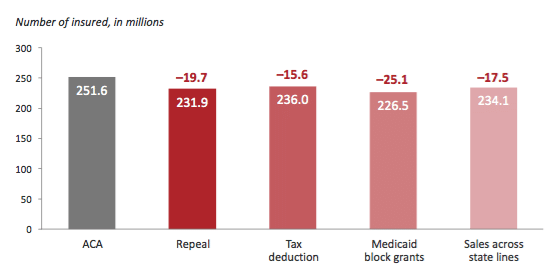
Trump’s plan would leave more low-income individuals without health insurance coverage. However, for those earning $30,000 annually and lacking employer-sponsored coverage, his tax deduction policy would make purchasing insurance more affordable and prove more effective than the Affordable Care Act under Obama. According to estimates in the report, 2.7 million low-income individuals would gain insurance coverage.
The Impact of Trump-Proposed Reforms on Income Distribution Among the Uninsured,Expected to be achieved in 2018
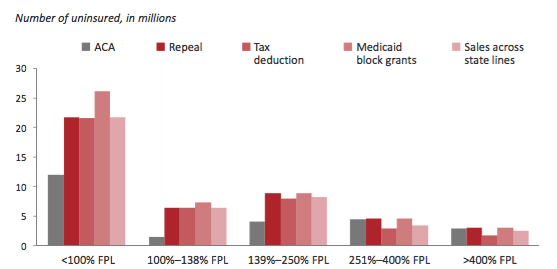
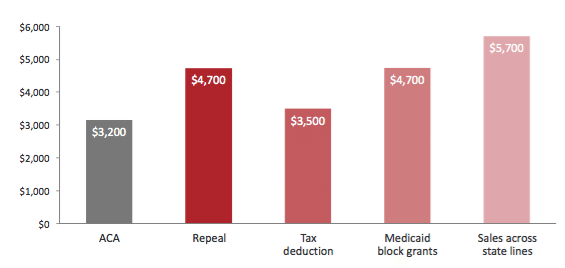
All of his proposals would raise health insurance costs for individuals who purchase their own coverage, with the exception of high-income earners, who would benefit from the tax deduction plan proposed by Trump.
The Impact of Trump’s Proposed Reforms on the Average Annual Out-of-Pocket Costs for Individual Market Participants,Expected to be achieved in 2018
“Without subsidies, middle- and low-income individuals cannot afford health insurance, which would only benefit high-income individuals who already have coverage. Trump’s plan will not expand coverage and will harm the federal debt,” said John E. McDonough, a professor at Harvard University.
The idea of Trump’s Medicaid plan had previously been proposed by other Republican policymakers, including Speaker Paul Ryan, but past block grant proposals were more restrictive than the existing Medicaid program.
Since 2005, every Republican presidential candidate has proposed the interstate sale of insurance. This idea, predicated on free-market competition, seems well-suited to a businessman like Trump. However, experiments in certain states have clearly failed to keep pace with local insurers that have worked hard to establish provider networks across state lines. Sara R. Collins, Vice President for Health Coverage at the Commonwealth Fund, points out that if interstate insurance sales were indeed implemented, insurers might flock to states with the weakest consumer protections.
It is worth noting that all of these healthcare reform measures must pass through Congress and cannot be implemented immediately. “It seems the country is not ready for another major debate on health insurance policy,” said Levitt, “either repeal the ACA or make use of it.”
Although some of Trump’s ideas sound like conservative clichés, he does not always adhere to Republican orthodoxy. For instance, he has suggested that Medicare should be allowed to negotiate drug prices—a policy also championed by the progressive Bernie Sanders. While Trump advocates repealing the Affordable Care Act (ACA), he has also expressed plans to support low-income individuals through Medicaid, whose expansion was one of the key pillars of the Obama era.