

Profitability Landscape of China's Elderly Care Sector and the Rise of Community-Based Platform Business Models: Insights from NEEQ Company Financial Reports
The rapid development of the elderly care industry over the past two years has led to a growing number of elderly care companies listing on the National Equities Exchange and Quotations (NEEQ). By analyzing the financial data and development models of several such companies, we now have the opportunity to explore the current profitability landscape of the elderly care sector, as well as the attitude of capital markets toward elderly care enterprises. Furthermore, by examining the development models of several representative elderly care startups, we will analyze the emergence of community-based platform business models in the next phase.
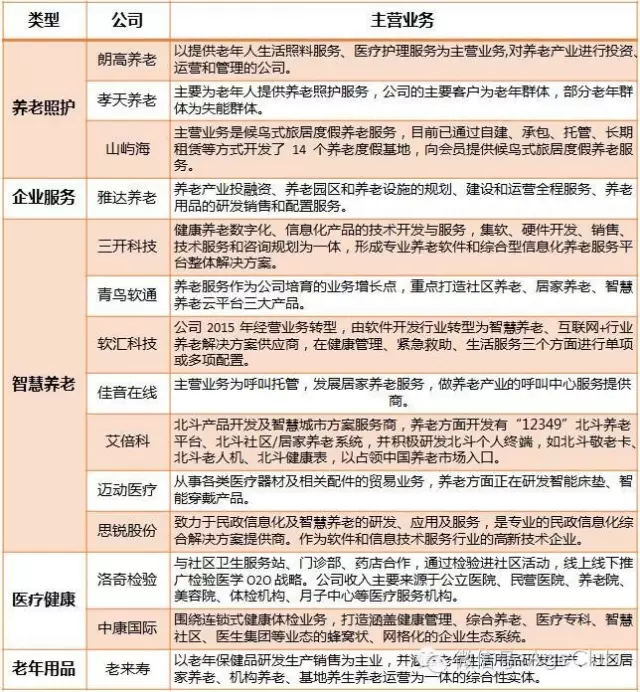
1. Sankai Technology: From SaaS to Offline Services
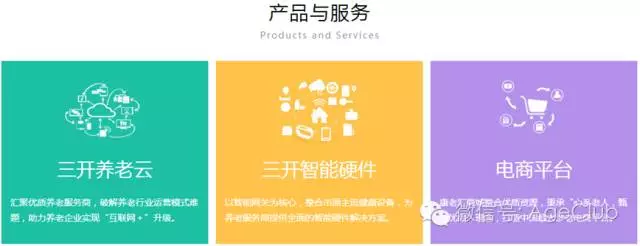
(1) According to the recently released 2016 semi-annual report, Sankai Technology achieved an operating revenue of RMB 11.59 million in the first half of the year, representing a year-on-year increase of 561.43%, while its net profit decreased by 3709.95% compared to the same period last year;
The 2015 annual report shows that the operating revenue for 2015 was RMB 10.7083 million, representing a year-on-year increase of 679.22%; net profit was -RMB 5.7872 million, a year-on-year decrease of 22,105.50%.
(2) In the first half of 2016, Sankai Technology's net cash flow from operating activities was -5.05 million yuan, compared to -440,000 yuan in the same period of the previous year; in September 2016, Sankai Technology issued 416,660 shares to individuals and secured approximately 6 million yuan in financing.

(3) According to the “Risk Warning Announcement on Beijing Sankai Technology Co., Ltd.’s Irregular Early Use of Raised Funds” issued by Southwest Securities Co., Ltd. on August 16, 2016, Sankai Technology used a portion of the raised funds to cover its daily operational expenses, including payment of employee salaries, housing provident fund contributions, and equipment purchase payments, prior to obtaining the filing letter for its stock issuance.
(4) Sankai Technology established a wholly-owned subsidiary: Beijing Kanglaohui Elderly Care Service Co., Ltd. The Kanglaohui brand includes: Smart Elderly Care Cloud Platform (SaaS), Mall (E-commerce), Elderly Care Circle (Media), Health Hall (Science Popularization), and Premium Elderly Care Selection.
Based on the above information, we can draw several simple conclusions:
1. To fulfill the valuation adjustment mechanism (VAM) agreement previously reached with investment institutions, Sankai Technology rapidly expanded its workforce, leading to a significant increase in management costs, and captured market share in the smart elderly care sector through substantial operating losses;
2. Based on the previously announced financing data, we can calculate that Sankai Technology's current market valuation is RMB 150 million!
3. According to publicly available financial report data, due to persistent losses in prior periods, Sankai Technology’s operating cash flow has been negative for two consecutive years. The company is currently experiencing rapid cash burn, with its capital chain under significant strain, necessitating continuous external investment injections to sustain operations;
4. Relying solely on the sale of smart elderly care products can no longer support the company’s long-term sustainable development; Sankai Technology has begun to expand into new business areas;
The predicament faced by Sankai Technology is not merely an issue for a single company, but rather a challenge that the entire smart elderly care industry is poised to confront. Due to low barriers to entry, the number of smart elderly care enterprises transitioning from various other sectors has surged explosively over the past two years. The industry has now entered a phase of intense competition, with profit margins remaining exceedingly low. Relying solely on the sale of hardware and software products to elderly care institutions is no longer sufficient to sustain the long-term development of such companies.
Therefore, we observe that Sankai Technology has adopted a variety of market strategies:First, it launched a SaaS system to elderly care institutions at extremely low or even free prices, connecting as many institutions as possible. By leveraging the SaaS system as a market channel, it laid the groundwork for future value-added services targeted at these institutions. Meanwhile, SanKai Technology established an offline elderly care service company to expand into home-based and community care sectors.
However, based on the services and products that Sankai Technology has rolled out over the past year—including the Smart Elderly Care Cloud Platform (SaaS platform), an online mall (B2C e-commerce platform), the Elderly Care Circle (media platform), the Health Hall (science popularization platform), and Preferred Elderly Care (a matching platform connecting seniors with elderly care institutions)—we believe that Sankai Technology has spread its resources too thinly and lacks a clear strategic direction.
For smart elderly care companies, a large-scale construction initiative targeting community-based home care service centers has already been launched. This wave of development will provide new growth opportunities for smart elderly care enterprises.
In fact, many smart elderly care companies have shifted their target customers from institutional elderly care (To B) to community-based home care (To C). However, due to intense market competition and a relatively obvious ceiling, if these companies cannot continue to deepen their offline services and explore new business models, their profitability will remain limited.
In light of the current state of smart elderly care development, we believe that leveraging existing expertise in smart elderly care services while integrating with offline community service centers to transition toward a platform-based community model represents a critical pathway for the future growth of smart elderly care companies. This aspect will be discussed in detail later.
2. Langgao Elderly Care: Transitioning from Institutional to Community-Based Home Care
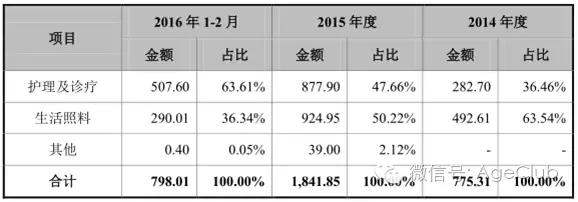
(1) According to the published announcement, Langgao Elderly Care reported operating revenues of RMB 7.7531 million, RMB 18.5448 million, and RMB 8.0487 million for the fiscal years 2014 and 2015, and the period from January to February 2016, respectively; its net profits were RMB 1.4711 million, RMB 1.7152 million, and RMB 1.0909 million, respectively.
(2) Langgao Elderly Care currently operates 500 self-owned beds and manages 250 entrusted beds. Additionally, it added approximately 500 beds this year through its subsidiaries, Meiyuan Nursing Home and Liyuan Elderly Care Home. Meanwhile, the company has signed cooperation agreements with two sub-district offices and 25 community centers, and is gradually expanding the number of partner communities.
(3) Using community centers as a strategic entry point, Langao Elderly Care has actively partnered with internet and telecommunications companies to develop home-based elderly care devices with online capabilities. By embedding Langao’s brand and service information into community households through networks, television, and other channels, the company enables seniors receiving home care to access nursing and caregiving services without leaving their residences.
As can be seen from the financial information disclosed by Langao Elderly Care:
1. Langgao Elderly Care is currently in a phase of rapid expansion, with revenue growth exceeding 100% and net profit demonstrating a significant upward trend, growing at a rate of over 70%!
2. Langgao Elderly Care’s current revenue is derived from three sources: first, the nursing home charges bed and personal care fees for providing daily living assistance and nursing services; second, the affiliated nursing hospital provides medical diagnosis and treatment services to resident seniors and collects corresponding medical fees; third, it offers rehabilitation and nursing services to communities and health centers, charging service fees.
3. Leveraging its own elderly care institutions as a platform and integrating information technology, Langao Elderly Care is extending the reach of its services into community neighborhoods and home-based settings.
Langgao Elderly Care is located in Wuxi, Jiangsu Province, a second-tier city. Its current fee range is between RMB 3,000 and RMB 5,000. Based on the company’s disclosed profitability data and our online and offline interviews, we believe that elderly care institutions with clear market positioning in first- and second-tier cities can sustain market profitability through effective operational management without significant challenges! (Of course, no discussion here will be devoted to those who spend all day preaching that elderly care is unprofitable while simultaneously striving to expand their chain operations!)
Particularly in first-tier cities, where most elderly individuals own their own independent housing and the rental market demand is exceptionally strong. (The practice of having seniors sell their properties to fund retirement has proven unfeasible after several years of implementation.)
By renting out their properties, elderly residents in first-tier cities can earn monthly rents of over RMB 5,000 for a two-bedroom apartment within the city. Combined with current average monthly pensions exceeding RMB 2,000, a significant number of seniors in these cities can afford price levels ranging from RMB 5,000 to RMB 10,000 per month.
In first-tier cities such as Beijing, Shanghai, Guangzhou, and Shenzhen, the institutional elderly care market in the price range of RMB 5,000–10,000 has fully opened up. Particularly this year, as government support policies have become more precise and practical, profit margins in the sector have begun to materialize comprehensively.
In fact, even in Hefei, Anhui—a city classified as “tier 2.5”—we previously learned that a senior care company operating seven small-to-medium-sized chain facilities with a mid-range market positioning and over 3,000 beds achieved a net profit exceeding RMB 15 million in 2015 through effective operational management and cost control, while maintaining a high profit growth rate.
An analysis of the two aforementioned elderly care companies listed on the National Equities Exchange and Quotations (NEEQ) reveals a significant trend: the comprehensive integration of institutional elderly care with community- and home-based care services. In practice, many urban elderly care institutions have expanded their service reach to include community and home-based care, while policy support for this direction has become increasingly evident:
In October this year, the "Notice on Doing a Good Job in the Radiation of Community Home-based Elderly Care Services by Nursing Homes in 2016" issued by Beijing Municipality has clearly stated:Elderly care institutions in Beijing can receive subsidy support for providing short-term care, meal assistance, and cleaning services to community-dwelling seniors by leveraging their professional expertise. Citywide elderly care institutions are encouraged to utilize their resource advantages to develop home- and community-based elderly care services.
After several years of cultivation, the development direction and business models of the institutional elderly care market have gradually become clear. The next wave of growth opportunities will emerge in community-based home care. As this segment targets individual elderly consumers (B2C), it will give rise to a diverse array of business models and innovative companies.
Several representative startups in community-based home care for the elderly have already emerged in the current market. By analyzing their development trends, we believe that the greatest growth opportunity will stem from: the rise of platform-based business models in community care!
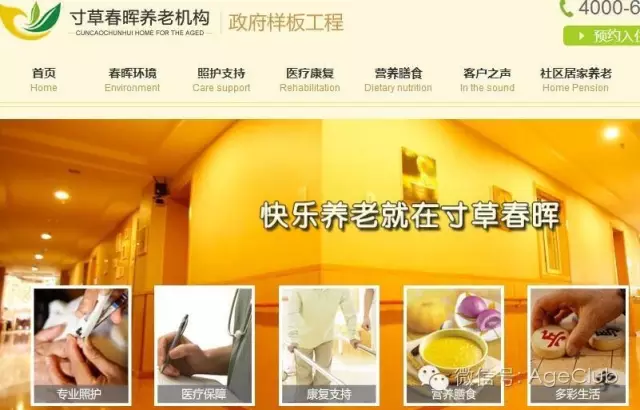
Wang Xiaolong, founder of the well-known Beijing elderly care institution Cuncha Chunhui, mentioned this year that all 100 beds at Cuncha Chunhui are fully occupied, with over 700 seniors on the waiting list for admission. Meanwhile, the institution’s current net profit margin has reached 8%.
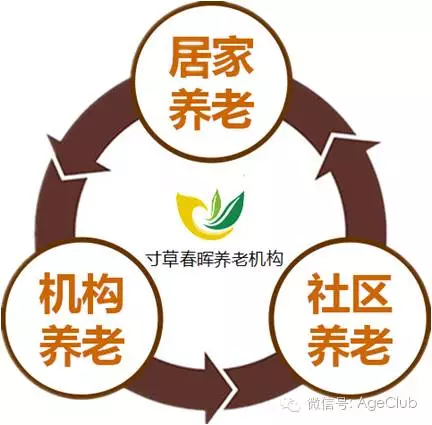
These data reveal that: 1. After several years of exploration, Cuncha Chunhui’s integrated elderly care model—spanning institutions, communities, and home-based services—has been largely validated; 2. A signal is being sent to society, capital investors, and partners that Cuncha Chunhui will rapidly expand and replicate its model in the next phase!
The integrated development model of "Inch of Grass, Spring Sunshine" primarily integrates institutional and community-based care by leveraging the strategic location of its community-embedded elderly care facilities. With support from the government and local sub-district offices, as well as through information technology solutions, it provides a range of home-based elderly care services—including day care, meal delivery, medical accompaniment, rehabilitation nursing, psychological comfort, and daily living assistance—to over 5,000 seniors aging in place within the surrounding community.
However, to meet the diverse needs of the large number of home-dwelling elderly individuals surrounding its facilities, Cuncao Chunhui alone cannot fulfill all demands with its own service capacity. Ultimately, third-party elderly care service providers must be introduced. In this model, Cuncao Chunhui will organize and distribute services based on the needs of the elderly population, while also overseeing and ensuring service quality. As this model further develops in the future, Cuncao Chunhui will gradually transition from being an institutional elderly care service provider to assuming a platform-based role.
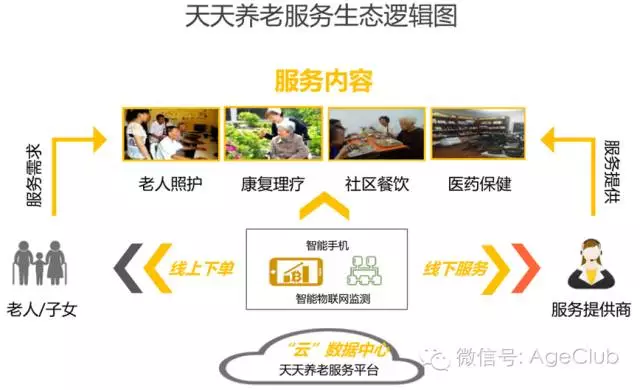
In fact, many technology-driven eldercare startups have previously attempted to establish community-based platform models, commonly referred to as “virtual nursing homes,” which garnered significant attention for a time. Some tech companies connect home-dwelling seniors through smart devices; when seniors have needs, they contact the platform, which then notifies third-party providers to deliver in-home services.
This model appears simple; however, due to the absence of offline service outlets, it fails to provide sustained operational support or ensure service quality. Relying solely on government leadership and continuous financial subsidies, this model is difficult to implement in practice and is highly likely to fail under market-oriented operations.
The “Inch of Grass, Spring Sunshine” model, which uses embedded elderly care institutions as its vehicle, is merely one type of platform-based business model. The most critical factor behind its success is its self-sustaining revenue-generating capability, allowing it to maintain normal operations over the long term even independently of home-based elderly care demand.
However, this model has certain drawbacks if it is to fully evolve into a platform-based model. First, the asset-heavy nature of establishing elderly care facilities within communities would significantly slow down expansion if a large-scale networked community platform were to be built. Second, due to the need to meet the development requirements of its own institutions, site selection is highly stringent, making broad geographic coverage difficult.
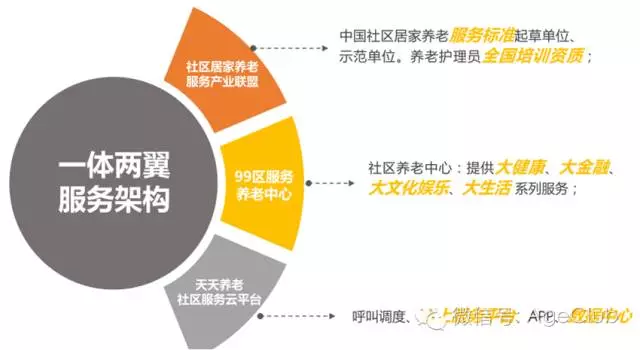
Another model, which involves establishing community-based elderly care service centers/stations, is better suited for this type of scalable, platform-driven business model. In this regard, the most promising business model we have observed so far comes from a company called Zhongkang Xingjian. Its Tiantian Elderly Care project has leveraged its own resources and advantages to develop a pragmatic and sustainable business model:
(1) As Tiantian Elderly Care is a drafting unit for China’s community-based home care service standards, backed by central state-owned enterprises such as Datang Wire & Cable, and possesses extensive experience in home-based elderly care services, local governments and sub-district communities have invited the company to establish operations by providing community office spaces free of charge. This initiative aims to leverage idle resources to develop community-based elderly care services. Through this model, Tiantian Elderly Care has established multiple community elderly care service centers in Beijing and Shenyang, and is replicating this approach in other cities.
(2) Tiantian Elderly Care holds the qualification for training elderly care workers, authorized by the Ministry of Civil Affairs. It has established four training centers for elderly care workers in Beijing, Shandong, Anhui, and Shanghai. These training centers have laid a talent foundation for the large-scale and rapid replication of community elderly care service centers in the next phase;
(3) A community-based information resource database for the elderly has been established, alongside the development of mobile applications for family members and service providers. By integrating various smart devices, this system enables precise scheduling and matching of elderly care demands with service supply within the designated service radius.
We are optimistic about the development model of Tiantian Elderly Care because it captures several key points:
First, it has secured support from local sub-district governments, enabling access to premises free of charge and reducing operational costs, thereby creating conditions for individual stores to achieve profitability;
Second, there is a steady supply of human resources to support rapid replication. The emphasis on rapid replication stems from the fact that those who can cover community channels and capture market share at the fastest speed will gain a dominant position in the future integration of service resources;
Third, the use of elderly care databases and smart devices has expanded the service radius, improved service efficiency, and reduced costs!
Operational data from Tiantian Elderly Care’s actual business operations also corroborate the aforementioned viewpoint. During previous interviews, communications with the two founders of Tiantian Elderly Care provided insights into the company’s real-world operational circumstances.
At Tiantian Elderly Care’s flagship store in Shenyang, founder Mr. Xiao Hongyi conducted over six months of on-the-ground operational exploration. By continuously refining staff matching criteria and selecting third-party service providers suited to local home-based elderly residents, Tiantian Elderly Care has achieved a monthly revenue of RMB 200,000 per store, with profits exceeding RMB 20,000, serving more than 2,000 elderly individuals. Similar operations are concurrently being rolled out at six other local facilities. The available operational data demonstrate that this asset-light, platform-based business model for community-based home care is viable.
The reason we previously cited Cuncun Chunhui’s slow expansion speed as a flaw is that, in the current stage of China’s elderly care market, once a business model becomes clear, the market will not afford you any room for hesitation! Moreover, this is a battle for channels and entry points targeting the 90% of the elderly population who age in place within their communities. The commercial resources that can be integrated through this entry point in the future offer boundless potential!
This October, Beijing’s aggressively launched elderly care station plan attracted competition from more than 10 state-owned enterprises, inadvertently reinforcing the development trend of this community-based platform business model!At the current pace of development, we anticipate that it will take only three to four years for various centers and stations providing home-based elderly care services in Beijing to reach saturation. Companies offering such platform-based service models will then enter a phase of competition centered on service quality, where the decisive factors will be their operational capabilities and brand trustworthiness.
As elderly care workers are the frontline personnel in direct contact with older adults and serve as the final gatekeepers of service experience, their quality of service directly determines seniors’ trust in enterprises. Therefore, cultivating a sufficient number of qualified elderly care professionals is key to the future competitive success of community-based eldercare companies.This demonstrates that Tiantian Elderly Care’s self-established training center for elderly care attendants reflects a long-term strategic vision!
In the current capital market, we can observe a phenomenon: despite substantial policy support and active participation from numerous enterprises, mainstream venture capital firms remain highly cautious about elderly care investments, leaving the sector in a marginalized position.
I believe the most critical reason is that the elderly care industry came into the view of these investment institutions too late. Most investment firms have not allocated dedicated investment professionals, nor have they had sufficient time to conduct systematic tracking and research on the sector. Consequently, they lack a genuine understanding of the current state of the elderly care industry, eldercare needs, and national policies.
Based on prior discussions with numerous investment institutions, it appears that some still view the elderly care sector merely as a subset of medical services or as senior housing real estate. They fail to recognize the industry’s rapid evolution, along with the emerging business models and new opportunities that have already taken shape.
To give a brief example, in March this year, investors from several well-known financial advisory (FA) firms contacted us, hoping we could recommend promising elderly care projects. At the time, we recommended MaiMai Elderly Care. However, they responded with a lengthy argument that elderly care is part of the healthcare sector and expressed skepticism about MaiMai Elderly Care’s business model. Yet, just two months later, MaiMai secured RMB 30 million in investment.
However, contrary to mainstream venture capital firms, many of the elderly care industry investment cases we have observed offline originate from state-owned enterprises, financial institutions, and industrial funds within the sector. These companies, having been engaged in the elderly care industry previously, possess a clearer understanding of industry changes and opportunities!
We believe that in two years, as the asset-light operational model for community-based home elderly care gradually matures, and as investment firms gain a firmer grasp of industry dynamics and investment opportunities following talent acquisition and market research, mainstream venture capital will shift greater attention to the elderly care sector. At that point, we may well witness a surge in investment activity reminiscent of the 2013–2014 period, when numerous investors flocked to the mobile health space.
By Duan Mingjie, Zhou Chao
Source: Silver Hair Club