

From 'Pharma' to 'Healthcare': JoinTown Redefines 'Pharma E-commerce 4.0'
The internet pharmaceutical industry is in the ascendant, with positive developments emerging continuously. Driven by growing consumer demand for online medication purchases and health management services, the market size of “Internet + Healthcare” continues to expand, attracting intense interest from traditional pharmaceutical companies, e-commerce platforms, hospitals, and investors. How to adapt to evolving user needs and achieve industrial upgrading and transformation in the internet era has become a critical question for every participant in this sector.
Jointown, as one of the largest pharmaceutical manufacturing and distribution enterprises in China, has actively explored the “Internet + Healthcare” model in recent years. It has developed internet-based pharmaceutical businesses such as Jointown Pharmaceutical Network (B2B), Haoyaoshi Online Pharmacy (B2C), and Qumaiwang Online Pharmacy (O2O), achieving sustained performance growth and successfully transforming its traditional operations through digitalization.
In February this year, Haoyaoshi partnered with the outpatient pharmacy of Wuhan Central Hospital to pilot the remote sale and delivery of certain prescription drugs, with related payments settled online. This experimental step in the online sale of prescription drugs has opened up new possibilities for the future of internet-based pharmaceutical services.
VCBeat (WeChat ID: vcbeat) seeks to review Jointown Pharmaceutical Group’s e-commerce development steps in recent years, identifying the highlights and lessons from its transformation.

As the earliest offline business segment established by the e-commerce group, Haoyaoshi Pharmacy Chain Co., Ltd. was officially founded in Wuhan, Hubei Province, in November 2003. The company has set up chain branches in more than ten provinces and municipalities, including Shanghai, Beijing, Hubei, Jiangsu, Shandong, Henan, Fujian, and Xinjiang. As of 2016, it operated nearly 1,000 retail pharmacies under its brand, and has since become a well-known brand in China’s pharmaceutical retail chain industry.
In 2010, Jointown Pharmaceutical Group established Haoyaoshi.com in Beijing, venturing into the B2C pharmaceutical e-commerce sector and marking the commencement of its consumer-facing (C-end) e-commerce operations. As the group’s once most loss-making e-commerce segment, the B2C business turned profitable in 2016, breaking the long-standing “nightmare” of pharmaceutical e-commerce burning cash without generating profits, and signaling that the sector was gradually reaching an inflection point toward profitability.
In April 2014, to address the pain points and weaknesses in the development of its B2C business, Jointown Pharmaceutical Group began piloting an O2O pharmaceutical service model anchored by offline retail stores. That same year, the Haoyaoshi APP was officially launched, entering the pharmaceutical O2O sector with its core service promise of “24-hour medication delivery, guaranteed within one hour.”
As of October 2016, the Haoyaoshi APP had successfully launched in ten cities, including Wuhan, Beijing, Shanghai, Nanjing, Fuzhou, Zhengzhou, Jinan, Suzhou, Wuhu, and Urumqi, providing one-hour home delivery of medications within main urban areas and demonstrating strong operational performance.
In line with the Group’s development plan, the number of covered cities is projected to exceed 30, enabling service coverage in all first- and second-tier cities as well as selected third-tier regions.
In July 2015, Jointown Pharmaceutical Group signed an agreement with the First Affiliated Hospital of Zhengzhou University in Henan Province, Huawei Technologies Co., Ltd., and Donghua Software Corporation to formally explore telemedicine models. The four collaborating parties will leverage their respective strengths to integrate resources, creating a closed-loop system for the patient care journey that encompasses diagnosis, pharmaceutical distribution, and backend information tracking.
In February 2016, Haoyaoshi partnered with the outpatient pharmacy of Wuhan Central Hospital to pilot the remote sale and delivery of certain prescription drugs, with related payments settled online. This move marked a breakthrough progress for Jointown in the online sale of prescription drugs, enabling it to bridge the most critical link in the pharmaceutical e-commerce sector.
In 2015, Jointown Pharmaceutical Group established a health management company and developed the “Health 998” APP, a cloud-based personal health management platform that integrates online and offline omnichannel services. On August 19, 2016, after one year of trial operation, the “998 Medical Escort” service was officially launched. This service covers all aspects of the medical consultation process, representing a significant innovation in service marketing within the “Internet + Healthcare” market environment.
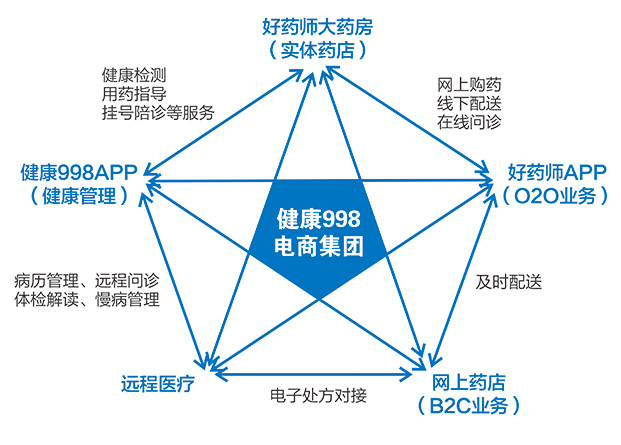
Jointown Pharmaceutical E-commerce Omnichannel Strategic Blueprint
Jiang Zhitao, General Manager of the E-commerce Group, stated that the group’s current strategic focus is to align “pharmaceuticals” with “medical services.” While technologies such as telemedicine are already in place to provide customers with online consultations, medication guidance, and chronic disease management, the “998 Medical Escort” feature enables a more comprehensive, professional, and effective approach to addressing users’ healthcare needs.
The turnaround to profitability in the B2C segment and the rapid development of the O2O business are the result of comprehensive efforts, including improved internal management, leveraging resource advantages, and achieving omni-channel integration. The Group has fully utilized the effective integration of its “three networks”—the upstream supply network, the downstream distribution network, and its proprietary marketing network—to achieve efficient transmission and sharing of procurement, logistics, and sales information across the upstream and downstream industries. This has strengthened connections among all parties in the pharmaceutical industry chain, effectively reduced costs, and significantly enhanced efficiency and service quality.
In August 2016, Jointown Pharmaceutical Group released its semi-annual report for the first half of 2016. The report stated that the group achieved operating revenue of RMB 29.786 billion in the first half of the year, a year-on-year increase of 24.66%. Its B2C e-commerce business under Beijing Haoyaoshi Pharmacy recorded sales of RMB 470 million and net profit of RMB 4.7904 million during the same period. Amid the current environment characterized by slowing growth in the pharmaceutical e-commerce market, policy uncertainties, and a generally “sluggish” market trend, these figures undoubtedly served as a significant boost to Jointown.
Within Jointown’s overall strategic plan, pharmaceutical e-commerce constitutes a critically important component. Regarding future development plans, Jiang Zhitao, General Manager of Health 998 E-Commerce Group, stated, “Jointown aims to achieve RMB 100 billion in sales by 2019. As such, high expectations are placed on Health 998 E-Commerce Group. In line with our own projections, we are striving toward RMB 10 billion in sales, aiming to account for 10% of the group’s total.”
Beyond this, Jointown’s primary objective in the near term is to leverage its involvement in pharmaceutical sales to shift the operational focus of pharmaceutical e-commerce from mere medication services to customized user health services. This aligns with what is externally discussed as the “Pharmaceutical E-commerce 4.0” stage. In layman’s terms, Pharmaceutical E-commerce 4.0 refers to integrated “drug + medical” solutions or a model where “drugs” serve “medical care.” At this stage, pharmaceutical companies should place greater emphasis on integrating resources across the entire pharmaceutical industry chain, building a more comprehensive service system, and gradually establishing an effective, differentiated strategic framework and business model.
Amidst a broader landscape in which the internet’s penetration and transformation of the industry continue to deepen and user demands are constantly evolving, adapting to market trends requires bold experimentation and breakthroughs. Jointown Pharmaceutical Group’s pilot program for the online sales and distribution of prescription drugs is leading the upgrade of the entire industry.