

We Spoke with Kuai Fang Song Yao CEO Gao Yue: The O2O Medicine Delivery Market Still Holds Vast Potential
Recently, online pharmacy purchases have been characterized as low-frequency consumption with low average transaction values. Critics argue that the capital influx into this sector is driven by pseudo-demand and illusory prosperity, leading to sustained negative discourse. Consequently, major online pharmacies and mobile health models have faced varying degrees of skepticism.
VCBeat (WeChat ID: vcbeat) spoke with Gao Yue, CEO of Kuai Fang Song Yao. He told us that purchasing medication is not a low-frequency consumer behavior; online pharmaceutical sales have entered a period of rapid growth, with significant market potential yet to be tapped, enough to sustain several companies committed to this sector.
Gao Yue’s remarks are not mere empty talk. As a pioneer in testing online drug sales and mobile healthcare services in China, Kuai Fang’s experience precisely corroborates the development trajectory of China’s pharmaceutical e-commerce and internet healthcare sectors.
In September 2014, the Kuai Fang Song Yao (Quick Prescription Delivery) app was launched. Three months later, it secured an angel-round investment of several million RMB from Unity Venture Capital. During the same period, competitors such as Yao Gei Li, Hao Yao Shi, and Ding Dang Kuai Yao also entered the market. Suddenly, traditional pharmacies, internet healthcare providers, and investors all set their sights on this emerging sector, with institutional funding propelling the medicine delivery O2O (Online-to-Offline) industry into a phase of explosive growth.
By October 2015, Kuaifang had secured another RMB 200 million in Series B financing from Tiantu Capital. Operational data at the time showed that its services covered multiple cities, including Beijing, Shanghai, Guangzhou, Shenzhen, and Hangzhou, with both registered users and average daily order volume on an upward trajectory.
A keen observation is that the pharmaceutical O2O business model is quite straightforward: it captures consumer demand on the C-end, submits orders to pharmacies, and then handles medication dispensing and delivery. The entire process is clear and transparent, meaning there are few technical barriers to entry. This has led to intense competition, with delivery speed being a key factor. KuaiFang has adopted the slogan “One-hour door-to-door medication delivery, compensation for delays,” while other competitors are also focusing heavily on delivery timeliness.
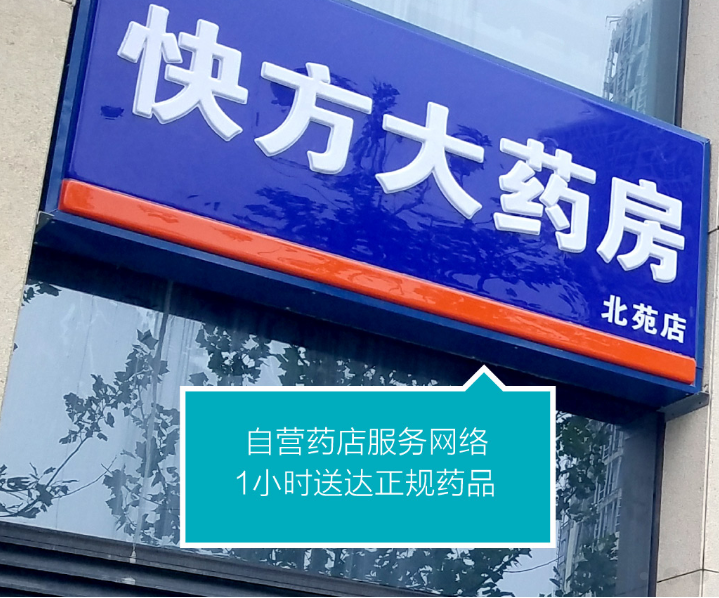
To seek greater autonomy and control over every stage of medication delivery, KuaiFang has begun its transformation, shifting from its original model of partnering with pharmacies to developing its own proprietary pharmacy network.
“There are many problems with the cooperative pharmacy model, such as disjointed management and an inability to guarantee service experience. The key to addressing users’ pain points is to provide them with the best possible service experience. If service quality cannot be assured, this business model simply cannot succeed,” said Gao Yue, CEO of KuaiFang, explaining the reasons for considering a strategic pivot in an interview with VCBeat (WeChat ID: vcbeat).
After more than a year of exploration, KuaiFang has achieved notable success with its self-operated pharmacy and delivery model. Currently, in the Beijing area, KuaiFang operates 18 stores, offering thousands of pharmaceutical products, with an average daily order volume of 10,000. In terms of user data, there are over 1 million registered users, with a daily active user rate exceeding 3%. Repeat purchases are common, and the average transaction value is around RMB 30.
In terms of revenue, Gao Yue revealed that KuaiFang has basically achieved a balance between income and expenditure, and while maintaining stable revenue, profitability has begun to take shape.
This stems from KuaiFang’s optimization of store site selection and the digital transformation of its self-operated pharmacies. Regarding site selection, factors such as rental costs and delivery convenience are taken into account, while the digital transformation of self-operated pharmacies enables dynamic adjustment of listed drug information to adapt to order volumes and user demands.
“Interlocking” is a key term that Gao Yue emphasizes regarding self-operated pharmacies and efficient delivery. From drug procurement, warehousing and distribution, and order fulfillment to last-mile delivery, KuaiFang ensures autonomous control over every link. This approach has significantly reduced operational costs while improving delivery efficiency and customer satisfaction.
“Currently, our delivery rate exceeds 95%, and customer satisfaction is above 98%,” said Gao Yue.
Regarding competition with traditional pharmacies’ online operations and other medication delivery services, Gao Yue stated that pharmaceutical O2O differs significantly from conventional O2O businesses. There is no price war or cutthroat competition, and the industry still holds substantial room for growth. As residents’ demand for pharmaceutical consumption rises and online purchasing of medicines becomes established, the market size will continue to expand.
“It is possible to support seven, eight, or even ten companies with similar business models. It also requires industry peers to work together to standardize the sector, continuously expand its scale, and increase its market share,” said Gao Yue.
Kuaifang’s partnership with JD.com further corroborates this point. On October 22, Kuaifang Medicine Delivery announced its launch on JD Daojia. Regarding the rationale behind this collaboration, Gao Yue stated that the primary consideration was JD.com’s ability to drive traffic. Within less than a month of going live, orders generated through JD.com had exceeded 3,000.
The dense network of offline pharmacies represents the future market size. The key challenge lies in shifting existing offline consumption to online channels. In essence, KuaiFang operates as an internet pharmacy. The most significant difference between internet pharmacies and traditional ones is their level of informatization. Data collected via the internet enables mutual benefits for both pharmaceutical companies and users.
From a nationwide market perspective, according to statistics from the China Food and Drug Administration, the total number of pharmacies in China grew from approximately 320,000 in 2006 to 430,000 in 2013. However, the number of people served per independent pharmacy decreased from over 4,100 to around 3,000, while chain pharmacies experienced slow growth. The medicine delivery app market is, in essence, a further consolidation of resources within the existing retail pharmacy industry.
The advance and retreat represent the future direction of the industry.
Regarding the future, Gao Yue stated that the priority is to deepen its presence in the Beijing area, establish a stable foothold, and accumulate operational experience before gradually expanding its geographic coverage.
News that Yaogeili’s business was suspended due to a breakdown in financing has cast a shadow over the online-to-offline (O2O) medicine delivery sector. We specifically inquired about KuaiFang’s financing status. Gao Yue stated that investors had been relatively satisfied with KuaiFang’s business model and operational results. The company provides annual reports to its investors on financial and operational performance, and investors remain highly confident in KuaiFang’s future development.
Currently, KuaiFang has no plans for a new round of financing. Gao Yue stated that any updates will be promptly shared with VCBeat (WeChat ID: vcbeat). Your continued attention is welcome.