

2016 Deloitte Survey of U.S. Physicians: Financial Incentives and Data-Driven Tools Are Essential for Value-Based Care Adoption (Part I)

The U.S. presidential election concluded with the ultimate victory of Donald Trump, a political outsider often dubbed “the madman.” Although Trump repeatedly emphasized during his campaign his intention to repeal the Affordable Care Act (Obamacare), he quietly softened his stance after securing the presidency, mirroring the pattern of previous presidential candidates who moderated their positions once assured of assuming office.
At his White House meeting with Obama on November 10 (local time), Trump appeared serious and chose his words carefully, a far cry from the arrogant bravado he had displayed just days earlier. Although the Trans-Pacific Partnership (TPP), seen as a strategic counterbalance to China, was essentially dead, Trump indicated that Obamacare could still be preserved.
In an interview with The Wall Street Journal on the same day, he stated that the decision was made to retain two key provisions of the Affordable Care Act (Obamacare)—namely, the prohibition on health insurers denying coverage to patients and the allowance for parents to keep their children on their health insurance plans for an extended period—thereby preventing the repeal of the legislation.
Therefore, given the current situation, it remains unclear to what extent Trump will fulfill his campaign promises; at least until the end of the year will we see concrete actions. The specific details of his “100-Day New Deal” and its impact on physicians’ income also require further observation.
But in any case,The Trend of Healthcare Systems Transitioning from Fee-for-Service to Value-Based Care Remains Unstoppable. In the past few years, the transition from fee-for-service to value-based payment and care delivery models has become one of the most significant industry-wide efforts. For example, in a 2016 survey of senior executives at provider organizations, 94% of respondents indicated that they were transitioning to value-based healthcare. On the other hand, the pace of change has been relatively slow, with only 27% of providers having completed pilot projects. This figure has remained virtually unchanged compared to 2015.
DeloitteReleased its “2016 U.S. Physician Survey Report” in late October. The report surveyed 600 U.S. primary care and specialist physicians,Analysis of the Essential Elements Required by Physicians for Implementing Value-Based Healthcare Practices。
The report suggests that combining fiscal incentive policies with data-driven tools can help align physicians’ clinical practices more closely with the principles of value-based care. VCBeat (WeChat ID: vcbeat) has compiled the core content of the report to provide insights into the current status, challenges, and future directions of value-based healthcare practices in the United States, with a particular focus on their impact on physicians. Due to the length of the article, it will be published in two parts. This is Part I.
Deloitte’s “2016 U.S. Physician Survey Report” to600 PhysiciansA series of topics related to MACRA, consolidation, and health information technology were discussed, specifically covering the following subjects:
(1) Use of Practice Pattern Data. Practice pattern reports can assist physicians in selecting among different healthcare services and comparing their practice patterns with those of peers or against quality benchmarks. Practice pattern information can also help physicians determine which specialists or healthcare facilities to refer their patients to. For example, if one specialist tends to favor surgical intervention while another prefers conservative management, the patient’s “clinical pathway” will depend on which specialist her physician refers her to;
(2) Measurement and Reporting of Healthcare Quality. Both healthcare systems and individual clinicians will measure and report on the quality of medical services they provide. The measurement of service quality is a fundamental component of healthcare model analysis and serves as the basis for performance-based physician compensation. Furthermore, many private and public insurers also require healthcare quality reporting;
(3) Reduce variability in healthcare. Clinical nursing guidelines (also known as clinical protocols) are the primary tools for medical standardization.
Currently, the reimbursement model for most U.S. physicians is based on a fee-for-service (FFS) system.. Fee-for-service (FFS) encourages physicians to adopt more tests, procedures, and treatments, but not all of these are supported by evidence-based quality and value. Consequently, many efforts to improve the performance of the U.S. healthcare system have focused on physicians. Healthcare systems, physician organizations, health plans, government payers, life sciences companies, and others seek to better understand how to influence physician behavior to achieve success in value-based payment models.
As previously stated, the transition in healthcare payment models has been slow.FFS remains the largest source of revenue for many healthcare systems and medical groups., only3% of healthcare systems deliver more than half of value-based care services. To meet quality and cost targets, healthcare organizations may face certain risks when implementing value-based care contracts; in response, many institutions continue to compensate physicians using a fee-for-service model.
The Medicare Access and CHIP Reauthorization Act (MACRA), enacted in 2015, aims to encourage U.S. healthcare organizations to adopt value-based care models. Starting in 2019, MACRA ties Medicare payments to the cost and quality measures implemented by clinicians in their practice. It encourages participation in alternative payment models to share financial risk and improve healthcare quality.
Current Status of Value-Based Healthcare
1. Financial incentives for participation in value-based healthcare remain insufficient
Although many stakeholders in the healthcare industry are committed to promoting value-based care, the findings of this study still indicate that most independent physicians have not yet received compensation under value-based care models. Understanding physicians’ perspectives on various compensation methods can guide health systems and other healthcare organizations in collaborating with physicians to develop robust physician compensation frameworks that better align their clinical practices with the principles of value-based care.
2. Value-based payments account for a negligible share of physician compensation
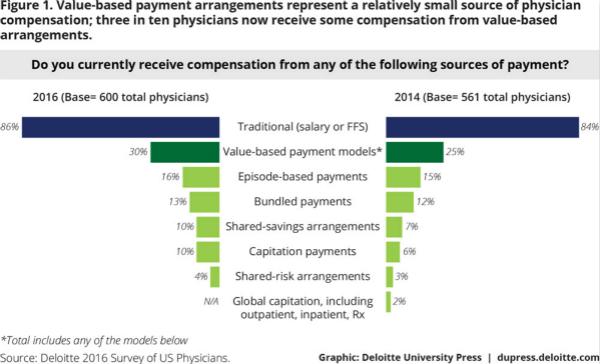
Similar to the 2014 findings, in 2016 most physicians (86%) were still compensated under the fee-for-service (FFS) system or through salaries (see Figure 1). Although the proportion of physicians participating in value-based payment models is increasing (30% in 2016, compared with 25% in 2014), few physicians are engaged in models with the greatest downside risk (10% for capitation and 4% for risk-sharing arrangements). Additionally, 16% of physicians are compensated based on episodes of care, 13% through bundled payments, and 10% via shared savings arrangements.
Studies have shown that even for organizations participating in pilot programs run by the U.S. Centers for Medicare & Medicaid Services (CMS), such as Accountable Care Organizations (ACOs), physician compensation structures are similar to those of non-ACO entities. Research found that physician compensation in both ACOs and non-ACOs consisted of 49% salary, 46% productivity-based pay (fee-for-service), with only 5% tied to quality and other factors.
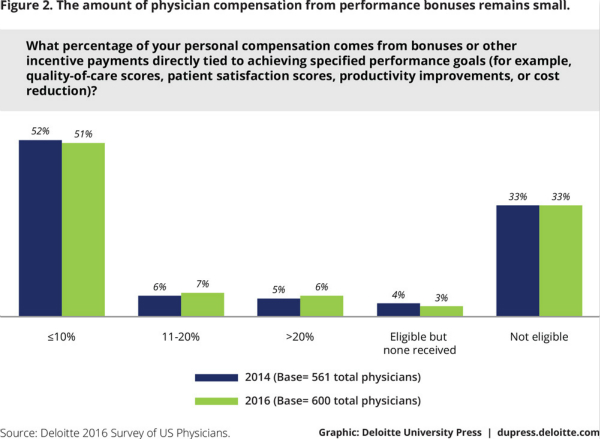
Thus, it can be seen thatNot only is value-based payment less common in physician compensation, but performance-linked compensation—such as for better quality or lower costs—also accounts for a small proportion.(See Figure 2). In the survey report, 51% of physicians indicated that their performance bonuses were less than or equal to 10% of their total compensation, while 33% reported being ineligible for performance bonuses. Only 7% and 6% of physicians received performance bonuses accounting for 11–20% and more than 20% of their total compensation, respectively. These figures are substantially lower than the threshold cited in the literature as effective for incentivizing physicians and driving behavioral change (i.e., 20% of total compensation).
Interestingly, some surveyed physicians responded that they would be willing to assume a considerable proportion of compensation risk if necessary. Half of the respondents indicated that this proportion could be 15%, meaning that approximately 50% of the participants were willing to accept a compensation risk exceeding 15%, while the other half were willing to accept a risk level below 15%.
3. Physicians still prefer fee-for-service (FFS) and salary-based compensation models
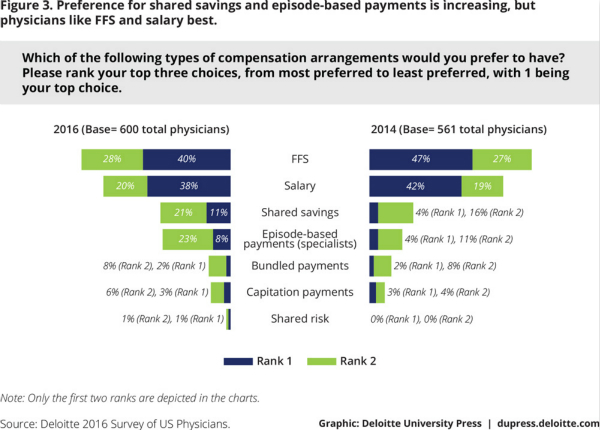
Most physicians reported that they still prefer the fee-for-service (FFS) system (ranked first by 40% of respondents and second by 28%) and/or the salary model (ranked first by 38% and second by 20%).See Figure 3). As was the case in the 2014 report, few physicians prefer value-based payment models, as such models often entail significant financial risks (e.g., capitation and risk-sharing). However, compared with 2014, there are alsoMore physicians prefer models that include upside risk components, such as shared savings models.。
Insights
Research indicates that incentives are most effective when provided directly to individual clinicians, rather than to medical or treatment teams; furthermore, financial incentives are most likely to improve healthcare outcomes when they are sufficiently substantial (at least 20%).
Geisinger Health System is an integrated healthcare provider that has pioneered and led innovation in electronic health records (EHR). It is renowned for its employed-physician model and robust performance in cost and quality, utilizing an 80/20 compensation structure under which 20% of physician compensation is tied to cost and quality metrics. Since implementing this compensation framework in 2006, Geisinger has achieved significant improvements in clinical outcomes and reduced costs for 18 common therapeutic interventions, such as congestive heart failure.
Recommendations
(1) Organizations that employ physicians or work closely with physicians practicing under value-based care models should consider aligning their own incentives with physician incentives;
(2)Link at least 20% of physician compensation to performance targets. This can help increase physicians’ implementation of value-based care initiatives and strengthen their incentives to improve cost and quality;
(3)Steps to achieve this goal may include assessing individual physician performance and compensation, as well as setting targets. Effective compensation redesign strategies involve the active participation of physician leaders and regular, open communication with general physicians.
4. Tools and capabilities supporting value-based healthcare services vary significantly in terms of usability and maturity
Financial incentives, whether implemented to reduce costs or improve healthcare quality, will struggle to achieve their objectives if physicians lack corresponding data-driven tools. These tools can help physicians understand cost and quality metrics and support them in making medical decisions aligned with evidence-based clinical practice.
This survey explores physicians’ needs for and usage of these tools, including clinical protocols that inform decision-making, care model data used to measure performance and improve healthcare outcomes, care model data utilized for external referrals, and EHR technology. Most surveyed physicians reported being able to use these tools, although the extent of usage varied by physician and tool type.
Variations in healthcare services lead to changes in cost and quality. Based on an analysis of these variations, the Dartmouth Atlas Project estimates that up to 20% to 30% of U.S. healthcare spending may be unnecessary. For healthcare organizations participating in value-based payment models, reducing unwarranted variations in healthcare services is a critical clinical priority, as doing so can help improve quality and cost performance. Methods to reduce unwarranted clinical variations include:
(1) Use of evidence-based practice. The availability of clinical protocols (commonly referred to as clinical practice guidelines) in healthcare enables physicians to more easily select cost-effective clinical protocols and base their treatment decisions on solid evidence. This approach can reduce unnecessary variations in medical care;
(2) Enhancing transparency through the use of medical practice pattern data. Medical practice pattern data can help physicians understand the discrepancies between their own clinical practice patterns and the established benchmarks or standards in the field;
(3) Shared medical decision-making involving clinical doctor-patient interactions. It can help patients make informed choices that reflect their values and preferences. This approach is not discussed in this report.
5. Clinical protocols are widely available and highly valued by physicians
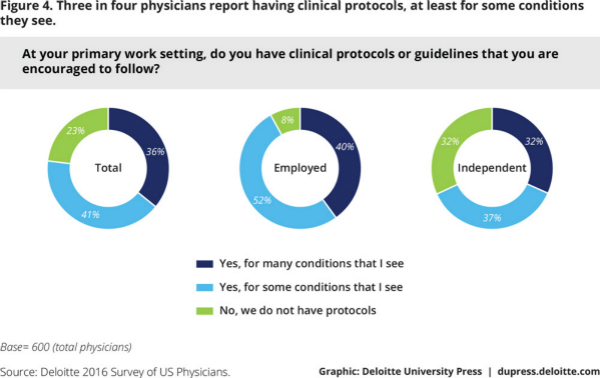
Surveyed physicians reported having access to clinical pathways and acknowledged their value. 77% of respondents indicated they have access to clinical pathways, with 36% reporting comprehensive availability across many medical scenarios and 41% reporting availability in some scenarios. Notably, healthcare standardization has a longer history of implementation in inpatient settings (i.e., hospitals). The survey results confirm that the availability of clinical pathways is higher among inpatient physicians (90%) compared to outpatient physicians (69%).
Furthermore, the survey also revealed significant differences between employed physicians and independent practitioners: 92% of employed physicians had access to clinical protocols, compared to only 68% of independent physicians (See Figure 4). The reason for this phenomenon is that implementing clinical pathways at medical sites may require electronic health records (EHR) and clinical decision support systems, and the costs associated with these technologies have led to lower adoption rates of clinical pathways among independent physicians.
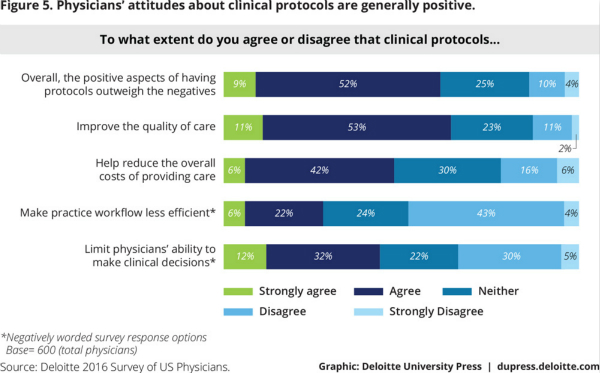
Overall, physicians hold a positive attitude toward the adoption of clinical pathways and the reduction of clinical variation. Sixty percent of surveyed physicians reported that the benefits of clinical pathways outweigh the drawbacks (See Figure 5); 48% of respondents believed that reducing clinical variation helps improve the performance of the U.S. healthcare system (See Figure 6)。
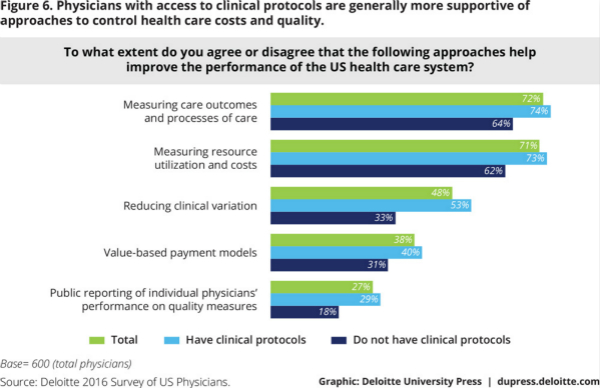
Physicians with access to clinical pathways often hold more favorable views on cost and quality control, performance measurement, and the reduction of clinical variation. Furthermore, although value-based payment models and strategies such as public reporting of individual physician performance are currently adopted at low rates among physicians overall, acceptance of these strategies is relatively higher among this group.
Some physicians expressed concern that clinical pathways would restrict their ability to make clinical decisions (43% agreed, 35% disagreed). According to other studies on this topic, concerns about the loss of clinical autonomy have become a major barrier to the adoption of clinical pathways. The results of this study indicate that physicians who have access to clinical pathways generally hold a positive attitude toward them. The report also found that even among physicians who accept clinical pathways, there is similar concern about the loss of clinical autonomy, with 37% agreeing and 39% disagreeing that clinical pathways would restrict physicians’ ability to make clinical decisions.
Insights
Physicians’ positive attitudes toward the use of clinical protocols indicate that the healthcare industry is increasingly integrating evidence-based approaches into point-of-care settings. However, several barriers persist in this process: some physicians still lack access to clinical protocols, let alone adopt them; there are challenges in expanding the scope of these protocols to cover a broader range of clinical scenarios; and existing clinical guidelines require ongoing review and updates to ensure they accurately reflect the current evidence base. The low adoption rate of clinical protocols, particularly their underutilization in small, independent medical practices, may be attributed to the absence or insufficiency of hospital information technology (HIT) systems, skepticism regarding the utility of clinical guidelines, and distrust in the guideline development process.
Recommendations
(1)To enhance physicians’ support for and adoption of clinical pathways, healthcare organizations that employ physicians or work closely with physicians delivering value-based care should seek to understand their specific perspectives on the use of clinical pathways;
(2)After understanding physicians’ perspectives, healthcare organizations can develop corresponding strategies to overcome these barriers, including: engaging physicians in the development of clinical protocols to help persuade and attract those who are skeptical; demonstrating the relationship between protocol adherence and patient outcomes to support commercial adoption and broader use of the protocols; expanding the scope of existing protocols to cover more patient scenarios, thereby increasing the availability of relevant clinical protocols in specialty areas with currently poor coverage; communicating rules regarding permissible exceptions and deviations while simplifying documentation requirements to support deviations from clinical protocols and mitigate the perceived loss of clinical autonomy; and investing in health information technology (HIT) systems to facilitate the dissemination of protocols and their seamless integration into daily medical practice.
6. Medical Model Reports Are Applicable to Most Physicians, but Challenges Remain
Medical Practice Reports can provide physicians with feedback on their clinical practice. These reports may include information on patient experience, quality of care, resource utilization, or costs, and can be used for continuous quality improvement in healthcare or performance-based compensation.
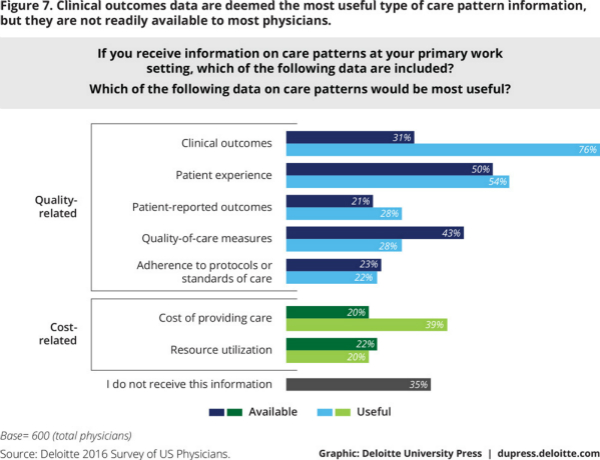
Sixty-five percent of surveyed physicians reported that they receive care model information. However, the survey also revealed a gap between the availability of care model reports and the perceived usefulness of this tool. Physicians pointed out that care model reports should include information on clinical outcomes, patient experience, and costs. In practice, however, physicians mostly receive information related to the “care process,” such as healthcare quality metrics, rather than clinical outcomes. Patient experience is a commonly used quality measure, and many physicians consider this metric to be highly useful (See Figure 7)。
Compiling and reporting accurate data on care models is highly challenging, as patients often consult multiple physicians, leading to delays in data collection and categorization. This is particularly evident in primary care, where despite numerous improvement initiatives, the granularity and precision of care model data still lag behind those in specialized fields such as oncology and nephrology. Quality reporting is costly, with an estimated annual expense of approximately $40,000 per physician. The survey results indicate:
(1) 85% of physicians believe that they require additional resources in their practice to comply with the quality reporting requirements mandated by Medicare;
(2) 74% of respondents stated that the task of collecting and reporting quality measure information is extremely burdensome;
(3) 83% of respondents believe that these measures fail to accurately reflect their quality of medical care.
Physicians with advanced capabilities to access certain types of information, such as clinical pathways and/or care model data, generally do not report being ill-prepared for quality reporting requirements under MACRA. However, even within this group, the majority still consider quality reporting tasks to be highly burdensome. For instance, 72% of physicians with access to clinical pathways and 82% of those with limited access reported that quality reporting constitutes a significant burden; furthermore, 84% of physicians with access to clinical pathways and 87% of those with limited access indicated that they require additional resources to meet reporting requirements.
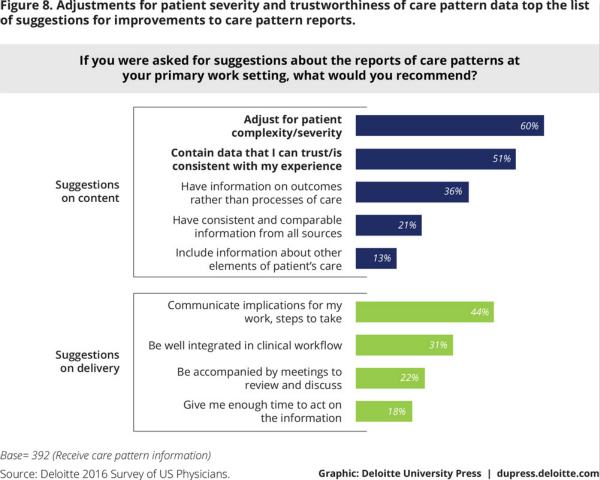
When asked about their desired improvements to clinical pathway reports, surveyed physicians indicated that they hoped such reports could adjust data based on the complexity or severity of patients’ conditions (60%), enhance credibility and align with physicians’ clinical experience (51%), and place greater emphasis on outcomes rather than processes (36%). The functionalities physicians expect are more related to the delivery and usability of clinical pathway reports than to their actual content.See Figure 8)。
Implications
Under MACRA, performance on resource utilization and quality measures will be factors influencing physician reimbursement levels in federal Medicare. In fact, only one-fifth of physicians report receiving resource utilization data (Figure 7), indicating that further development of these reporting functionalities is still needed. These data must not only be delivered to physicians but also disseminated in a useful, easily understandable, and actionable format.
Similarly, quality data used to benchmark the performance of healthcare institutions should be reliable, reproducible, and focused on outcomes within physicians’ control. Methodological details and rationales regarding outcome measurement (such as severity adjustment or its absence) and patient attribution, as well as their implications for physicians’ practice and areas requiring improvement, should be clearly explained.
Recommendations
(1) When designing performance-based physician compensation, it is essential to ensure that performance goals are meaningful and realistic; furthermore, the number of measures should be reasonable;
(2) Priority should be given to medical quality performance over cost;
(3) Educate physicians on performance measures and assist them in setting priority goals for their efforts.
7. Low utilization rate of cost or quality data during patient referral
For organizations building value-based care capabilities, understanding physicians’ referral behaviors and patterns can help identify ways to reduce costs or improve treatment outcomes. One study found that, in the absence of detailed treatment guidelines, physicians in high-spending regions were more likely than those in low-spending regions to adopt more intensive clinical approaches, some of which involved referrals (e.g., referring patients to specialists for one-time consultations or ongoing management, ordering tests and diagnostic procedures, or transferring patients to hospitals or skilled nursing facilities).
In such cases, medical prices can vary significantly, and these variations are often unrelated to the quality of care; furthermore, price disparities can even occur within the same market, with the cost of the same medical procedure varying by as much as three to four times.
In this survey, the interviewed physicians cited trust or working relationships (75%) and professional expertise (69%) as the top two criteria for patient referrals.See Figure 9). Other studies have also shown that physicians place great emphasis on clinical expertise.
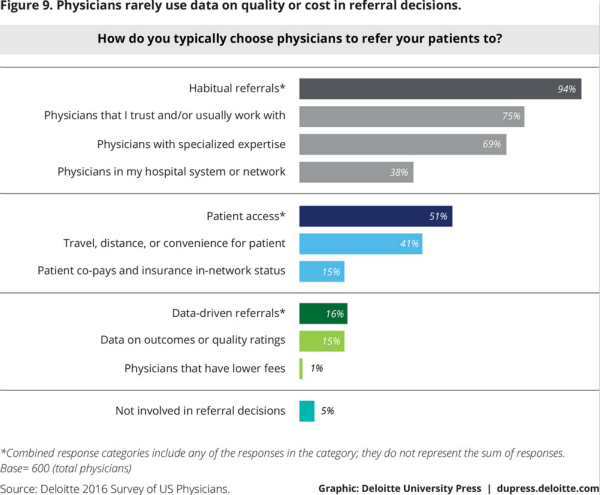
Consistent with the literature, patient inquiries are considered an important factor in referral decisions (51%). This is particularly true in primary care (58%) and among non-surgical specialists (60%).
The survey results indicate that referrals based on data-driven and evidence-based models are relatively uncommon. Only 15% of physicians reported considering the medical outcomes or quality ratings of referral institutions when making referral recommendations. Cost considerations were also infrequent, with only 15% of physicians taking into account patients’ out-of-pocket expenses and insurance network status. Furthermore, merely 1% considered physician fees.
Clearly, physicians are highly interested in different types of information for various referral categories. Sixty-four percent of physicians indicated that complication rates help them refer patients to appropriate specialists. For specialist referrals primarily intended for consultation, patient experience (55%) and diagnostic error rates (42%) were considered the most useful. For referrals to treatment facilities, patient experience (44%) ranked highest. For referrals to outpatient diagnostic facilities, patient cost (52%) was the primary consideration, followed by diagnostic error rates (45%).
Insights
Many physicians are inclined to incorporate quality data into their referral recommendations; in the absence of readily available relevant data, they rely on habitual practices for referrals. Given physicians’ interest and the incentives associated with resource utilization measures under the Merit-based Incentive Payment System (MIPS), physicians may perceive greater value in referring patients to healthcare providers who routinely employ low-intensity (or conservative) approaches. Furthermore, if the current trend of increased patient costs due to high deductibles persists, physicians’ interest in cost-related information is likely to grow, as many must consider the affordability of medical services for their patients.
Recommendations
(1) Healthcare organizations that employ physicians or work closely with physicians providing value-based care may need to collaborate with payers in the market to enhance transparency in quality and cost. This will facilitate the development of comprehensive data reporting on care models, providing relevant data and information to internal and external physicians and facilities;
(2) Data supporting referral-based medical models should include all information deemed relevant by the physician; information may be prioritized according to the type of “recommended referral destination.”
All data and information in this article are sourced from Deloitte.In late October, VCBeat compiled and released its “2016 U.S. Physician Survey Report.”