

Five Gene Testing Companies, One Reporter: How DNA Database Errors Could Haunt the Future of Precision Medicine

How to Obtain Valuable Data After Participating in Genetic Testing,What Is the Connection Between Genetic Analysis and Specific Functions? U.S. Renowned Journalist Rebecca Robbins Experienced ItThe genetic testing services offered by five companies: DNAFit, Genomic Express, Kinetic Diagnostics, Orig3n, and Simplified Genetics,Prices range from $154 to $400, providing us with a preliminary understanding of the industry. VCBeat (WeChat: vcbeat) has provided a complete compilation.
My genes indicate that I am better suited for high-intensity aerobic exercise rather than low-intensity aerobic exercise. In fact, I am not entirely certain, as I placed two orders via email for genetic testing, and the results provided two completely different interpretations for the chromosomes at the same location in my DNA.
Perhaps I should opt for a third test. It might even interpret the same genotype as indicating that I derive associative benefits from the stir-fried egg whites, quinoa salad, and stir-fried chicken I consumed on Sunday.
After completing the five most popular genetic tests currently available for athletes, I found myself in a hall of mirrors populated by athletes ranging from elite competitors to recreational joggers like me. The tests promised to analyze my genetic makeup and provide “unprecedented insights” into my “fitness potential,” or help my body reach its optimal state.
However, some tests are oversimplified and contradictory. Regarding the risks associated with my tendon strain, these tests attribute such risks to specific chromosomal regions but offer divergent interpretations. For instance, they indicate that I am predisposed to hypertension and specify which chromosomal regions contribute to this susceptibility.
I underwent this test in the genuine hope that it would help explain why I excel at a particular type of sport. (Back in high school, strictly speaking, I was a softball pitcher.) I also hoped they would provide useful tips to enhance my current athletic performance.
Since undergoing the tests, I have endured having seven vials of blood drawn from my arm at once. They also inadvertently caused bleeding in my inner cheek. Furthermore, they incidentally discovered that I am at risk for Alzheimer’s disease—a fact I would have preferred not to know. But so what? Nothing of value was gained.
Gene analysis companies are forming alliances with personal trainers, chiropractors, and coaches worldwide to promote genomic testing, which they believe can help athletes at all levels tailor their training based on their DNA. They have finalized collaboration plans with Baylor University’s football team in Texas, the English Premier League, Egyptian football clubs, elite training facilities in Arizona, and top track-and-field athletes, including several participants in the Rio Olympics.
However, there is no scientific basis to support the claim that genetic analysis can identify whether a specific athlete is predisposed to benefit from a certain type of sport, is susceptible to tendon injuries, or will face difficulties in recovering from strenuous exercise.
According to the consensus statement published last year in the British Journal of Sports Medicine, these tests “have no role in talent identification or individualized training programs, and thus offer little value in helping individuals reach their peak performance through corresponding training.” This statement was endorsed by more than twenty experts in genomics and sports performance.
As far as I am aware, there is limited research on how to interpret the relationship between genetics and individual fitness levels. Moreover, there is currently no evidence to guide athletes on how to respond to such information.
This may also be why the information I received was overall very discouraging; they merely offered generic, common-sense advice, such as stretching before exercise. Furthermore, some details were oddly specific (and completely impractical for me), such as providing a meal plan that instructed me to eat quinoa on Sundays.
Below is the information I have gathered about myself from these tests, as well as relevant information about the industry:
Choosing a satisfactory test from such a wide array of categories is exceedingly difficult. According to statistical data from one researcher, at least 39 companies had launched consumer genetic tests for fitness purposes by last year, nearly doubling the market size compared with 2013.
I ultimately chose DNAFit, Genomic Express, Kinetic Diagnostics, Orig3n, and Simplified Genetics Testing. Their prices range from $154 to $400.

Rebecca Robbins participated in trials at five companies.
In the following weeks, test kits arrived by mail. Each box contained a swab along with instructions on how to collect a DNA sample from the inside of your cheek. (One gentle reminder advised against swabbing too vigorously, but I still managed to draw a tiny bit of blood.) Kinetic Diagnostics also arranged for me to visit a nearby laboratory, where seven vials of blood were drawn; I must have appeared somewhat anxious, as the technician asked more than once if I was doing okay. I later learned that part of the blood sample was used to analyze non-genetic biomarkers, such as vitamin levels and cholesterol.
I mailed the swabs used to wipe the inner cheeks back to each company and anxiously awaited the results.
Over the following weeks, my genetic test results trickled in and were delivered to my email inbox. Orig3n, keeping up with the trend, even developed a dedicated app for its results. I received relevant data tables, charts, and a slew of athlete photos. Each test provided a corresponding report on my gene sequences, covering positions 2 to 57, with genotypes represented by two-letter codes, such as CC or AT.
Holding these reports, I felt as if I were trying to decipher an arcane script. I attempted to identify the symbols I could understand: I appear to be remarkably resistant to tendon injuries, and I favor sprinting over long-distance jogging. My long arms give me a distinct advantage as a softball pitcher; however, my excessively slender build and poor coordination work to my disadvantage.
A simple cheek swab has become the savior of football: a straightforward genetic test can help identify which young athletes are at risk of suffering the most severe consequences of concussions. This concept has led to keeping these children away from contact sports, while giving their less susceptible peers the green light to play rugby.
“What if you don’t know whether the outcome will be better?” asks a genetic testing company in an advertisement on Facebook. Meanwhile, another company promotes: “Know your risks. Make confident choices.”
Are these tests being conducted? The market for such testing only began to emerge a few years ago. Although touted as revolutionary, it has seemingly failed to create a stir. Not many athletes are interested in undergoing the tests, and insurers are unwilling to cover the costs.
Now, even some supporters of the tests are pulling back. They have voiced their inner concerns to athletes and their parents, explaining that unknown risks may lurk within their genes—including the heightened risk of disease in children who have experienced concussions, as well as an increased risk of developing Alzheimer’s disease later in life.
I didn’t realize there were so many risks. Frankly speaking, after reviewing all this information, I found nothing of practical value. From a practical standpoint, it was entirely unhelpful. For example, Kinetic Diagnostics reported that I have six pairs of chromosomes associated with an increased risk of osteoarthritis, and another four pairs indicating a predisposition to typical diseases. Orig3n informed me that five pairs of my chromosomes ensure normal metabolism.
Most importantly, I am eager to know whether the test will confirm that choosing softball was the right decision for me. Softball has played a pivotal role in my development, and I wonder if my genes have predisposed me to this “correct” choice. Through softball, I have forged many close friendships. I have spent countless hours on the field, and by the end of high school, I had become quite proficient at the sport.
Am I destined to be passionate about softball? Yet I was disappointed, as the test results failed to provide any specific information.

Map of the Geographic Distribution of Five Genetic Testing Companies
But this may be the best approach: When such tests were first introduced to the market five years ago, many sales representatives used genetic perspectives to help children determine which sports would be ideal for them. However, many companies that continue to thrive today have stopped issuing these controversial prescriptions, but ratherOnly provide some brief reports informing about various genetic indications for engaging in endurance sports or "high-intensity" sports.(typically involving rapid burst speed), the existing advantages and disadvantages.
The problem, however, is that some people’s results are not clearly superior or inferior but fall somewhere in between. Take me, for example: all analyses, including the ACTN3 genetic test, agree that I am suited for both high-intensity and endurance exercises, yet I possess no significant advantage in either. In other words, I am quite average.
Genomic Express provided me with a list of six sports, ranging from basketball to water polo, noting that “sports requiring endurance but featuring high intensity offer greater advantages” (softball was not included). However, the company carefully emphasized that DNA does not determine destiny: “You can enhance your performance in all types of activities through proper diet/nutrition and training regimens.”
Alright, understood. So, will genetic testing help me find my optimal diet and training plan? In a word: No.
The guidance I received is nearly universal. For instance, what recommendations does Kinetic Diagnostics offer? Regarding how to mitigate the increased risk of muscle spasms, they state: “Perform proper stretching and muscle warm-ups before and after exercise.”
How can I follow DNA Fit’s recommendations to make up for deficiencies and help me benefit more from endurance training? “Stay well hydrated.”
Kinetic Diagnostics indicated that I have an elevated risk of hypertension, while DNAFit suggested that I might experience fewer blood pressure issues. Both companies claimed their assessments were tailored to my genotype and offered the same recommendation: exercise. (When I later questioned them about this advice, these companies acknowledged that such recommendations could benefit anyone but maintained that individuals with my specific genotype would find it particularly beneficial.)
The most specific guidance appears to come from simplified genetics, which suggests dividing my weekly exercise routine into three high-intensity workouts, such as sprints or step aerobics, and one low-intensity workout, such as yoga or hiking.
But I found this advice unconvincing, as it was based solely on the analysis of two variables from a single genome. (Kurt Johnsen, CEO of Simplified Genetics, told me that these two genetic markers provide customers with an entry point.)
The company also developed a one-week meal plan that, according to Johnsen, optimizes the distribution of fats, proteins, and carbohydrates based on my genotype and sex. Monday’s breakfast is a smoothie, Tuesday’s lunch is a turkey salad, and Wednesday’s dinner features tilapia and quinoa.
All of this sounds extremely healthy, without a doubt,But I find it hard to believe that a single gene could make this particular menu more suitable for me, given that the diverse array of foods in other menus is undoubtedly healthier.。
Then, the explanations offered one by one were feeble and mutually contradictory.These tests each target different locations in my genome.. This may be intended to differentiate them from their competitors, but it in itself indicates that the field is still immature. Therefore, it is impossible to compare the full results of each company.
However, among the data point scores, I found that 20 genetic variables appeared simultaneously in two or more test results. These companies provided identical genetic readings for these variables, leading me to doubt whether they correctly analyzed the buccal swab cells I sent them. Nevertheless, in six of these cases, the interpretation provided by one company directly contradicted that of another.
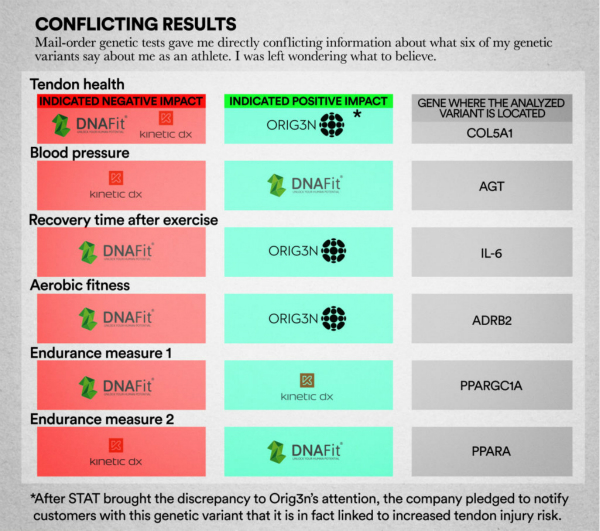
Contradictions in Genetic Testing Are Frequently Emerging
In one case, two companies cited the same journal article to support opposing conclusions. In their analysis of the gene known as COL5A1, which functions to regulate the amount of protein produced in tendon and ligament tissues, all three tests reported that I have the TT genotype. According to Orig3n, this is a relatively rare variant, present in less than 10% of the population.
DNAFit stated that this gene makes me more susceptible to tendon injuries, citing several research findings. Kinetic Diagnostics referenced another study report from 2012 and concurred that I have an elevated risk of tendon injury.
However, Orig3n cited the same 2012 research study but reached the opposite conclusion: I engage in self-protective behaviors when at risk of tendon injury.
On this point, I was already confused. So I contacted the authors of the 2012 study, and they said that their findings “Too rudimentary to yield reliable interpretations”, especially in my case, where the TT genotype implies a risk of injury.
But what surprised me even more was that Robin Smith, CEO of Orig3n, admitted that his company may have made a mistake.
After I shared my findings with Smith, he stated that his team had reviewed the literature and concluded that I likely face a higher risk of tendon injury. He committed to sending corrections via email to other clients with the same TT genotype. He also informed me that his team would investigate data on another genotype, where Orig3n’s interpretation similarly contradicted the test results from another company.
When I asked other companies how they responded to these contradictions, DNAFit provided me with a 2,000-word document defending its interpretation of my genotype. The document even included citations from scientific studies to bolster its explanation and refute the conflicting results I had received from other companies. (My apologies to the DNAFit employees who persisted with this task.)
Kinetic Diagnostics did not respond to my specific questions regarding the discrepancies. It has withdrawn its test from the market, describing it as a “pilot,” and is working to improve its business model.
An Important Disclosure
In my results, there are even more outlandish findings. My Kinetic Diagnostics test indicated that my DNA makes me more likely to try smoking. (However, my records show that I have never smoked.)
A supplementary genetic assessment I ordered from Orig3n, a test called “Superhero,” told me that it would “take longer to learn new languages.” (To be honest, Spanish and Italian were not my strong suits in school.)
I also received some significant information that I had not anticipated. A few months ago, I received a report indicating that athletes undergoing testing were sometimes faced with difficult decisions regarding the analysis of two variants of the APOE gene. APOE is the most reliable genetic predictor for assessing the risk of developing Alzheimer’s disease.
I knew it; I never wanted to know this information. Then I discovered my APOE status, unsurprisingly, on Orig3n’s Fitcode testing page, where it was listed as an indicator predicting my likelihood of becoming overweight. I immediately noticed that I carried a relatively rare variant—rare enough that I recognized its association with either an increased or decreased risk of Alzheimer’s disease. My heart began to pound in my chest.
After a quick search, my anxiety gradually subsided as I learned that the chromosome I carry appears to offer some protection against what some people refer to as Alzheimer’s disease. Nevertheless, I still had an odd feeling that, although this information was private, it was not something I had wished to know.
Orig3n is the only company that does not publish on its website the specific list of genes it screens for. Smith stated that the company is not concerned about reporting on genes including APOE, as the results are not analyzed in the context of Alzheimer’s disease; however, the related test report indicated that I have normal cholesterol metabolism.
So, how has such genetic testing changed me? I haven’t developed the habit of eating quinoa on Wednesday nights. Nor has my exercise routine changed significantly. However, I may spend more time stretching before each workout, as it is certainly harmless to me.
Enthusiasm for precision medicine, from the White House to everyday physicians, is at an all-time high. However,Severe Issues in Databases Used to Interpret Patient Genetic Profiles May Lead to “Inappropriate Treatment” and “Devastating Consequences”, researchers warned at the Mayo Clinic on Monday.
Their report described approximately twenty cases in which test subjects were informed that they might be suffering from a fatal disease and required surgical implantation of a cardiac defibrillator, but it turned out that such intervention was entirely unnecessary. After a young relative died from a cardiac syndrome, family members underwent genetic testing. The results indicated that they carried mutations in heart-related genes; the database used by the testing company suggested that these gene mutations would lead to severe disease.
However, a reanalysis by Dr. Michael Ackerman, a genetic cardiologist at Mayo Clinic, and his colleagues, who had access to more modern genetic databases, indicated that the genetic mutations were in fact harmless and that invasive treatment was unnecessary. “This is the well-known dark side of genetic testing and precision medicine,” said Ackerman. BecauseThe Company’s Database for Interpreting DNA Tests Is Riddled with Errors“We are starting to see a lot of nonsense,” the patient said, explaining that DNA misreads can lead to a diagnosis of disease when the individual is not actually ill.
Other experts have also expressed concerns about the database. “This is not a new issue,” said Michael Watson, Executive Director of the American College of Medical Genetics and Genomics.He stated that most recent genetic studies have focused exclusively on populations in the United States and Western Europe, and the resulting data may not be applicable to other populations.. DNA variants that may cause disease in one racial group might not produce disease in other groups.
These issues have drawn significant attention, as the use of “precision” methods may lead to misdiagnosis or result in ineffective or even harmful treatments for patients.
“Obtaining DNA sequencing is the easy part,” Ackerman said. “The Achilles’ heel lies in the analysis of genetic testing.” He estimates that at least 10% of long QT syndrome genes have been misidentified due to sequencing errors, leading to false-positive predictions of disease causality. This can cause confusion and may result in misdiagnosis.
In addition to cardiology, he added, “Up to 30% of disease-associated genes undergo mutations rather than remaining unchanged. We will need to carry out extensive data curation.”Need to clean up erroneous data in the databaseOtherwise, the dream of DNA-based precision medicine could become a nightmare of misdiagnosis.