

2016 U.S. Physician Survey Report: Financial Incentives and Data-Driven Tools Are Essential for Physicians to Meet Value-Based Care Goals (Part II)

As mentioned above, Obama’s proactive abolition of the TPP agreement was seen as a compromise following Trump’s announcement to retain certain provisions of his healthcare plan.
In an interview with The Wall Street Journal a few days ago, he stated that the decision was made to retain two key provisions of the Affordable Care Act (Obamacare)—one prohibiting health insurers from denying coverage to patients and the other allowing parents to keep their children on their health insurance plans for a longer period—thereby averting the repeal of the legislation.
Therefore, from the current perspective, it remains uncertain to what extent Trump will fulfill his campaign promises; the specific details of his “100-Day New Deal” and its impact on physicians’ income also require further observation.
Nevertheless, the trend of transitioning from fee-for-service healthcare to value-based care remains unstoppable. In recent years, the shift from fee-for-service to value-based payment and care delivery models has become one of the most significant industry-wide initiatives. For instance, in a 2016 survey of senior executives at provider organizations, 94% of respondents indicated they were moving toward value-based care. On the other hand, the pace of change has been relatively slow, with only 27% of providers having completed pilot projects. This figure has remained virtually unchanged compared to 2015.
In late October, Deloitte released its “2016 U.S. Physician Survey Report.” The report surveyed 600 U.S. primary care and specialty physicians and analyzed their perspectives on the essential elements required for implementing value-based medical practice.
The report suggests that combining financial incentive policies with data-driven tools can help align physicians’ clinical practices more closely with the principles of value-based care. VCBeat (WeChat ID: vcbeat) has compiled the core content of the report to provide insights into the current status, challenges, and future directions of value-based healthcare practices in the United States, with a particular focus on their impact on physicians. Due to the length of the article, it is divided into two parts. This is Part II. In Part I, we examined the current landscape of value-based healthcare delivery; this installment explores physicians’ willingness to participate in value-based payment models.
Deloitte’s “2016 U.S. Physician Survey” asked 600 physicians a series of questions related to MACRA, consolidation, and health information technology, specifically covering the following topics:
1. Use of Medical Practice Pattern Data. Medical practice pattern reports can help physicians choose among different healthcare services and compare their practice patterns with those of peers or against quality benchmarks. Practice pattern information can also assist physicians in determining which specialists or healthcare facilities to refer their patients to. For example, if one specialist tends to favor surgical intervention while another prefers conservative management, the patient’s “clinical pathway” will depend on which specialist her physician refers her to.
2. Measurement and Reporting of Healthcare Quality. Both healthcare systems and individual clinicians measure and report on the quality of medical services they provide. The measurement of service quality is a fundamental component of healthcare model analysis and serves as the basis for performance-based physician compensation. Furthermore, many private and public insurers require healthcare quality reporting.
3. Reduce Variability in Healthcare. Clinical practice guidelines (also known as clinical protocols) are the primary tools for healthcare standardization.
Currently, the reimbursement model for most physicians in the United States is based on a fee-for-service (FFS) system. FFS incentivizes physicians to order more tests, procedures, and treatments, yet not all of these are supported by evidence-based standards of quality and value. Consequently, many efforts to improve the performance of the U.S. healthcare system have focused on physicians. Healthcare systems, physician organizations, health plans, government payers, and life sciences companies, among others, seek to better understand how to influence physician behavior to achieve success with value-based payment models.
As previously mentioned, the transition in healthcare payment models has been slow. Fee-for-service (FFS) remains the largest source of revenue for many health systems and medical groups, with only 3% of health systems delivering more than half of their care through value-based arrangements. To meet quality and cost targets, healthcare organizations may face certain risks when implementing value-based care contracts; in response, many institutions continue to compensate physicians using a fee-for-service model.
The Medicare Access and CHIP Reauthorization Act (MACRA), enacted in 2015, aims to encourage U.S. healthcare organizations to adopt value-based care models. Starting in 2019, MACRA determines Medicare payments based on the cost and quality measures implemented by clinicians in their medical practices. It encourages participation in alternative payment models to share financial risk and improve healthcare quality.
To better understand the factors most likely to promote physician participation in value-based payment models, this report developed a regression model using demographics, medical practice facility characteristics, and measures of tool and resource availability. The report found that physicians willing to adopt value-based payment models can be categorized into three major groups:
Willing.With appropriate incentives, these physicians are highly likely to participate in value-based payment models. Many of them already possess the experience and tools associated with value-based care and performance-based compensation models.
Neutral.These physicians are more cautious about value-based payment models. They have less experience in this area and fewer support tools at their disposal.
Resistance.These physicians are skeptical of value-based care and are unlikely to engage, even when incentives are offered.
This detailed analysis of the survey reveals significant differences in demographic characteristics and medical practice facility features among the three types of physicians (See Figure 10):
(1) Young physicians, and those employed by or affiliated with healthcare systems, are more willing to participate in value-based payment models.
(2) Older physicians and independent practitioners, particularly the latter, are more likely to resist value-based payment models.
(3) Those with Medicare Advantage payment models implemented in western states and/or surgical specialists are more willing to participate in value-based care practices.
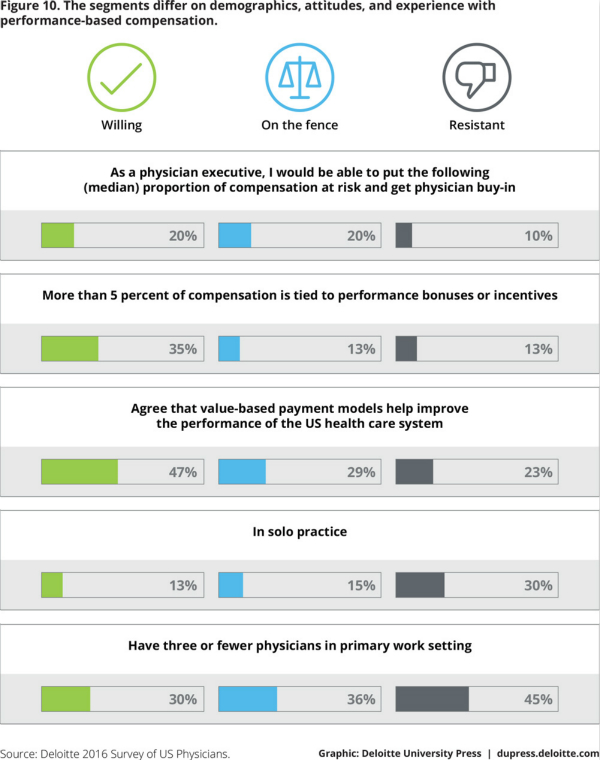
The survey analysis also reveals significant variations among respondents in terms of attitudes, experience with performance-based compensation, and risk tolerance. For instance, among physicians willing to participate, 36% have already received some compensation from value-based payment sources, whereas this figure stands at only 24% and 21% among physicians with neutral and resistant attitudes, respectively.
Among the three major types of physicians, differences in demographic characteristics and medical practice settings hold particular significance for value-based care initiatives. For instance, independent practitioners and those in small medical practices may find it more challenging to effectively participate in value-based care, as they often face greater resource constraints in terms of staffing and technology availability.
Interestingly, however, this study’s analysis indicates that the availability of tools and resources helps mitigate the impact of non-modifiable demographic characteristics. For instance, when physicians have access to medical pattern information, clinical protocols, and Electronic Health Records (EHRs) meeting Stage 3 Meaningful Use criteria, their willingness to engage in value-based care increases. Therefore, providing these tools will help shift physicians with neutral attitudes into the category of those willing to participate.
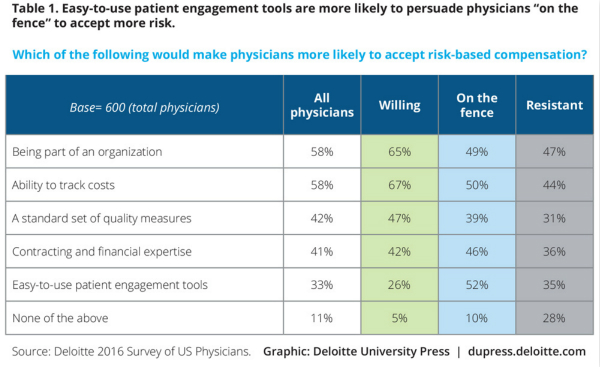
Physicians’ perspectives on the necessary resources and functionalities provide insight into the factors that increase their likelihood of accepting risk-based compensation models. For instance, many physicians consider cost-tracking capabilities a prerequisite for adopting risk-based compensation, with 67% of respondents indicating their willingness to accept such models under this condition. Physicians who remained neutral placed greater emphasis on patient engagement tools, whereas those resistant to change were highly skeptical of risk-based compensation models; 28% of respondents stated that none of the options presented in the survey would encourage them to assume additional risk (see Table 1).
Insights
Although financial incentives and support mechanisms are crucial to physicians’ willingness to participate, this survey analysis indicates that their risk tolerance for financial risks is also correlated.
Recommendations
(1) Understand the distribution of physicians by specialty within your healthcare network
(2) Recognize the different approaches and support tools that may be required to attract different types of physicians
(3) Prioritize investment in tools that enable physicians to track costs and quality.
(4) Study effective incentives and potential challenges for different types of physicians to gain their support for and adoption of value-based care initiatives
Financial incentives, support tools, and functionalities may increase the likelihood of physicians transitioning to value-based care. Every organization in the healthcare sector should consider how it can better assist physicians in this transition.
Healthcare System: Introduce value-based healthcare contracts, enhance incentives, and improve physician support tools
(1) Implement value-based care contracts. Value-based care contracts help better align physician incentives. Furthermore, the survey results indicate that as physicians gain more experience with value-based care, their confidence in and support for the transition to this model tend to increase correspondingly.
(2) Enhance the alignment of physicians’ financial incentives with value-based care. Research indicates that, to drive behavioral change, at least 20% of physicians’ total compensation should be tied to quality and cost targets.
(3) Use data-driven tools. Data-driven tools, such as medical pattern reports and clinical protocols, can help physicians achieve quality goals, inform clinical decision-making, and track physician performance.
(4) Implement a performance management plan. Developing a robust performance management plan will help ensure that physicians receive the feedback they need. When designing performance-based compensation, efforts should be made to:Make Performance Goals Meaningful. 1)Evidence suggests that improvements in patient outcomes are a stronger motivator for physicians than pure cost savings. For example, Geisinger’s experience demonstrates that cost reductions are the result of quality improvement. 2)Similarly, patient outcomes will serve as a more compelling rationale than cost considerations when encouraging physicians to initiate or expand clinical protocols. At the same time, it shouldEstablish a reasonable number of measures and realistic performance benchmarks, such asEducate physicians on performance measures and assist them in prioritizing various items.
(5) Use performance data to support organized clinical quality improvement initiatives. For example, certain clinical variations or deviations from quality benchmarks may indicate the need to develop or modify clinical protocols and/or processes.
Health Plans: Data and Resource Analysis of Acquisition Costs and Referral Information to Support Value-Based Healthcare Services
(1) Real-time or near-real-time information sharing with physicians and healthcare systems can better support clinical practice. Health plans possess data that many physicians and provider organizations lack, such as longitudinal patient views across different healthcare entities, patients’ medical costs, and outpatient pharmacy utilization rates. Health plans can also help identify high-cost patients or those at risk of incurring high costs, enabling physicians to intervene in a timely manner.
(2) Invest in supporting independent physicians to help them maintain their independence. By fostering healthy market competition, this approach will benefit payers in the long term. Independent physicians in small practices require greater support. While CMS’s MACRA education grants for independent physicians have been beneficial, other payers should also consider providing assistance to independent physicians.
(3) Align quality and resource utilization measures with MIPS. Doing so within pay-for-performance programs has the potential to reduce the burden on physicians when reporting quality data.
(4) Apply the principles of performance-based compensation and clinical improvement plans described above to help physicians enhance their quality and cost performance. This is particularly relevant for physicians employed by health plans or those engaged in value-based care contracts.
Biopharmaceutical and MedTech Companies: Building Value-Based Economic Evidence and Partnerships
(1) Identify evidence of products’ ability to reduce healthcare costs or achieve other population health goals, thereby aligning them with value-based care incentives. Changes in financial incentives may influence physicians’ decisions regarding product selection in their clinical practice. Cost is one of the factors considered when developing clinical pathways and designing order sets, which has heightened the importance of economic differentiation among competing product categories. Products lacking both clinical and economic differentiation may experience a decline in utilization. The Medicare Access and CHIP Reauthorization Act (MACRA) will also accelerate this trend, as it measures and holds physicians accountable for their resource utilization.
(2) Invest in the development of real-world evidence, which not only supports products’ value propositions but also helps suppliers and health plans achieve population health goals.
(3) Collaborate with health plans and vendors to collect, analyze, and interpret evidence. Processed data can be incorporated into clinical protocols to increase the utilization of products associated with positive outcomes.
(4) Provide services to healthcare systems and physicians to help them achieve the goals of value-based care. Content may include adherence solutions, patient education and support, development of patient registries, and data analysis.
(5) As physicians place increasing emphasis on value, implement value-based care contracts. Contracts that focus on product performance can help align with physicians regarding value-based care incentives and may also shift negotiations with customers from unit price to overall value. Companies can collaborate with interested suppliers and health plans to overcome regulatory and operational challenges and begin piloting the aforementioned types of healthcare contracts.
Active physician engagement is pivotal to the advancement of value-based care, as physicians’ decisions directly influence treatment pathways, costs, and quality of care. All stakeholders should consider how they can play their respective roles in helping physicians transform the delivery of healthcare services. Only when all stakeholders collaborate toward a shared goal can the triple aim of lower costs, better health, and improved patient experience be achieved.
The data and information in this article are sourced fromDeloitte & Touche LLPIn late October, VCBeat compiled and released its "2016 U.S. Physician Survey Report."
Related Reading: