

YishiTong, Chongqing's Pioneer Internet Healthcare Company, Files for IPO After 8 Years of Operations with 124 Elderly Care Facilities and 1,300 Clinics

On November 11, 2016, Chongqing Yunxin Medical Technology Co., Ltd. (Yishitong) signed an agreement with the Chongqing Federation of Trade Unions at a project department of China Railway Tunnel Group in Lianglukou. The agreement pertains to the “Internet + Trade Union Services” initiative spearheaded by the Chongqing Federation of Trade Unions, aiming to provide services such as appointment registration and health consultations to over 210,000 grassroots trade unions, 8.05 million employees, and 7.7 million trade union members in Chongqing Municipality.
Yishitong, which entered the healthcare sector as early as 2008, is a 3G medical information service platform designed to support urban-rural integration within the context of healthcare system reform. By deeply integrating medical services from existing hospitals, health insurance systems, disease control and prevention agencies, and pharmaceutical manufacturers, and building upon an interactive system for domestic wireless information infrastructure services, it provides a comprehensive, personalized mobile healthcare platform tailored to residents in both urban and rural areas.
Over the past eight years, the Yishitong team has expanded to 380 members, with 70% dedicated to R&D and operations. Its service scope has broadened significantly, extending from hospitals to labor unions, banks, and enterprises. Currently, 124 elderly care institutions have joined the Yishitong platform, and 1,300 clinics have become affiliated partners. The platform serves 8.5 million real-name registered medical users in Chongqing. Tang Yulan, General Manager of Chongqing Yunxin Medical Technology Co., Ltd., gave an exclusive interview to VCBeat (WeChat ID: vcbeat), sharing their business story.
Starting with Regional Healthcare: Residents Are Users
Tang Yulan has worked in the media industry, founded a company, and served as Deputy General Manager at Japan’s Lingtong Holdings Co., Ltd. She is currently the General Manager of Chongqing Yunxin Medical Technology Co., Ltd. In the healthcare sector, she has confronted three major challenges: difficulties in data integration, resource allocation, and quality supervision.
In terms of data, the main challenges are information standardization, data security, and issues related to data openness, sharing, and certification management. Insufficient understanding of informatization has led to inadequate investment in funding and talent for IT infrastructure, thereby constraining the development of internet-based healthcare.
The imbalanced development of health and family planning informatization across different regions, sectors, and levels urgently needs to be addressed, as health resources lack effective integration and utilization. Resistance to information sharing by some hospitals has become a bottleneck hindering the development of healthcare informatization.
Due to the significant variations in individual circumstances, substantial disparities, and marked regional differences among healthcare institutions at various levels, as well as the differing quality of medical services, health administrative supervision and management are exceptionally challenging.
By collaborating with regional government and enterprise partners, Yishitong adopts a “residents-as-users” operational model to deliver public health services and manage public health data. Leveraging new technologies—cloud computing, big data, the Internet of Things (IoT), wearable devices, and mobile internet—it has established the Yunxin Public Health Cloud Platform, a regional medical and health information service support platform. This platform provides residents (covering the entire population across the full life cycle) with a unified, standardized, secure, efficient, and reliable one-stop, open cloud-based medical and health service platform, along with health management applications and comprehensive oversight of all service applications.
By pinpointing the pain points in regional healthcare, Yishitong’s solution directly serves the public by making medical information open and transparent, improving the efficiency of medical resource utilization, facilitating access to care, and alleviating information asymmetry between patients and providers. With a focus on lifelong health, it integrates high-quality resources through horizontal and vertical collaboration, emphasizes health management, enhances equitable access to medical services for the general population, and helps address the challenge of “difficulty in accessing medical care.”
This innovative service model and philosophy leverage internet information technology to drive development, reducing non-clinical time and costs, thereby alleviating the issue of “high medical expenses.” By coordinating medical resources and promoting the open sharing of healthcare elements, it expands the temporal and spatial accessibility of medical services, thus mitigating the “three longs and one short” problem.
“Yunxin Health Service Cloud Platform” deeply integrates with every link within hospitals, penetrating medical institutions to create a novel and convenient healthcare delivery model. From pre-visit consultation through intra-visit treatment to post-visit care, both patients and physicians can access more convenient services and efficient management tools on the platform.
The platform is patient-centric, or more accurately, patient-data-centric. By leveraging big data analytics and retrieval, it provides physicians with foundational support such as patient health data, medication guidance, and health monitoring, thereby enabling more efficient clinical consultations. Meanwhile, physicians’ diagnostic information is integrated back into the patient’s health records. This interactive approach not only utilizes big data but also helps maintain and enrich it.
“This partnership with the Chongqing Federation of Trade Unions reflects Yishitong’s user-centric operational philosophy, which regards residents as users and is committed to providing comprehensive health services to the employees of the Chongqing Federation of Trade Unions,” said Tang Yulan.
Building a Comprehensive Regional Industry Ecosystem with Multiple Verticals
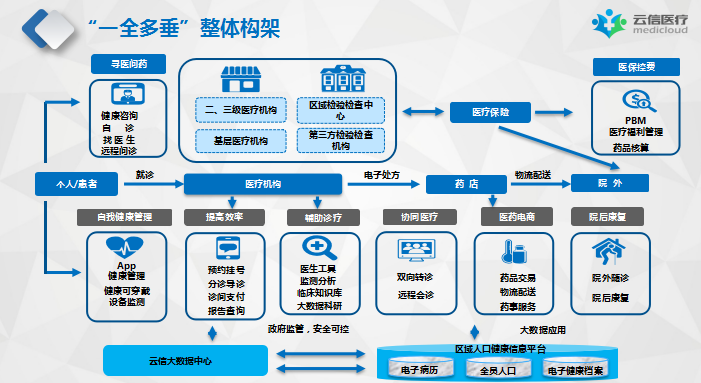
Against the backdrop of the “Internet + Healthcare” and “National Health for All” era, the “Yunxin Medical Health Cloud Platform” not only interconnects information among various healthcare components—including patients and physicians, medical staff, and insurance providers—but also optimizes healthcare service processes and innovates service delivery models. It embodies a vision to build a new ecosystem and industrial chain for online healthcare services that encompasses the entire human life cycle, the full spectrum of medical service processes, and all formats of health products, ultimately enhancing the efficiency of medical resource utilization and improving the overall health level of the population.
Supported by the regional medical information platform and the sharing of corresponding resident health data and clinical visit data, remote consultations are implemented, including management of consultation requests, approval processes, consultation procedures, and consultation result reports.
Teleconsultation encompasses both synchronous and asynchronous modalities. Synchronous consultation systems feature interactive tools akin to video conferencing and electronic whiteboards, enabling real-time exchange of text, voice, images, and video. Asynchronous consultation systems operate on a store-and-forward mechanism, where various types of information—such as images, videos, audio, and text—are compiled into a multimedia email and sent to specialists at their convenience; the specialists then transmit their diagnostic conclusions to the relevant healthcare providers. Teleconsultation can reduce consultation time, improve the quality of diagnosis and treatment, and lower healthcare costs.
“Supported by the emerging resource technology of ‘big data,’ Yishitong integrates the healthcare service ecosystem to create a complete closed loop and deliver an excellent user experience.”
In addition, “we have also invested in ‘Healthy Sichuan’ and participated in the development of the Sichuan Provincial Medical and Health Public Service Portal. This platform will gradually implement seven major functions: policy information dissemination, convenient medical services, personal full-lifecycle health management, doctor-patient communication, interactive exchanges in healthcare and online learning, health administrative supervision and management, and the publication of health standards and norms. Ultimately, it aims to help patients access medical care quickly, achieve personal health management and online diagnosis and treatment services, and provide decision-making support for managers in the health and family planning system.”
Guided by the vision of building an online healthcare service ecosystem and industrial chain that covers the “full life cycle, full process of medical services, and full spectrum of health products,” the Yunxin Medical Information Platform is being developed into a deeply specialized vertical internet healthcare platform. By self-building or integrating a comprehensive suite of medical service platforms, it enables users to access one-stop, closed-loop medical services on a single platform, ultimately establishing a regional industry ecosystem characterized by “comprehensive coverage with multiple vertical specializations.”
A Multi-Stakeholder Win-Win Business Model
Yunxin Health Service Cloud Platform leverages government-supported regional health service data and self-generated operational health data to form a comprehensive public health database. By integrating healthcare institutions and related enterprises (such as pharmaceutical companies and insurers) through data connectivity, it establishes a vast medical ecosystem, creating favorable conditions for multi-party win-win outcomes.
From the hospital’s perspective, Yunxin Medical has enhanced management efficiency and increased revenue. It facilitates the effective deployment of medical resources for complex cases from large hospitals, while elevating the brand reputation and clinical capabilities of primary care institutions, thereby improving patient retention.
Patients have experienced a transformation in their healthcare journey through the Yunxin Medical Platform, enabling them to promptly identify suitable hospitals and specialists, thereby saving time, money, and effort. Amidst the national vigorous promotion of tiered diagnosis and treatment, the platform has addressed the uneven distribution of medical resources in China and optimized resource allocation.
Furthermore, the big data aggregated through this platform facilitates drug R&D and forecasts the market size of new drugs; it also enables personalized treatment and medication recommendations for users, as well as precision marketing.
For medical institutions, Yunxin integrates automated healthcare management information systems and telemedicine service platforms with existing infrastructure such as Hospital Information Systems (HIS), Laboratory Information Systems (LIS), and Picture Archiving and Communication Systems (PACS). By responding in real time to functional requirements and customization needs of target clients via mobile phones, landlines, and other channels, it enables functionalities including informatization construction for medical institutions, personal health management for individual users, and remote visual consultations. Its technology ranks at the leading level domestically. While improving operational efficiency and reducing office, promotional, and human resource costs for medical institutions, it enhances the image of patient-centered services, improves doctor–patient relationships, and alleviates doctor–patient conflicts.
From the perspective of telecom operators, this platform is an innovative platform in the field of electronic information, as well as an industry support service platform facilitating information exchange between healthcare systems and the general public. It truly achieves the convenience and human-centric nature of having medical services readily accessible on mobile devices, providing end users with added value for communication products while enhancing brand reputation and customer loyalty for operators. Furthermore, user engagement with this service generates additional e-commerce revenue, opening up a new application domain for operators to serve their customers in the 3G era. This constitutes an application-level integrated medical information service platform.
In Tang Yulan’s view, regional interconnectivity of medical information is an indispensable path to achieving the “Healthy China” initiative. As over 90% of healthcare-seeking behaviors occur within local regions, only by establishing a unified data platform at the regional level and breaking down barriers between institutions can we effectively monitor and issue early warnings on the health status of the broader population, thereby leveraging big data and the internet to better deliver accessible, localized services to the public.
Yunxin Healthcare has been deeply rooted in regional healthcare for eight years. It has streamlined medical access processes for urban and rural residents, transformed their habits regarding appointment registration and medical consultations, enabled them to schedule medical visits more rationally, and aligned with the broader trends of healthcare reform and informatization in urban and rural areas.