

Engaging in Illicit Gene Editing Research May Put You on the Radar of Biosecurity Agents
Have you ever seen something strange in your friends’ petri dishes in their basements? Or do you know of a peculiar graduate student who spent hours working in a pathogen laboratory, perhaps researching something unusual?If garage-gene editing technologies were to cause a biological disaster, biological agent Edward You is already prepared to counter them. How much do you know about “bio-cops”? VCBeat (WeChat: vcbeat) takes you through their work and responsibilities.
Edward You is a management expert on weapons of mass destruction at the Federal Bureau of Investigation (FBI) headquarters in Washington, D.C., and is regarded as one of the United States’ foremost biosecurity law enforcement specialists. His role involves monitoring laboratories exhibiting abnormal, rapid development to ensure they do not give rise to biological threats.
This is a daunting task. Microbial engineering and DNA-related methods are easily accessible to others, and their potential for harm is significant. More importantly, a new “do-it-yourself biology” movement has begun shifting genetic engineering from large institutions to private laboratories or even people’s homes, where it is difficult to obtain detailed experimental records.
Edward joined the FBI in 2005. Since then, the bureau has expanded his role within the agency, and he has also influenced policymakers to address certain policy blind spots. Additionally, Edward launched a friendly and open campaign to engage “independent biologists” through community outreach.”Understand the job responsibilities of the federal government.
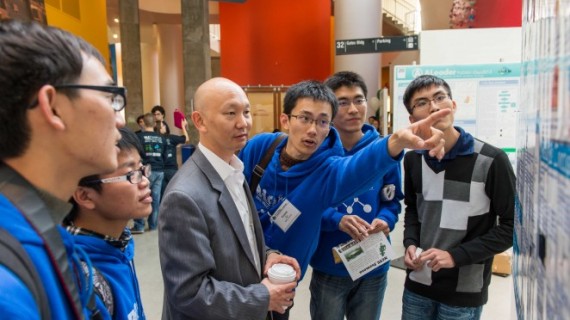
Edward (in the suit) talks with students during the 2013 International Genetically Engineered Machine competition
Edward refers to his data source as the “Detection Network,” which enables him to monitor issues of concern to scientists. To date, he states that he has not engaged in any “car chases” (i.e., halting malicious experiments). Instead, his work primarily involves placing “911 calls” in the biological realm to report reckless conduct (i.e., issuing warnings about potentially unethical experiments).
Edward stated that nuclear weapons are typically controlled through clandestine research or by monitoring the specialized high-speed centrifuges used to convert uranium into bomb-grade fuel. However, addressing biological threats poses a different challenge, as biological experts are not easily monitored. A more severe challenge is that the same bacteria, technologies, and skills required for disease research can also be readily weaponized.
Results: Potentially hazardous technologies are available free of charge. In February this year, the United States declared gene editing—a novel method for modifying DNA—to be a potential weapon of mass destruction. Meanwhile, it is concerning that a set of techniques for genetically modifying bacteria, known as CRISPR, is being sold online for approximately $140. This situation creates the theoretical possibility of bioterrorism, whereby a malicious actor could develop a lethal designer bacterium or resurrect an old pathogen, such as smallpox.
“Although such engineering is not easy to succeed in practice today, it may become exceptionally simple in the near future. Nevin Summers, Executive Director of the MIT Center for Synthetic Biology, said, ‘When the barriers to carrying out malicious acts are low, it endangers us all. The next generation of children engaging with biology must address some difficult questions about safety.’”
The Federal Bureau of Investigation is a law enforcement and domestic intelligence agency. This means that Edward will focus on identifying more native anomalous organisms, as opposed to foreign ones.
Biocrime remains exceedingly rare, although when it does occur, we tend to blame individuals with scientific training. In 1996, Diane Thompson, a laboratory technician at St. Paul Medical Center, told her colleagues that she had brought blueberry muffins and donuts for everyone to enjoy in the kitchen; however, she was carrying Shigella bacteria, which resulted in nine people being hospitalized (she was sentenced to 20 years in prison). Additionally, following the lethal anthrax attacks via the U.S. postal system in 2001, the Federal Bureau of Investigation concluded that the attacks were carried out by a mentally disturbed military scientist.
Edward stated that part of his job is to help scientists learn how to identify such “insider” threats. Generally, prior to an attack, there are often warning signs, such as suspects sending inappropriate emails or unusual incidents occurring—for example, excessive use of supplies at odd hours outside of normal work times. However, most biologists deeply engrossed in academic research tend to overlook these red flags while striving to develop cancer treatments or design new assays.
“Preventing the misuse of technology is a shared responsibility, a need that is more urgent now than ever before. We need to don white hats and work together to identify black hats.”
Earlier this month, Edward attended a two-day conference hosted by SynBioBeta in San Francisco. The event drew a diverse array of participants, including major corporations such as DuPont, startups like those cultivating lab-grown meat, and biohobbyists. While Edward worked the room, shaking hands and blowing kisses, his partner remained at the local FBI field office. An agent with a nose ring and tattoos handed her business card to an entrepreneur present at the scene, saying, “If you have anything you’d like to share with us, we can forward it to headquarters in Washington.”
Edward wore a blue suit, making him stand out in the crowd. On the second day of the event, he unbuttoned his shirt. I asked Edward whether he would let his guard down at such an event. “Actually, we are all secret agents,” he replied ambiguously.
Edward earned a master’s degree in molecular biology and later worked at Amgen. According to Ken Oye, a political scientist at the Massachusetts Institute of Technology, Edward has also assisted the government since joining the Federal Bureau of Investigation, helping it become “less ignorant and rigid” in its approach to biology.
In 2004, an FBI investigation led to the detention of Steve Kurtz, a bioartist from Buffalo, after bacterial cultures were discovered in his home. Kurtz was subsequently prosecuted under the Patriot Act. Although the case was hailed as a major blow against bioterrorism, a judge ultimately dismissed the charges, ruling him innocent. “It was really nothing—just a harmless mistake. You might have even licked food containing bacteria,” said Rob Carlson, an investor and analyst who operates his own garage laboratory.
By 2009, the FBI had changed its approach. It began sponsoring the International Genetically Engineered Machine (iGEM) competition, an annual event that attracts more than 3,000 student teams working on engineered microbes. This year, the FBI will set up a career booth and has invited several DIY biologists—viewed as members of a counterculture movement—to participate. Their projects include developing open-source insulin, dairy-free cheese, and other commercial biotechnologies that are far from trivial.
Edward’s actions were not intended to persecute those engaged in biological work; rather, his activities drew government attention to certain fringe actors. Under Edward’s guidance, the FBI extended a degree of trust to him, occasionally supplemented by financial support. Sebastian Cocioba, who lives in New York and operates a laboratory out of his spare bedroom, stated that he has “contacts” at the FBI’s field office. According to him, the FBI wants “him to visit regularly so that headquarters stays informed about recent developments.”
I find Edward’s network remarkably effective, and I have been trying to learn more about him. At least one person relayed my questions directly to him, serving as a series of prompts from the remote corners of the biotechnology sector, which were then forwarded to his office in Washington, D.C.
Megan Palmer, a biosafety scholar at Stanford University, says that about twice a month she introduces individuals to Edward. These individuals include a biotechnology company manager who had questions about customer requests, and a member of the DIY community who came across an experiment that seemed concerning. “When you don’t know whom to call to report such suspicious activities, Edward is the person you call,” said Palmer.
Edward is often the first to hear scientists’ deepest concerns. Recently, some of these concerns have centered on the gene-editing technique CRISPR, which can be used to cut viral DNA in insects while driving the spread of genetic modifications.
Another project closely tied to the security risks of large-scale DNA and biological databases that Edward has been pursuing is the U.S. Million-Person Precision Medicine Initiative. Merely collecting these data entails substantial commercial challenges. Even though it remains unclear why attackers might seek to breach these datasets, Edward is sponsoring workshops on “Safeguarding the Bioeconomy” to explore the potential harms that could arise.
One thing the FBI has not done is describe to the public the results of its series of operations. For instance, how many biological threats are there? Where are they located? How many have been investigated? And how many originated from government microbiology laboratories? Do these laboratories already have unfortunate records? Palmer said that scientists also want to know how the information they provide to the FBI will be used, but communication with agents is currently a one-way street, and we do not know the answers to these questions.
Edward does not describe any of his investigations to others, but he acknowledges that he is examining certain biological threats that may never materialize. “‘Threat’ implies some underlying intent—knowledge we have yet to observe,” he says. “However, as these elements become increasingly widespread and broadly distributed, while regulatory standards continue to decline, the likelihood of incidents posing safety risks will inevitably rise.”