

Affordable Chinese Patent Medicines Set for a Breakthrough Amid Multiple Policy Tailwinds
Chinese proprietary medicines, an essential component of modern pharmacotherapy, inherit the medical practices and empirical summaries of successive generations. Owing to their convenient administration and moderate pricing, they have garnered a substantial consumer base. As the second-largest category in retail pharmacies, their market share exceeds 30% and continues to rise year on year.
VCBeat (WeChat ID: vcbeat) reviewed research reports and sales data on the proprietary Chinese medicine market, and, in light of recently issued policies such as the “Guidelines for the Development Planning of the Pharmaceutical Industry” and the “Opinions on Promoting Experience in Deepening Healthcare Reform” jointly released by the General Office of the CPC Central Committee and the General Office of the State Council, explored various possibilities for the development of the proprietary Chinese medicine industry.
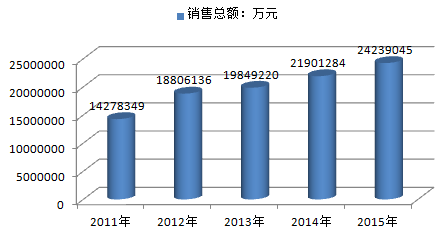
The “2016–2022 In-Depth Investigation and Market Prospect Forecast Report on China’s Chinese Patent Medicine Market,” released by Zhiyan Consulting, shows that the total sales volume of Chinese patent medicines reached RMB 242.39 billion in 2015, a year-on-year increase of 10.67% compared with 2014. The compound annual growth rate (CAGR) of national sales of Chinese patent medicines from 2011 to 2015 was 11.61%.
National Total Sales of Chinese Proprietary Medicines, 2011–2015
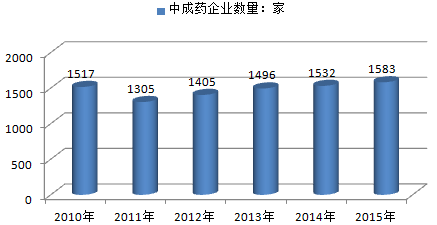
In terms of the number of enterprises, since 2010, driven by favorable policies from the new healthcare reform, the number of companies involved in the manufacturing and distribution of Chinese patent medicines has been on a steady rise. Data shows that there are currently nearly 1,600 enterprises across China engaged in the production and distribution of Chinese patent medicines.
Number of Chinese Proprietary Medicine Enterprises, 2003–2015
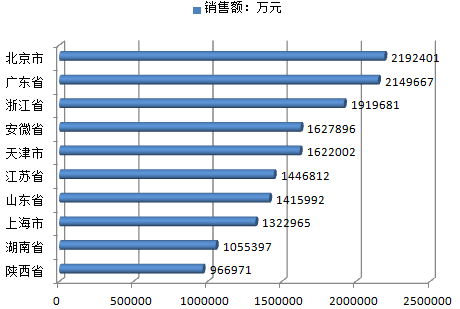
According to statistics from Zhiyan Consulting, in 2015, the regions with the highest sales of Chinese proprietary medicines were concentrated in economically developed areas. The sales in Beijing, Guangdong, and Zhejiang each reached approximately RMB 20 billion, and the top ten provinces and autonomous regions accounted for 64.85% of the national total sales of Chinese proprietary medicines.
Top 10 Provinces and Regions by Sales Revenue in 2015
Among the sales categories of Chinese proprietary medicines, cardiovascular and cerebrovascular, throat, antitussive, blood-tonifying, and cold remedies are the major classes. Data from the “2016–2020 Investment Analysis and Prospect Forecast for China’s Chinese Proprietary Medicine Industry,” previously released by the China Investment Advisory Industry Research Center, show that these five categories account for approximately 60% of total sales.
A key characteristic of the currently dominant proprietary Chinese medicines in the market is the proliferation of similar products and low market concentration. Taking cold remedies as an example, the retail market for proprietary Chinese medicines in Beijing, Shanghai, and Guangzhou in 2015 featured over 1,000 product varieties. The market shares of the leading brands were closely clustered, with the top five brands accounting for a combined market share of only 16.87%.
This situation is directly related to the manufacturing and distribution costs of proprietary Chinese medicines. A head of a chain pharmacy in Chongqing told VCBeat (WeChat ID: vcbeat) that proprietary Chinese medicines have relatively high prices but lower gross profit margins than comparable Western medicines. As pharmacies prioritize promoting Western medicines, consumer preference for proprietary Chinese medicines becomes less concentrated when substitutes are available.
Another reason is that manufacturers of proprietary Chinese medicines lack sufficient control over exclusive brands. Holding an exclusive brand grants considerable pricing power, facilitating inclusion in the list of low-priced drugs. Once included in this list, a company’s market control becomes significantly stronger.
This aspect is also directly related to policy. According to the List of Low-Priced Drugs within the Pricing Scope of the National Development and Reform Commission, there are 283 types of Western medicines and only 250 types of Chinese proprietary medicines, with significant differences in pricing. The average daily cost for Western medicines must not exceed RMB 3, while that for Chinese proprietary medicines must not exceed RMB 5.
In May 2015, the National Development and Reform Commission (NDRC) lifted price ceilings on 530 types of low-cost drugs, allowing manufacturers to set prices independently provided they did not exceed the specified daily cost standard. According to the “Opinions on Ensuring the Supply of Commonly Used Low-Cost Drugs,” jointly issued by eight ministries and commissions at the time, the policy aimed to “abolish maximum retail price limits, enabling manufacturers of low-cost drugs to set prices autonomously based on production costs and market supply and demand.”
This approach, combining policy guidance with market adjustment, has not yielded significant results. The purpose of lifting price caps was to stimulate corporate initiative; however, both hospital procurement and pharmacy supply generally adhere to the principle of “lowest price wins.” Consequently, once traditional Chinese medicine manufacturers adjust their prices, they are highly likely to lose competitiveness in the market. In response, the government introduced mandatory measures such as “catalog management and designated production,” directly assigning certain production tasks to specific enterprises, yet the market remains uninvigorated.
Danshen Hong, Compound Danshen, and Ginkgo Biloba Leaf from the low-price drug list have entered the top 20 in sales volume of Chinese patent medicines, with sales reaching RMB 5.165 billion, RMB 2.460 billion, and RMB 2.174 billion, respectively, while products such as Wuji Baifeng Wan have exited the regional low-price drug category. Danshen Hong and Compound Danshen are exclusive products included in the National Reimbursement Drug List.
It is reported that Danhong Injection, an exclusive product of Shandong Danhong Pharmaceutical Co., Ltd., is a medication for cerebrovascular diseases and ranks first in sales among traditional Chinese medicine (TCM) products in the public hospital market. Shandong Danhong Pharmaceutical Co., Ltd. is a subsidiary of Buchang Pharmaceuticals Co., Ltd. Buchang Pharmaceuticals has recently obtained approval from the China Securities Regulatory Commission (CSRC), becoming the first listed company in Heze. Its chairman, Zhao Tao, has clearly stated the goal to “further promote modernization and internationalization, and carry forward traditional Chinese culture.” This ambitious statement is closely related to the high growth potential of its TCM product sales.
Compound Danshen is the flagship product of Tasly Pharmaceutical, available in multiple dosage forms including concentrated pills, dripping pills, tablets, capsules, and granules. Among these, Compound Danshen Dripping Pills are listed as a Class A reimbursable drug under China’s National Medical Insurance program. According to media reports, the product has completed all clinical work for its U.S. FDA Phase III clinical trial, which was conducted across 127 clinical centers in multiple regions including the United States and Canada, and has entered the Close-Out Visit (COV) phase. According to Tasly’s financial report for the first three quarters of this year, the company achieved revenue of RMB 9.61 billion and net profit of RMB 1.003 billion.
The aforementioned two proprietary Chinese patent medicines have gained pricing and distribution advantages through exclusivity and inclusion in the national medical insurance catalog. Coupled with broad demand, they have maintained robust performance. However, the overall outlook for the low-priced drug sector remains pessimistic, which has exerted a certain impact on the Chinese patent medicine market.
This October, media reports highlighted that the price of a certain low-cost medication was speculated up from 0.8 yuan to hundreds of yuan, resulting in a situation where the drug was available at high prices but still out of stock. The underlying reason is that such low-priced drugs are approved for production under special provisions and offer low profit margins, leading pharmaceutical companies to be reluctant to establish production lines, which has caused shortages and black-market trading. In response to this issue, Yao Jianhong, Deputy Director of the Department of Structural Reform under the National Health and Family Planning Commission, stated that the solution lies in incorporating shortage products, such as low-cost and orphan drugs, into catalog management, including the National Basic Medical Insurance Catalog and the National Essential Drug List.
The development pathways of Danhong and Compound Danshen offer valuable lessons. In the future, with the improvement of policies on low-priced drugs and the elimination of hospital drug price markups, proprietary Chinese medicines will gain access to broader sales channels. Correspondingly, an autonomous pricing mechanism can help establish an effective market order, enabling manufacturers of proprietary Chinese medicines to flexibly adjust production based on manufacturing capabilities and market demand, thereby ensuring reasonable profits.
Another factor is the growing emphasis on traditional medicine, as represented by proprietary Chinese medicines. The recently released Guideline for the Development Planning of the Pharmaceutical Industry explicitly mentions the need to explore classic and well-established formulas for diseases where traditional Chinese medicine (TCM) demonstrates particular advantages—such as cardiovascular and cerebrovascular diseases, autoimmune disorders, and gynecological and pediatric conditions—and to develop new TCM drugs based on compound formulations, effective fractions, and active ingredients. This aims to accelerate the research, development, and industrialization of innovative TCM drugs with proven efficacy and high clinical value.
For marketed products, modern scientific and technological approaches should be employed to explore their clinical value, define therapeutic areas of advantage, and develop new indications. Post-marketing re-evaluations of efficacy, safety, formulation processes, and quality control should be conducted.
Looking further back, the 12th Five-Year Plan also mentioned the development of traditional Chinese medicine (TCM) and health rehabilitation, which will have a direct impact on the demand for proprietary Chinese medicines. The aforementioned head of a chain pharmacy in Chongqing also stated that due to their low toxicity and side effects, many customers have already chosen proprietary Chinese medicines. He further noted that with the future outflow of hospital prescriptions, pharmacies will have greater autonomy in drug dispensing, indicating that the market for proprietary Chinese medicines will have more room for growth.