China Internet Hospital White Paper (2016): A Panoramic Overview of the Emerging Digital Healthcare Ecosystem

I. The Boom of Internet Hospitals in 2016
1. Scale: 36 facilities under construction, 25 already operational
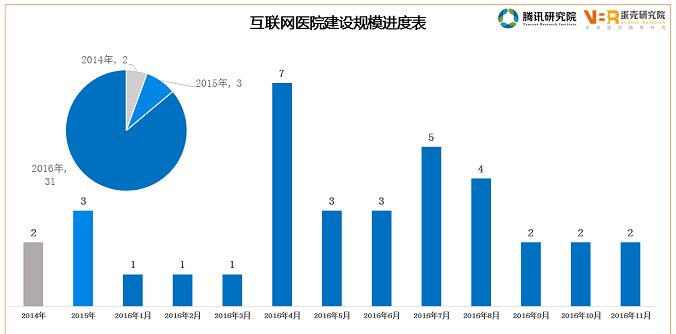
According to publicly available statistics, as of November 2016, the number of internet hospitals across China had grown to approximately 36. Among these, 25 had already commenced operations (offering service access via PC or mobile app), while the remaining 11 had publicly announced signed agreements and were under construction in 2016. It is anticipated that more internet hospitals will officially launch and provide services in 2017.
As there is no clear, unified definition of “Internet hospitals,” this report includes all entities named “Cloud Hospitals” or “Online Hospitals” in its statistics.

Note: The scale statistics are primarily based on news searches, with keyword settings and cross-referencing against news articles employed to maximize search coverage; however, minor omissions may still occur.
2. Construction: 31 projects commenced construction in a concentrated manner in 2016
Following the launch of pioneering initiatives such as the Guangdong Provincial Network Hospital in 2014 and the Wuzhen Internet Hospital in 2015, the development of internet hospitals entered a peak phase, with 31 facilities commencing operations in 2016 alone.
3. Multi-party collaborative initiatives have become the mainstream model
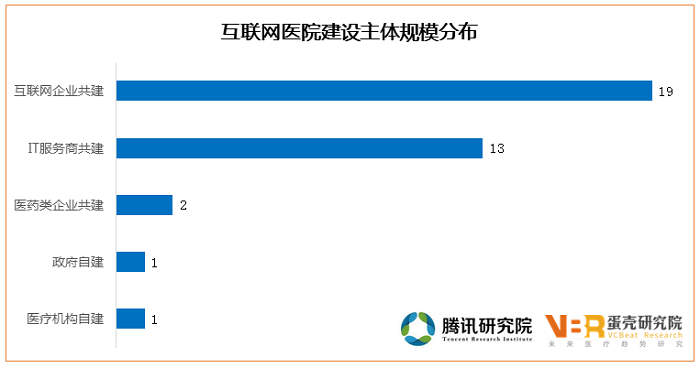
In terms of the entities establishing internet hospitals, the mainstream model involves joint initiation by internet healthcare companies (represented by WeDoctor and Ali Health), medical institutions, and local governments, accounting for more than half of the 36 internet hospitals. IT service providers, represented by Neusoft Xikang and Zhiye Hulian, participated in the establishment of 13 internet hospitals.
II. Maturity Assessment of Internet Hospitals
1. Internet Hospital Maturity Indicators
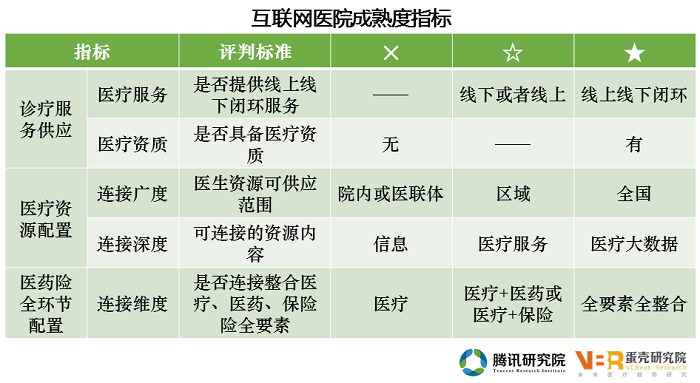
Although internet hospitals underwent concentrated development in 2016, their levels of maturity varied significantly. Based on the current key focuses of service practices in internet hospitals, we have identified five major maturity indicators and conducted a preliminary assessment of the service maturity of 25 internet hospitals that are already operational.
The five indicators are medical services, medical qualifications, breadth of connectivity, depth of connectivity, and dimensions of connectivity. Scores are assigned as no star, half a star, or one star for each indicator, and the total score is calculated by summing these values to assess maturity.
2. Overall Ranking Results
Among 25 internet hospitals, those rated four stars or above include Wuzhen Internet Hospital, Sichuan WeDoctor Internet Hospital, Gansu Internet Hospital, and Guangxi Internet Hospital. Ningbo Cloud Hospital, 39 Internet Hospital, and Ali Health Network Hospital achieved a rating of three and a half stars.
In terms of connectivity breadth and medical services, these five internet hospitals have already established connections at the regional level and even across regions nationwide, providing closed-loop online-to-offline healthcare services. Wuzhen Internet Hospital offers a platform connecting physician resources across China. Ningbo Cloud Hospital has currently achieved hospital connectivity within municipal-level regional units.
In terms of connectivity depth, Wuzhen Internet Hospital, Sichuan WeDoctor Internet Hospital, Gansu Internet Hospital, and Guangxi Internet Hospital are evolving from providing online diagnosis and treatment services to offering services such as data interoperability and data sharing between electronic medical records.
In terms of connectivity, Wuzhen Internet Hospital has already begun implementing the integration of pharmaceuticals, healthcare services, and insurance.
In terms of medical qualifications, all are able to rely on physical medical institutions to provide offline rapid consultation services for the patients they serve.
This maturity assessment reflects only the current primary practices of various internet hospitals. As the internet hospital model continues to improve, the maturity indicators and evaluations for each internet hospital will be updated and iterated accordingly.

3. Three Tiers of Internet Hospitals
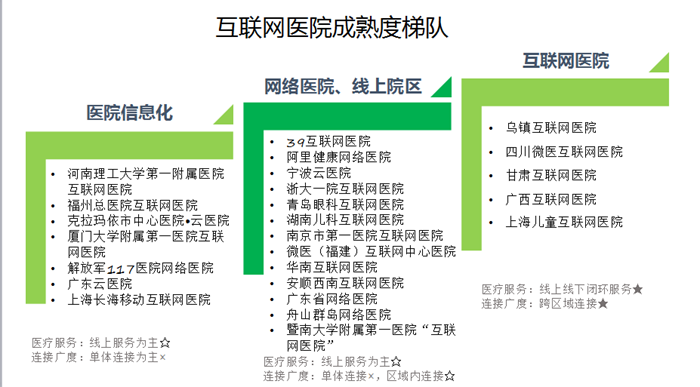
The 25 internet hospitals can be broadly categorized into three types, corresponding to different stages: hospital informatization, online hospitals, and internet hospitals.
(1) Wuzhen Internet Hospital and Its Regional Internet Hospitals
From the perspective of internet hospital construction, with WeDoctor as one of the main operators and Wuzhen Internet Hospital as the central node, the internet hospitals implemented in various regions have basically achieved a prototype of the service model for internet hospitals.
(2) 13 institutions have entered the networked stage, operating as internet hospitals or online campuses.
During this phase, internet hospitals are generally hospital-led, with single institutions or medical consortia as the core of development, extending vertically to grassroots levels. Leveraging the internet as a carrier and technological tool, hospitals establish comprehensive platforms that integrate diverse forms of medical services, commonly referred to as “online campuses.” A representative example is the Internet Hospital of The First Affiliated Hospital, Zhejiang University School of Medicine. Meanwhile, online hospital platforms co-built by internet and IT service providers together with healthcare institutions have also emerged, exemplified by Alibaba Health’s Online Hospital.
(3) Six hospitals are in the stage of hospital informatization to provide convenient medical treatment processes
Generally led by hospitals, these platforms provide online services focused on streamlining the medical consultation process or offering remote consultations, thereby enhancing the patient experience within the hospital or its affiliated medical consortium. The physicians providing online services are employed directly by the hospital. Although branded as “Internet Hospitals,” their functionality essentially remains at the stage of hospital informatization.
III. Reasons for the Surge of Internet Hospitals
Reason 1: The industry has entered a new stage of development
(1) The entrepreneurial window for online light medical consultations is about to close
Light consultation has long struggled to identify a viable monetization model within its business framework. The scale of paid consultations is small, and conversion rates for other revenue streams, such as value-added services, remain low. This makes it difficult to establish a complete commercial loop, preventing platforms from relying solely on online models to sustain long-term development. There is an urgent need to explore new extension models.
(2) Establishing a complete commercial closed loop requires starting with offline physical entities.
Under the current policy framework, the services provided by light consultation platforms to patients are extremely limited. Online consultations, doctor-patient interactions, appointment scheduling, and referrals are all peripheral healthcare activities, while substantive clinical practices such as diagnosis, prescription, testing, and surgery still require offline hospital visits. It is inevitable to delve deeper into the clinical care process and integrate online and offline services to form a closed commercial loop. Furthermore, the expansion of business models such as pharmaceutical e-commerce, insurance, and health big data relies on the integration of the clinical care process.
Reason 2: National Policies Rapidly Clarified
(1) Macro-level policies promote “Internet + Healthcare,” with local policies breaking through in key areas
With the advancement and implementation of the national “Internet Plus” strategy, policy directions in the field of “Internet Plus Healthcare” have become increasingly clear. In 2015, the Guiding Opinions of the State Council on Actively Promoting the “Internet Plus” Action set forth specific development goals and requirements for the healthcare sector, namely to “achieve richer internet applications, more diversified public services, and continuously optimized allocation of social service resources in the health and medical fields by 2018.”
As 2016 unfolded, policy support for the “Internet + Healthcare” sector continued to intensify. At the National Conference on Health and Wellness held in August, President Xi Jinping emphasized the importance of primary healthcare services in his address, calling for the adoption of a comprehensive perspective on hygiene and health, shifting the focus from disease treatment to people’s health, establishing and improving health education systems, and enhancing health literacy among the entire population.
Building on this, on October 25, the Central Committee of the Communist Party of China and the State Council issued the “Outline of the Healthy China 2030 Plan,” elevating guidelines for the health and medical industry to a national-level strategy for the first time.
In December 2015, the Tongxiang Municipal People's Government of Zhejiang Province approved the establishment of China’s first internet hospital, launching the Wuzhen Internet Hospital website platform and the Wuzhen Hospital Online APP to provide online diagnosis and treatment services focused on follow-up consultations nationwide. The hospital received support from the Cyberspace Administration of China, the National Health and Family Planning Commission, the China Food and Drug Administration, the Zhejiang Provincial People's Government, and the provincial health and drug regulatory authorities.
As the pilot effects became evident, local medical insurance policies also began to favor internet hospitals. On August 15, 2016, the Department of Human Resources and Social Security of Guizhou Province issued the "Notice on Issues Concerning the Inclusion of Telemedicine Service Items in the Basic Medical Insurance Fund Payment," stating that, to accelerate the development of telemedicine and further meet the healthcare needs of insured individuals, it had been decided to include telemedicine service items within the scope of basic medical insurance fund payments. The Sichuan Provincial Development and Reform Commission, jointly with the Sichuan Provincial Health and Family Planning Commission, also issued the "Notice on Setting Prices for Internet Medical Service Items," addressing issues such as pricing, medical insurance settlement, and charging standards for internet medical services at the policy level.
Reason 3: Strong Market Demand Drives Growth
For a long time, high-quality hospitals in China have been concentrated in the eastern coastal regions, particularly in Beijing, Shanghai, and Guangzhou. According to data from the 2015 China Health and Family Planning Statistical Yearbook, eastern region Class A tertiary hospitals accounted for 46%, while the western region accounted for 23%. High-quality medical resources are also concentrated in large hospitals, whereas primary healthcare institutions lack sufficient service capacity, resulting in low public acceptance of initial consultations at the primary care level.
“Seeking care at large hospitals for minor illnesses” has become the norm. Major hospitals, originally positioned to “manage acute and critical conditions, complex and refractory diseases, and train medical professionals,” are now treating patients with both major and minor ailments. This has intensified the supply–demand imbalance for these large hospitals, which already constitute a small proportion of healthcare institutions, while general hospitals and primary care facilities are experiencing the opposite trend.
Under the “siphon effect,” the healthcare landscape centered on tertiary hospitals is unlikely to change in the short term. Statistics show that primary and lower-level hospitals, which account for 66% of all hospitals, handle less than 20% of outpatient visits and only 13% of inpatient admissions, with low bed occupancy rates. In contrast, tertiary hospitals, though the smallest in number, are becoming increasingly saturated. Moreover, the patient volume at tertiary hospitals continues to expand, with growth rates consistently around 10 percentage points higher than those of other hospitals. The imbalance between supply and demand among high-quality medical institutions and non-core medical facilities is expected to worsen in the future.
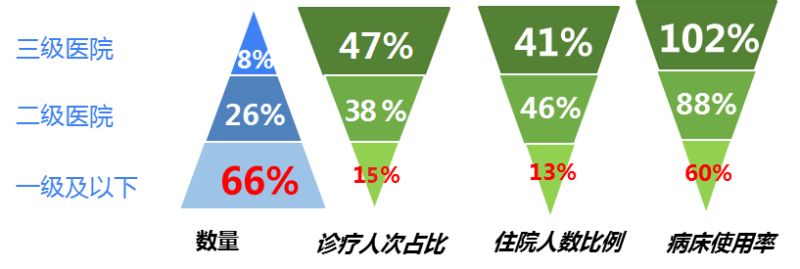
Data source: China Health and Family Planning Statistical Yearbook 2015
Internet-based healthcare has gained popularity among users. The number of internet-based healthcare users in China has reached 152 million, accounting for 22.1% of the country’s internet population. Among various stages of care, pre-consultation services are the most widely used, with a combined usage rate of 18.4% for online health information searches, online appointment registration, and online medical consultations.
IV. Where Did Internet Hospitals Come From, and Where Are They Headed?
The emergence of internet hospitals represents a significant milestone in the process of healthcare reform, marking an important leap from networked hospitals to smart hospitals.
How Can We Explore the Integration Model of “Internet + Healthcare”? We Believe It Is About Building the Capability to Connect Everything and Integrate Medical Services. The Supply of Diagnosis and Treatment Services, the Allocation of Medical Resources, and the Comprehensive Configuration of All Elements Across Pharmaceuticals, Healthcare, and Insurance Constitute the Three Dimensions Through Which Internet Hospitals Return to the Essence of Medical Care.

(1) Supply of Diagnostic and Treatment Services
Key Stages in the Evolution of Diagnostic and Treatment Services: Online Instrumental Assistance → Online Diagnosis → Matching and Provision of Offline Diagnostic and Treatment Services → Precision Diagnosis + Proactive Health Management
Since the essence of healthcare services extends beyond what online medical services alone can address, it is imperative to achieve seamless integration with offline medical imaging examinations, surgeries, and consultations. Therefore, in the evolutionary stage of internet-based healthcare services, consideration must be given not only to the depth and efficiency of online services but also to how they can seamlessly integrate with offline medical service offerings. By leveraging online platforms as a pivotal link bridging upstream and downstream resources, offline diagnostic and therapeutic services—such as medical imaging, surgical procedures, and in-person consultations—can be matched efficiently and precisely while ensuring sustainable supply.
In the future, with the interconnectivity of big medical data, proactive prevention and active health management will be possible. Furthermore, empowered by artificial intelligence, medical diagnosis will achieve greater precision and personalization.
(2) Allocation of Medical Resources
Key Points for Optimizing the Allocation of Medical Resources: Expanding Physician Resource Connectivity — Enhancing the Quality of Primary Care Physicians — Activating Medical Big Data Resources
No matter how much precision matching optimization is carried out, the fundamental difficulty in accessing medical care cannot be truly resolved without an adequate supply of physicians. We believe that internet hospitals must provide comprehensive solutions to connect and rationally allocate medical resources on a large scale, activate primary healthcare resources, and address the trust deficit between primary care providers and patients. Only in this way can we realize the vision of leveraging “Internet Plus” to help rectify the uneven distribution of medical resources in China and alleviate doctor-patient tensions.
“Internet+” not only optimizes the allocation of existing medical resources, but its more valuable future lies in revitalizing big medical data resources, transforming data into a new medical resource, and unleashing its decision-making value for precision medicine and proactive health management.
(3) Full-process configuration of medical services, pharmaceuticals, and insurance
Healthcare is not merely about the clinical interactions between patients and hospitals or between patients and physicians; a complete healthcare episode also encompasses pharmaceuticals and insurance payment processes. Every healthcare encounter results from the interplay of these key elements. Therefore, “Internet + Healthcare” extends beyond optimizing the allocation and supply of medical resources; it aims to integrate the entire value chain encompassing medicine, healthcare services, and insurance. This involves innovating drug distribution, medication management, health insurance integration, and the development of commercial insurance products, while leveraging internet technologies to optimize cost-containment mechanisms in healthcare, thereby achieving the goal of “controllable healthcare.”
V. The Arduous Exploration of Innovative Technologies and the Emergence of a New Path
Exploration of the First Path
This internet company-driven pathway is typified by early players such as Chunyu, Haodafu, and Guahaowang. Their primary business models revolve around providing convenient online healthcare services—including online appointment registration, off-site waiting, in-clinic payment, and access to laboratory and diagnostic test reports—or offering online consultation and diagnostic services.
"Lacking medical institution qualifications, these enterprises can only provide non-core medical services such as consultation and appointment registration, failing to achieve a closed-loop healthcare service model. This has made profitability difficult, prompting them to seek paths for transformation and upgrading."
The Dilemma of the Second Path
Beyond the inherent drive of internet companies to pursue the “Internet + Healthcare” model, hospitals are also gradually embarking on a transition from traditional hospital informatization to online hospitals and virtual campuses.
Hospitals remain weak in horizontally expanding the value chain (integrating healthcare, insurance, and pharmaceuticals) and vertically connecting across regions (linking more tiers, particularly cross-regional medical institutions). Consequently, they are unable to fundamentally address the persistent issue of uneven distribution of medical resources, making it urgent to explore pathways for integrated upgrading.
The Practice of the Third Way
Given that the aforementioned two pathways are independent, highly competitive, and difficult to integrate in practice, the new approach adopts a different mindset focused on collaboration. It aims to achieve full integration between the two ends of the “+” in “Internet + Healthcare,” thereby addressing two major challenges: the inability of internet healthcare companies to provide medical services and the difficulty hospitals face in expanding their connectivity.
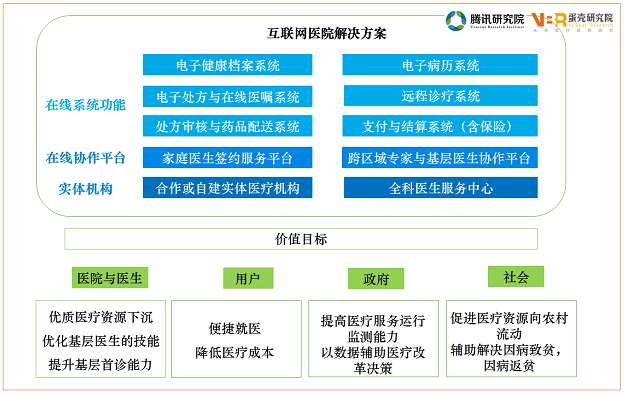
Internet hospitals are emerging as a new service model, enabling a win-win outcome for all three parties and delivering substantial value to hospital systems, patients, and government regulators.
First, internet hospitals have offline reliance or self-built physical medical institutions, which can lay the foundation for general practitioner development.At the hospital level, this facilitates the decentralization of high-quality medical resources, enhances the skills of primary care physicians, and strengthens their capacity for initial diagnosis and treatment. Furthermore, through online collaborative communication platforms, cross-regional collaborations between specialists and primary care physicians can be established to deliver technical support and training to primary care physicians and healthcare institutions.
Second, facilitate the sharing of big medical data to promote the development of tiered diagnosis and treatment.To this end, internet hospitals have established data systems that encompass online functional modules such as electronic health record (EHR) systems, electronic medical record (EMR) systems, electronic prescription and online medical order systems, remote diagnosis and treatment systems, prescription review and medication delivery systems, and payment and settlement systems (including insurance). Regulatory authorities can achieve a comprehensive national overview of healthcare service operations by facilitating data connectivity and sharing between the EMRs of primary care institutions and higher-level medical institutions, thereby supporting evidence-based decision-making for the optimization of healthcare reforms.
Finally, internet hospitals not only enable the sharing of high-quality medical resources across all strata of Chinese society, allowing users to access convenient healthcare and reduce medical costs, but more importantly, extend these resources to economically underdeveloped rural and remote areas, thereby helping to alleviate poverty caused or exacerbated by illness in these underserved regions.
VI. The “3+3” Theory of Sustainable Value Creation
What Key Capabilities Must Internet Hospitals Possess to Ensure Sustainable Service Delivery Rather Than Being a Fleeting Trend? Based on the evolutionary theory of “Internet + Healthcare” and observations from frontline practices of internet hospitals, the research team has summarized the “3+3” framework as the answer: Internet hospitals must meet three prerequisite conditions and achieve three operational closed loops to sustain value creation.
From this perspective, a comprehensive review of the internet healthcare landscape reveals that internet hospitals still face significant challenges, with many barriers yet to be broken in the future.
1. Prerequisites
Condition 1: Qualifications
Internet hospitals must possess prerequisite medical qualifications; without these, nothing else can be discussed. To engage in medical activities, internet hospitals are required to apply for an independent medical institution license in accordance with policy regulations. Otherwise, physicians cannot practice at multiple sites, and the hospital cannot charge fees. This prerequisite imposes higher professional operational standards on internet hospitals, requiring them to have the capacity to assume independent liability.
Condition 2: Technology
As the pool of connectable resources on internet hospital platforms expands, services such as remote video consultations and precise online medical matching will exhibit high-traffic characteristics. Internet hospitals must be capable of supporting massive concurrent processing, enabling hundreds of millions of doctors and patients to engage in diagnostic and therapeutic activities online simultaneously. To ensure the reliability and stability of online operational support, internet hospitals need to possess the technical reserves and practical application capabilities required to handle high traffic volumes and high concurrency.
Condition 3: Safety
Healthcare involves issues of life, health, and personal privacy; quality and safety are essential prerequisites for the implementation of “Internet + Healthcare.”
Given the involvement of core medical services, key challenges that internet hospitals will face in future assessments include whether they have sufficient professional pharmaceutical management personnel and qualified physicians, and whether their online and offline diagnostic and treatment activities follow scientifically sound and standardized protocols to ensure medical safety.
On the other hand, internet platforms that provide technical support for medical services must prioritize information security as a key development agenda. To mitigate the risk of medical data breaches, it is essential to comprehensively strengthen information security safeguards and early warning mechanisms, thereby enhancing regulatory oversight capabilities.
2. Key to Operations
Key Point 1: Closed-Loop Service Chain
This can be attributed to three key requirements. First, the legal and regulatory requirement: Internet healthcare providers offering online diagnosis and treatment services must possess appropriate medical qualifications and be equipped with necessary facilities, beds, equipment, and medical personnel in accordance with relevant regulations. Second, the medical service requirement: Medical services encompass diagnosis, examinations, treatment, surgery, and more; certain services, such as initial consultations, physical examinations, and surgeries, must be conducted offline. Third, the patient requirement: A fragmented healthcare experience, with disjointed online and offline services, fails to meet patients’ demands for convenience, efficiency, and affordability, making it difficult to gain user acceptance.
Key 2: Closed-Loop Business Chain
Hospitals, physicians, patients, the government, pharmaceutical companies, and insurers collectively constitute the six key resource elements of the healthcare system. Although the interrelationships among these elements are intricate, it is essential to recognize that a complete medical activity results from their joint interaction, forming an indivisible, integrated chain. Beyond optimizing basic healthcare resource allocation and establishing a closed-loop service model, internet hospitals must also focus on another critical competitive factor in the future: the ability to create a fully integrated closed loop spanning pharmaceuticals, healthcare services, and insurance.
Key Point 3: Closed-Loop Value Chain
Internet hospitals must be open, shared platforms to enable large-scale, efficient, and precise connectivity and matching. The follow-up consultation, specialist consultation, and referral services provided by internet hospitals rely on health and medical information, particularly the interoperability of clinical big data based on electronic medical records.
VII. Three Major Trends in Internet Hospitals
Trend 1: Cloud-Based Tiered Diagnosis and Treatment Service Platform
Led by the government, secondary and tertiary hospitals establish long-term collaborative mechanisms with primary healthcare institutions within a designated region, forming a cloud-based medical ecosystem that relies on large hospitals, is supported by dedicated physicians or their allocated professional time, and extends its reach through primary care facilities and households.
Patients can monitor their medical conditions in real time via the internet hospital platform, which aggregates information from various healthcare institutions to facilitate timely awareness across hospitals. This enables patients to receive comprehensive and practical medical services from physicians. The cloud-based platform offers enhanced functionality and fosters strong patient engagement. For follow-up patients, all medical data are stored on the platform, allowing for continuous monitoring and facilitating tracking and follow-up visits.
Trend 2: Population Health Management and Service Platform
As internet hospitals deepen their connectivity among hospitals, physicians, and patients—integrating information, services, and data—and achieve seamless coordination across healthcare, insurance, and pharmaceuticals, they are shifting from addressing low-frequency medical service needs to meeting broader health service demands. Leveraging structured big data, they provide precise, personalized health management services.
Trend 3: Service Platforms for Physicians’ Independent Practice
Hospitals, physicians, patients, and data are interconnected via the internet, granting physicians convenient, on-demand access to medical information upon patient authorization. Regardless of location, physicians can readily retrieve patients’ basic disease information, diagnoses, symptoms, and more, thereby facilitating their transition from multi-site practice to independent practice and affording them greater professional freedom.
Although internet hospitals must overcome numerous barriers to drive transformative value enhancement within the existing healthcare system, many challenges remain. As a new service model envisioned to optimize medical services through the internet, internet hospitals have prompted continuous exploration by hospitals, internet service providers, and government entities alike to innovate points of integration between digital technologies and healthcare. The future development trajectory of internet hospitals and the realization of their value warrant sustained attention.

To download the full PDF version, please follow the WeChat Official Account of VCBeat and reply with the keyword “Internet Hospital“Obtain”
By Tencent Research Institute and VCBeat. Please credit the WeChat Official Account when reposting:VBResearch2016
↓↓↓