

2016 BIO-Europe Conference Report: Immuno-Oncology Emerges as the Leading Investment Magnet Amid Industry-Wide Downturn
BIO-Europe, the largest biotechnology industry conference in Europe serving global enterprises, is being held this year in Cologne, Germany.At this conference, many companies will present their most cutting-edge innovations to potential partners.On one side, biotechnology continues to challenge the impossible in disease treatment; on the other, a political storm from the U.S. presidential election rages across the Atlantic. Every industry professional is asking themselves: What does America’s unstable political climate mean for the future of our sector? Although there is no clear evidence that things will definitely worsen, financial figures offer at least a glimpse of the situation. Clearly, this is a down year for the biotech industry!
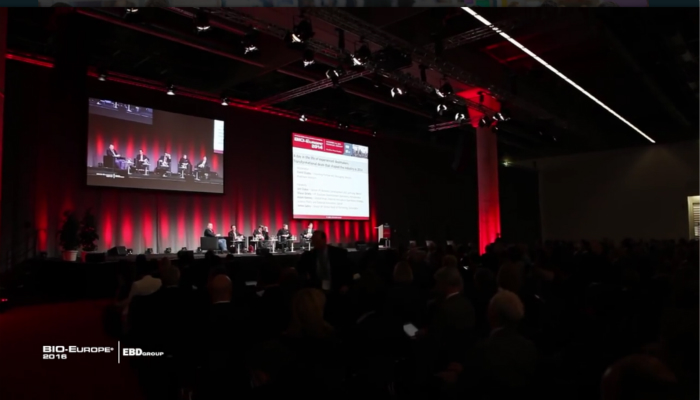
At the conference, David Thomas, Director of Industry, Research, and Analysis at the Biotechnology Innovation Organization (BIO), presented preliminary financial reports on the 2016 performance of biotechnology companies. VCBeat (WeChat: vcbeat) has compiled the information for you.
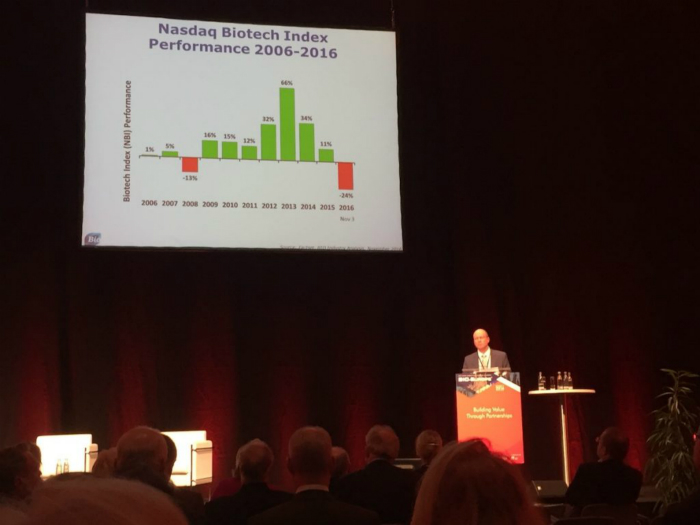
1. The report indicates that this year has been the worst for biotechnology in a decade, even worse than 2008, which was impacted by the financial crisis. The NBI Biotechnology Index reached a high of 66% in 2013, stood at -11% in 2008, and has plummeted to a staggering -24% this year. As for the specific reasons, economic factors play a relatively minor role; it is more influenced by certainMacroImpact of the Policy Environment: This year has seen a series of unexpected major events, including Brexit and Donald Trump’s election as U.S. President.
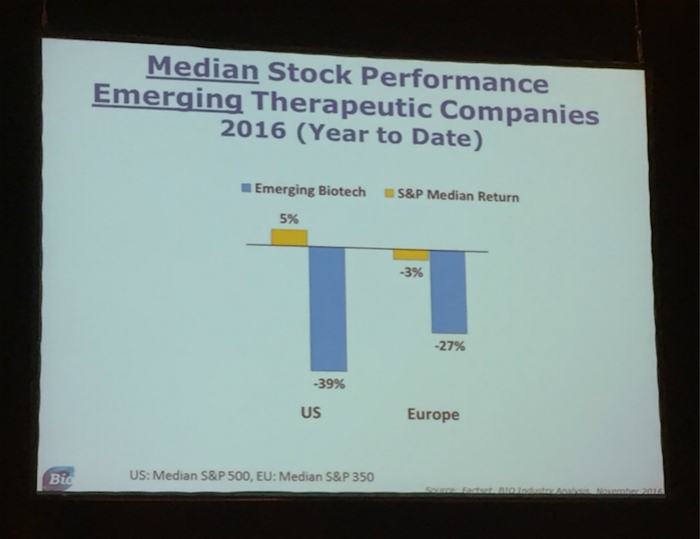
2. Thomas stated that the economic impact on biotechnology this year is industry-specific, indicating that poor performance is a direct result of policy influences. Overall,Smaller, emerging biotechnology companies are more susceptible to policy impacts, whereas large pharmaceutical companies demonstrate relatively stable performance.。
For obvious reasons, U.S. biotechnology companies have been among the hardest hit by national policy changes, but their stock prices(Year-over-Year)The downturn has also led to severe consequences in Europe. The median price-to-earnings (P/E) ratio for novel biotechnology companies in the U.S. stock market fell by 39%, directly dragging down the European market by 27%.
Small biotechnology companies are suffering more than larger corporations. Although the political turmoil is confined to the United States, its shockwaves have already crossed the Atlantic and impacted Europe. It is currently difficult to accurately predict Trump’s future plans; however, his policies have been relatively lenient by comparison. Among his seven healthcare reform initiatives, he proposed removing barriers to drug entry into the free market to provide patients with safer, more reliable, and more affordable pharmaceutical products, though the future outlook remains uncertain.
3. This decline also directly reflectsFinancing conditions have generally deteriorated this year.. CRISPR Therapeutics has finally completed its IPO, but its revenue is only half that of its competitors, Intellia and Editas. Of course, there are exceptions, such as ADC Therapeutics, which secured $105 million in financing this October from AstraZeneca, the Wild Family Office, and Auven Therapeutics. ADCT focuses on developing antibody-drug conjugates (ADCs) containing highly potent pyrrolobenzodiazepine (PBD) moieties.
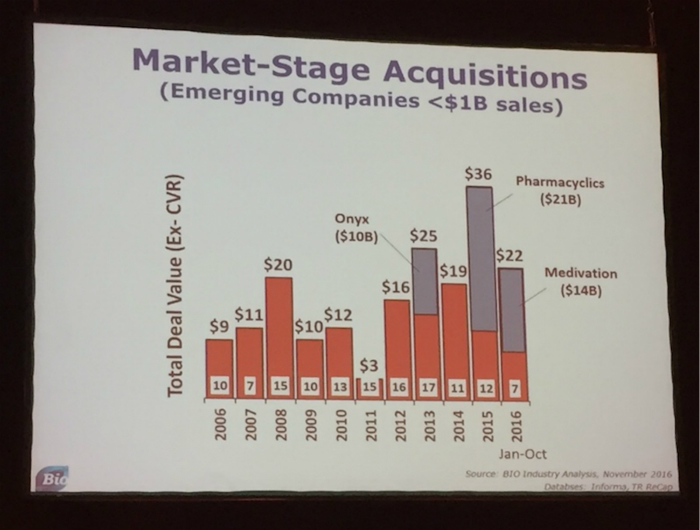
Although the number of IPOs has decreased this year and valuations have declined, Thomas stated that,There has been a substantial volume in terms of financing transaction amounts.Pfizer’s $14 billion acquisition of the anticancer drug company Medivation has sparked ongoing debate over whether the deal was worth it. This year has also seen smaller, yet still impressive, transactions; for example, in October, German biopharmaceutical company Ganymed was acquired by Japanese pharmaceutical company Astellas, which paid Ganymed a €422 million upfront payment to obtain 100% equity ownership. However, as reported by Merger Markets, the industry has been struggling since the UK’s exit from the European Union.
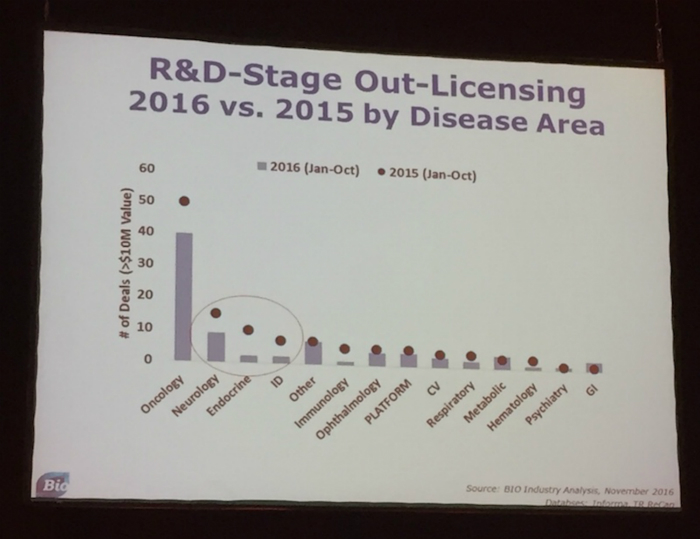
4. It is particularly noteworthy that the number of approved qualifications and licenses in the biotechnology industry has declined sharply across nearly all sectors,particularly in neurology, endocrine disorders, and oncology. An exception is the field of ophthalmology and metabolic diseases, which includes a collaboration agreement reached between Gilead and Genmab, under which Gilead will pay the Danish company Genmab up to more than $300 million (including a $5 million upfront payment and $277 million in milestone payments) to leverage the latter’s DuoBody platform for the development of bispecific antibody drugs for the treatment of HIV.
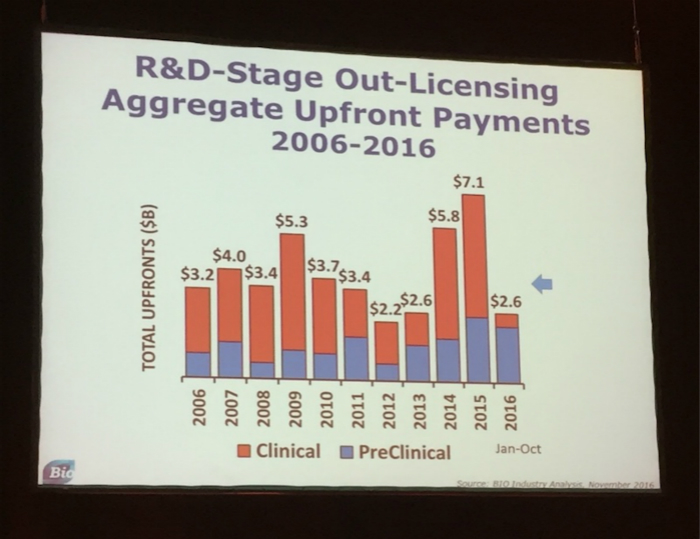
5. These declines are primarily attributable to a decrease in upfront payments for clinical-stage assets, as upfront payments for preclinical-stage assets remained stable. In fact,2016 May Still Be a Record-Breaking Year for Preclinical Deals. A significant portion of this may be attributed to Allergan; last year, Actavis completed its acquisition of Allergan for a total consideration of $70.5 billion, a staggering deal.
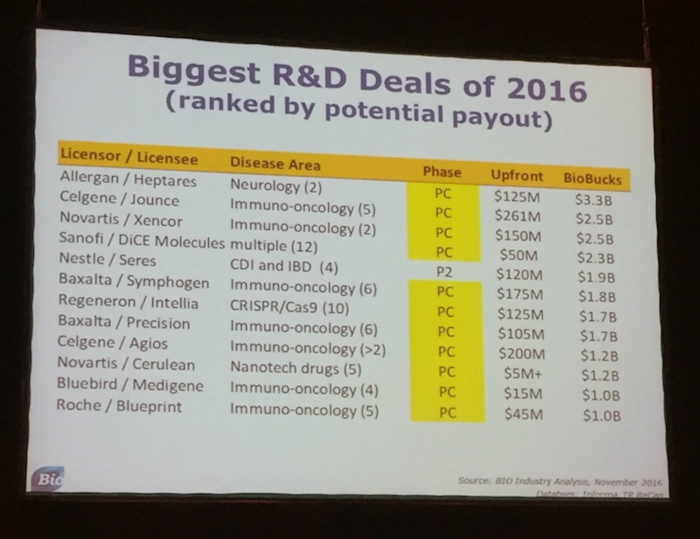
6. Among the year’s largest deals, 11 out of 12 were in the preclinical stage. Furthermore, seven of these 12 deals fell within the field of tumor immunology, indicating that this sector has bucked the trend this year and remains an absolute cornerstone. There are many such companies; recent examples include the transaction between Medigene and Bluebird Bio involving their TCR platforms, as well as Takeda’s investment in the startup Crescendo Therapeutics for the development of anti-tumor Humabody® therapeutics.
While these figures paint a bleak picture of the biotechnology industry, it is encouraging to note that the winds of change are blowing. Since the announcement that Donald Trump would be the next President of the United States,Biotech Stocks Have ReboundedBiotech stocks saw the iShares Nasdaq Biotechnology Index rise by as much as 8.98% last Wednesday (local time). The sector has recorded gains for four consecutive trading days, led by industry giants such as Biogen, Gilead, and Celgene. The market has now stabilized, with the advance-decline ratio reaching 0.65% on the 17th.
Thomas also pointed out that if the trend from last year continues, we may see another peak in acquisitions soon. However, the biggest issue now is that there isn’t enough time for the industry to recover quickly, but 2017 still looks like a promising year.