

World's First Fully Implanted Brain-Computer Interface Enables Locked-In ALS Patient to Communicate via Thought
By Synced
This novel implant is part of a brain-computer interface (BCI) system that enables the patient to spell out words and sentences. More importantly, the system is designed for near-ubiquitous use, allowing her to converse with friends even in outdoor settings without requiring the immediate assistance of medical professionals.
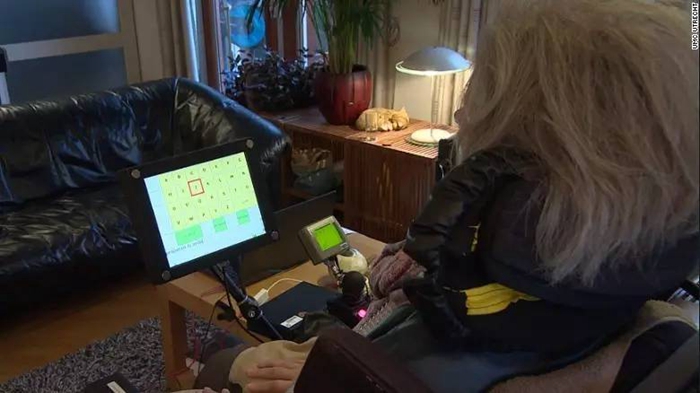
Hanneke de Bruijne Demonstrates the System
“This is the first case in history,” Nick Ramsay, a neuroscientist and principal investigator at the University Medical Center Utrecht in the Netherlands, told CNN. “It is a fully implantable system that can be used at home without any assistance from specialists.”
This female patient, named Hanneke de Bruijne, was diagnosed with amyotrophic lateral sclerosis (ALS) in 2008, and shortly thereafter, her motor neurons completely atrophied.
In less than two years, she went from being a healthy individual to a patient who could not breathe without a ventilator, unable to move or speak.
Before meeting de Bruijne in Ramsey, she communicated with the outside world through a system that tracked her eye movements, allowing her to select specific words and letters displayed on a computer screen to construct sentences.
But even this approach may not be viable for long-term use. As Jessica Hamzelou reported in New Scientist, she was one of three patients who lost their motor function—and even the ability to move their eyes—due to ALS.
Ramsey aims to figure out how to design a system that does not rely on any form of physical movement (the famous system used by Stephen Hawking relied on patients’ control over their facial muscles).
This means creating something new—a mind-reading device.
Over the past one to two decades, we have seen many different types of brain implant devices equipped for patients with paralysis or limb loss, but this technology remains very new. Most research has progressed slowly within experimental settings, with few outcomes making it out of the laboratory and into people’s homes. Ramsey and his team aim to create a device that users can operate at home without the need for continuous supervision by medical experts.
“For some reason, they have never achieved a breakthrough to become clinically applicable,” he told CNN. “No one has yet been able to make it work in a home setting.”
This device is surgically implanted into the brain and features two electrodes mounted on the motor cortex, enabling users to control movement through them.
The precise placement of these electrodes is critical—one must be implanted in the brain region responsible for right-hand movement, while the other activates when you intend to perform a countdown.
These electrodes are connected to a transmitter, the size of a pacemaker, implanted in de Bruijne’s chest; the transmitter can communicate wirelessly with the computer screen in front of her.
When de Bruijne looks at the screen, she sees a movable cursor on a virtual keyboard; when the cursor moves to the letter she wishes to select, she must imagine her right hand clicking that letter.
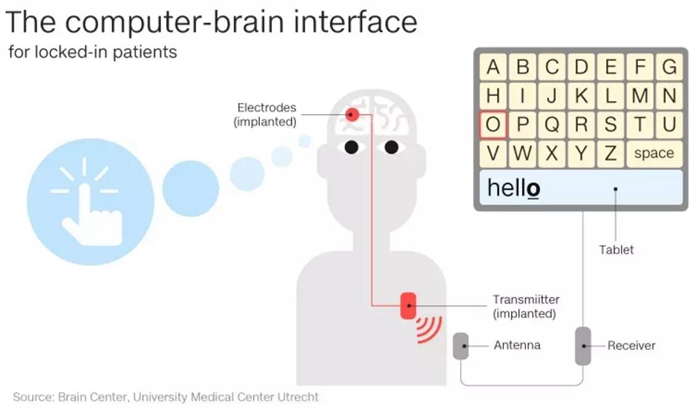
Schematic Diagram of the Working Principle of Brain-Computer Interfaces
Of course, de Bruijne is unable to use her right hand, but her brain can still issue motor commands. Electrodes collect these signals and transmit them to a transmitter, which then relays them to a computer and display screen.
After just six months of training, de Bruijne was already able to use the system normally, with a typing accuracy rate of 95%.
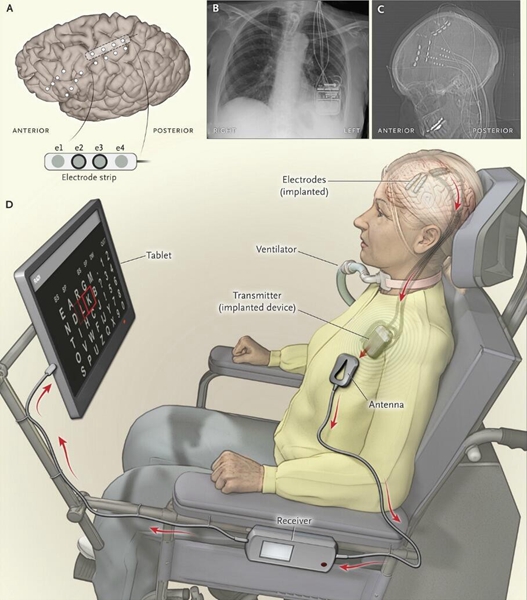
System Equipment Schematic Diagram
“Using the device for communication is a slow process—spelling out even a single word can take several minutes—but as training progressed, de Bruijne’s spelling speed increased,” Hamzelou stated in the report.
“Initially, it took her more than 50 seconds to select a single letter—now it takes her just over 20 seconds.”
“Although there are some concerns about implanting devices in patients, de Bruijne believes the new system is making her more confident and more willing to communicate with others, especially when strong natural light causes eye-tracking devices to fail.”
“I can now go out and interact with people even when my eye-tracking computer isn’t working,” she told Hamzelou. “I’ve become more confident and independent.”
Of course, to date, this system has been tested in only one patient. Although this represents a major breakthrough and the research team is currently transferring the device to Bruijne’s home, it may not achieve the same level of success in the next enrolled patient; therefore, we must remain cautiously optimistic.
Ramsey’s next goal is to accelerate de Bruijne’s communication speed by increasing the number of electrodes. He hopes to develop this system in the future to incorporate 30 to 60 electrodes, enabling faster decoding of sign language and internal speech.
“At that point, you’ll be able to spell out sign language for the deaf and mute,” he told CNN. “That is our goal.”
This study has been published in the New England Journal of Medicine.
Paper: Fully Implanted Brain–Computer Interface in a Locked-In Patient with ALS
For patients with severe paralysis who have lost the ability to speak, there are few options for communicating with the outside world. We describe a communication method for patients with advanced amyotrophic lateral sclerosis (ALS), which involves a fully implanted brain–computer interface comprising subdural electrodes placed over the motor cortex and a transmitter implanted subcutaneously in the left chest. By attempting to move the hand contralateral to the implanted electrodes, the patient was able to accurately and independently control a computer typing program 28 weeks after implantation, achieving a typing speed of approximately two letters per minute. This brain–computer interface provides an automated communication method that can supplement or, at times, replace the patient’s eye-tracking device.
Reference Article:
http://www.sciencealert.com/this-world-first-brain-implant-is-letting-a-locked-in-woman-communicate
http://edition.cnn.com/2016/11/12/health/als-brain-implant-communication/
https://www.newscientist.com/article/2112562-first-home-brain-implant-lets-locked-in-woman-communicate/