

2016 China Internet Hospital White Paper
At the 3rd World Internet Conference, a sub-forum on “Internet + Smart Healthcare” was established for the first time to explore innovative solutions for the deep integration of the internet and healthcare. Coinciding with the conference, Tencent Research Institute and VCBeat·VBInsight jointly released the *2016 White Paper on Chinese Internet Hospitals*, offering the first comprehensive overview of internet hospitals in China.
According to statistical findings in the report, by 2016, the number of internet hospitals across China had expanded to approximately 36, among which 25 had been implemented and were in operational use. The report comprehensively analyzes, from the perspectives of industry trends, policy environment, and market demand, the reasons behind the emergence and prominence of internet hospitals in 2016.
The report conducts a maturity assessment of 25 implemented internet hospitals based on five key indicators: medical services, medical qualifications, breadth of connectivity, depth of connectivity, and dimensions of connectivity.
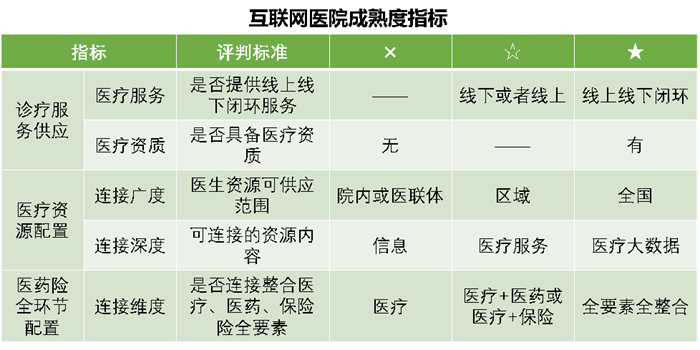
In 2016, the top five internet hospitals in terms of maturity were Wuzhen Internet Hospital, Sichuan WeDoctor Internet Hospital, Gansu Internet Hospital, Guangxi Internet Hospital, and Ningbo Cloud Hospital. The 25 internet hospitals fell into three maturity tiers: hospital informatization, network hospitals, and internet hospitals.


The report outlines an evolutionary roadmap for exploring the integration model of “Internet + Healthcare.” It posits that the emergence of internet hospitals represents a significant advancement in the healthcare reform process, marking a crucial transition from networked hospitals to smart hospitals. Internet hospitals propose solutions for effective connectivity with hospitals and physicians, while also advancing a framework for systematic collaboration with insurers, payers, and pharmaceutical companies. By integrating advanced technologies with traditional resources, they aim to enhance overall efficiency and develop innovative solutions.
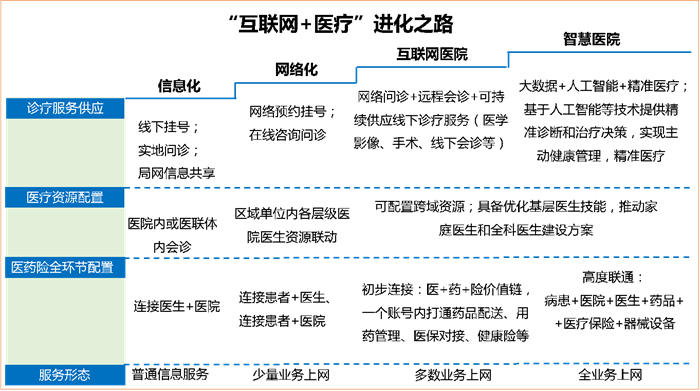
The report points out that internet hospitals are still not without challenges, and there are many areas requiring breakthroughs in the future. What key capabilities must internet hospitals possess to ensure sustainable service delivery rather than being a fleeting trend? Based on the evolutionary theory of “Internet + Healthcare” and observations from frontline practices of internet hospitals, the research team has summarized the “3+3” framework as an answer: Internet hospitals can sustain value creation only by meeting three prerequisites—qualifications, technology, and security—and achieving three operational closed loops encompassing the service chain, business chain, and value chain.
Finally, the report also outlines three major future development trends for internet hospitals, which will continue to evolve into cloud-based tiered diagnosis and treatment service platforms, population health management and service platforms, and platforms supporting physicians’ independent practice.
As a new service model envisioned to optimize healthcare delivery through the internet, internet hospitals have prompted hospitals, internet service providers, and government agencies to continuously explore innovative points of integration between digital technologies and medical care. The future development trajectory of internet hospitals and the realization of their value warrant continued attention.
For more information on the “2016 China Internet Hospital White Paper,” download the full version via the WeChat official accounts “Tencent Research Institute” or “VBResearch2016.”