

Legend Capital's Decade-Long Investment Strategy: Building a Medical Ecosystem Through 'Disease Spectrum' Approach

Legend Capital
Early-stage venture capital and growth-stage private equity investment institutions
An article has been widely circulated in the medical venture capital community recently, detailing Legend Capital’s strategic investments in the healthcare sector. Many were surprised to discover that, almost unnoticed, Legend Capital has been deeply engaged in the healthcare industry for a decade, developing not only a rigorous methodological framework but also a comprehensive healthcare investment map of the “Legend ecosystem.” Recently, Legend Capital held an internal meeting in Wuhan with its portfolio companies, which VCBeat covered in full.
Yet, how easy is it to build a healthcare ecosystem?
November 4,“Entering Asia Heart: Innovation and Cooperation Forum in the Cardiovascular Field” Held in WuhanThis closed-door meeting was hosted by Legend Capital and Wuhan Asia Heart Hospital, with VCBeat as a co-organizer. The primary objective of the conference was to leverage Wuhan Asia Heart Hospital as a hub to deepen mutual understanding among Legend Capital’s portfolio companies in the cardiovascular product and medical services sectors, thereby facilitating potential synergistic collaborations in products or services.
The conference brought together the Managing Director and department heads of Wuhan Asia Heart Hospital, domestic and international experts in the diagnosis and treatment of cardiovascular diseases, and leaders from Legend Capital’s portfolio companies in the cardiovascular sector. Participants discussed industrial collaboration within the field to foster greater interaction among cardiovascular enterprises.
This collaborative synergy embodies Legend Capital’s core investment thesis: centering on the disease spectrum to construct a tightly integrated and ecologically interconnected healthcare landscape. Ouyang Xiangyu, Managing Director of Legend Capital, attended the conference in person and summarized the investment logic and methodologies employed by Legend Capital in building its healthcare ecosystem.
A Decade of Dedication: Legend Capital’s Healthcare Investment Trilogy
From 2007 to 2016, a decade during which China’s healthcare market benefited continuously from favorable policy opportunities, rising social demand, and ongoing advancements in medical technologies and capabilities, healthcare investments continued to deliver growing returns driven by robust growth demand, even as the nation’s GDP growth entered the single-digit era.
Over the past decade, Legend Capital has executed a three-stage strategic evolution, transitioning from a generalist fund to specialized funds, and ultimately to in-depth investments within specific disease areas. Its inaugural healthcare investment was made in 2007 with Pharmaron. Subsequently, from 2008 to 2010, the proportion of healthcare projects within its generalist funds increased from 10% to 25%. Concurrently, following the establishment of its healthcare investment team, Legend Capital formed a dedicated healthcare group within its generalist funds in 2010, marking the beginning of a systematic industry layout. This progression culminated in 2016 with the establishment of specialized USD and RMB healthcare investment funds, with a total size of RMB 3.5 billion.
Over the past decade, Legend Capital’s healthcare investment team has invested in more than 50 projects, with multiple exits achieved through IPOs or M&A. Its investment portfolio across medical devices, pharmaceuticals, healthcare services, and diagnostics has become increasingly comprehensive.
“Disease Spectrum”—Legend Capital’s Unique Healthcare Ecosystem Investment Approach
Ouyang Xiangyu stated that Legend Capital has always maintained a highly systematic strategy and approach in its healthcare investments, consistently adhering to clear logics based on disease spectra and industry value chains. Specifically, the firm structures its healthcare investments around key therapeutic areas—including cardiovascular and cerebrovascular diseases, oncology, diabetes, maternal and child health, and other conditions—across four dimensions: genetic technologies, diagnostic equipment, biopharmaceuticals, and healthcare services. This approach aims to achieve comprehensive coverage with both depth and breadth across the industry value chain, foster synergies through collaboration among portfolio companies, and thereby build a unique healthcare ecosystem with a distinct competitive advantage for Legend Capital.
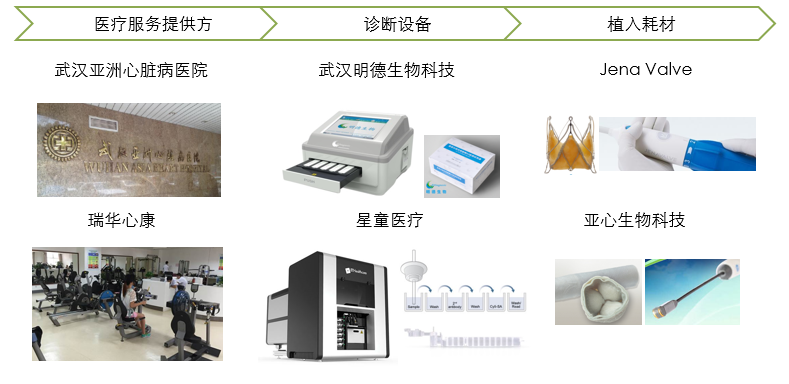
Targeting Top-Tier Enterprises to Build “Three-Chain Synergy” in the Cardiovascular Field
After a decade of accumulation, the more than 50 companies invested in by Legend Capital have gradually formed a systematic framework, achieving “three-chain synergy” among the industrial chain, value chain, and capital chain. This aligns with the strategic path Legend Capital established at its inception: targeting leading enterprises in each niche sector and leveraging these top-tier companies to build industry ecosystems. This closed-door meeting focused on Wuhan Asia Heart Hospital (hereinafter referred to as “Asia Heart Hospital”) as the cornerstone for developing an industry ecosystem in the cardiovascular field.
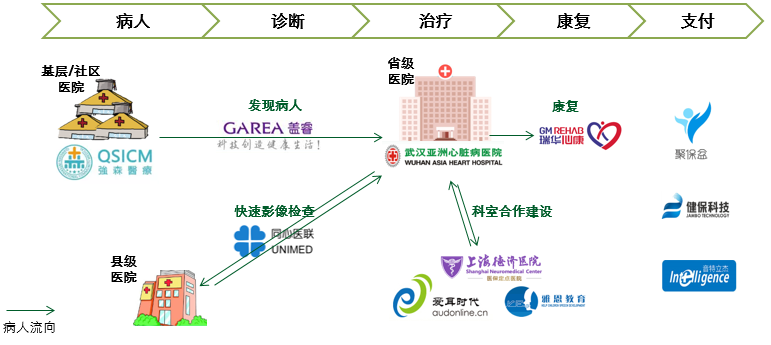
Asia Heart Hospital + N: Building a Closed-Loop Ecosystem in the Cardiovascular Field
From patient acquisition to diagnosis and treatment, then to rehabilitation and payment methods, Legend Capital has already launched a “three-chain synergy” model in the cardiovascular field. With Wuhan Asia Heart Hospital as its foundational point, it has strategically positioned itself at key segments of the cardiovascular industry chain and repeatedly facilitated in-depth, multi-level industrial collaboration among enterprises.
Wuhan Asia Heart Hospital + Gerui Medical
Gairui Medical is a leading domestic provider of mobile healthcare solutions, founded in 2010. Focusing on the primary care and health management markets, it holds dozens of patents and copyrights, serves as a key national research project contractor, and operates as an industry standard development base.
Asia Heart Hospital and Gerui Medical have already established highly successful collaborations in primary healthcare and remote ECG diagnosis. Ms. Li, a resident of Wuhan, Hubei Province, experienced chest pain and initially self-medicated at home. Upon examination at the Hanjiang Village Health Clinic, results from Gerui’s all-in-one health kiosk indicated a myocardial infarction. The village physician promptly referred Ms. Li to a higher-level hospital. After the District People’s Hospital determined it could not provide the necessary treatment, she was immediately transferred to Asia Heart Hospital for surgery. The early identification of this critical condition secured valuable time for Ms. Li’s timely treatment.
Wuhan Asia Heart Hospital acquires patients through Gairui Medical, specifically those reached or connected via grassroots medical care and daily health management services using technologies such as new-store diagnostics with all-in-one health kiosks. Meanwhile, through its collaboration with Wuhan Asia Heart Hospital, Gairui Medical can fully leverage the hospital’s expert resources to enrich the content and service design of its products, thereby providing expert support for its service-driven model.
Asia Heart Hospital+N
The tiered diagnosis and treatment collaboration for Johnson Medical’s integrated “clinic-community-home” full-course health services, the paired collaboration for Ruihua Xinkang’s post-cardiac surgery rehabilitation services, and specialized department collaborations with Shanghai Deji Hospital and Aier Shidai are all highly anticipated partnerships in the ecological development of the cardiovascular industry.
In addition, the closed-door meeting featured a dedicated technical session, where intense discussions were held on therapeutic technologies for cardiovascular diseases, diagnostic and laboratory testing techniques, and medical device innovation. Dr. Tao Liang, President of Wuhan Asia Heart Hospital, shared the hospital’s explorations and experience in translational cardiovascular medicine and expressed its proactive stance on seeking innovative collaborations with enterprises.
Ouyang Xiangyu: “Although China lags behind foreign countries, its theoretical foundations are advancing rapidly, making us very optimistic about the cardiovascular field. We hope that by building such a platform, we can narrow the gap with international counterparts and introduce more high-quality technologies and products into China. We also look forward to seeing more specialized applications and products, tailored to China’s clinical needs, brought to market through investment and collaboration.”