

World's Largest AF Screening Project in High-Risk Hypertensive Population Leverages Mobile Wearables for Clinical Application
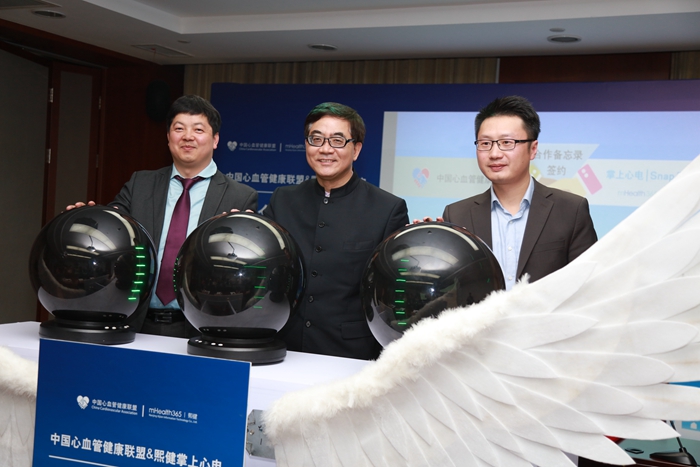
The “China Hypertension and Atrial Fibrillation Screening Project,” launched through a strategic partnership between the Chinese Alliance for Cardiovascular Health and Xijian Handheld ECG, was inaugurated in Shanghai on November 13. Ge Junbo, Academician of the Chinese Academy of Sciences, Chairman of the Chinese Alliance for Cardiovascular Health, Chairman of the Chinese Society of Cardiology, and Director of the Department of Cardiology at Zhongshan Hospital Affiliated to Fudan University; Zeng Wenming, Executive Secretary-General of the Chinese Alliance for Cardiovascular Health; Zhao Xing, Deputy General Manager of Nanjing Xijian Information Technology Co., Ltd.; and representatives from multiple media outlets jointly attended the event.
Academician Ge Junbo introduced the project:This project differs from previous studies in both its enrollment scale and level of innovation. It is currently the largest global screening initiative dedicated to atrial fibrillation, as well as the first clinical study in China conducted using a “mobile internet + healthcare” approach.
Zhao Xing told a reporter from VCBeat (WeChat ID: vcbeat) that Xi Jian’s mobile ECG initiative will invest over RMB 10 million in total across the development, maintenance, and operation of wearable ECG recorders, mobile apps, and big data cloud platforms. Provided as pro bono project support, this investment aims to participate in establishing standards for atrial fibrillation diagnosis and follow-up, thereby addressing current industry challenges such as the lack of standardized treatment and follow-up protocols, systematic frameworks, and comprehensive data.
Atrial fibrillation (AF) is one of the most formidable challenges facing the global cardiovascular field in the 21st century. In China, the number of AF patients exceeds 10 million, with new cases continually rising and the disease burden steadily increasing. Thromboembolic complications are the primary cause of mortality and disability among AF patients; it is estimated that 10–20% of AF patients will suffer a severe, disabling stroke in the future. Furthermore, statistical data indicate that annual expenditures for AF treatment in China reach RMB 30 billion, of which RMB 4.9 billion is spent on treating strokes caused by AF. Undoubtedly, atrial fibrillation imposes a substantial economic burden on both patients and society.
In the face of the disease burden posed by atrial fibrillation (AF), there is significant room for improvement in the awareness and detection rates of AF in China. Currently, the patient awareness rate stands at only 40%, and clinical missed diagnoses are quite common, with many patients not being diagnosed with AF until they suffer a stroke. Furthermore, numerous challenges persist in the treatment, management, and follow-up care of patients with AF.
Given that patients with paroxysmal atrial fibrillation may not experience episodes during hospital examinations, and those with persistent atrial fibrillation may be missed due to asymptomatic episodes, how to effectively improve the initial screening detection rate for atrial fibrillation has become an urgent issue for clinicians to address.
The emergence and integration of “Mobile Internet + Healthcare” has provided tangible and effective solutions for clinical practice. The Atrial Fibrillation (AF) Center, established under the auspices of the Chinese Alliance for Cardiovascular Health, will collaborate with Xijian’s Palm ECG to launch a professional “Rhythm-Heart Hotline” platform. Leveraging wearable ECG monitors and mobile internet technology, this initiative aims to conduct initial screening and follow-up for AF patients. Physicians will distribute Palm ECG recorders to eligible patients, who will use the devices in conjunction with a mobile app to collect and upload data to the Rhythm Center–Heart Hotline platform. Professional physicians will then retrieve and interpret the ECG data, thereby assisting clinicians in image reading, diagnosis, assessment, and follow-up care. This measure is expected to address current pain points in clinical medical practice.
The project plans to enroll approximately 100 hospitals and register around 10,000–15,000 outpatient hypertension patients who meet the inclusion criteria. Participants will be provided with handheld, single-lead, plug-in ambulatory ECG monitors for electrocardiogram monitoring. By leveraging out-of-hospital monitoring and the “Rhythm-Heart Hotline” platform, both physicians and patients can facilitate rapid data collection, enabling doctors to efficiently perform ECG interpretation, diagnosis, and patient follow-up. Furthermore, the platform aims to establish a big-data research infrastructure in the future. The collected data, research progress, and findings will be fully open to the medical community. The platform will continuously launch new research initiatives, employing advanced technologies and user-friendly tools to meet the clinical and research needs of healthcare professionals.
From the perspective of professional value, this collaboration will help establish unified accreditation standards for Atrial Fibrillation (AF) Centers; accelerate the enhancement of technical standards and quality control levels in AF Centers; and transform clinical perceptions and professional assessments of AF diagnosis and treatment. Furthermore, this partnership contributes to reducing the incidence of cerebrovascular and cardiovascular events, facilitates government control over healthcare expenditures, and holds significant value for the collection, aggregation, and analysis of domestic scientific research big data. In particular, it is of epoch-making significance for transforming the model of AF diagnosis and treatment in China.
Xijian Pocket ECG is a mobile health technology company specializing in the field of electrocardiography. Its innovative solutions encompass a range of medical-grade wearable ECG monitoring devices, a mobile app, an intelligent big-data cloud analytics platform, and cardiovascular medical service resources, providing professional cardiac health management services to physicians, patients, and individuals in suboptimal health conditions. Founded in 2013, the company launched China’s first pocket ECG product “understandable to the general public” in December of the same year and has since secured multiple rounds of investment from investors including Sinovation Ventures and Precision Medicine Baijiahui.
Xijian’s Palm ECG currently operates under a business model integrating “hardware + ECG data processing services + medical services.” It provides comprehensive solutions and value-added data services to industries including healthcare, pharmaceuticals, insurance, elderly care, and sports, while also exploring overseas markets. The company holds a leading position in the specialized field of electrocardiography, with technological and market share leadership. In April this year, Palm ECG secured a new round of financing from Precision Medicine Baijiahui. Leveraging Precision Medicine Baijiahui’s strong industry resource advantages, Palm ECG is rapidly expanding its presence in the medical market and has already achieved sales and collaborations with over 1,500 hospitals.
According to Zhao Xing, with the current rapid growth of its business, Xijian’s handheld ECG division is preparing to launch its next round of financing. The company plans to increase investment in hardware R&D, machine learning-based AI algorithms for ECG data processing and recognition, the development of a medical big data cloud platform, and market applications. It aims to continuously build a professional, high-quality cardiac health management platform, further expanding and strengthening its services in cardiac disease screening, follow-up care, and cardiac rehabilitation.