

YueTang Submits IPO Prospectus: Pioneering 'Health Management 3.0' with AI-Driven, Affordable, and Precision Solutions
/Written by Yuetang, first published on VCBeat
2016In October, the Central Committee of the Communist Party of China and the State Council issued the Outline of the “Healthy China 2030” Plan and circulated a notice requiring all regions and departments to earnestly implement its provisions in light of local conditions. The plan covers areas such as optimizing health services, promoting healthy behaviors, improving the physical fitness of the entire population, and strengthening health services for key populations. This represents both a significant opportunity for development in the health sector and a substantial challenge: how to ensure universal access to healthcare despite the scarcity of high-quality medical resources.
The development of artificial intelligence has solved this problem.An article once claimed that “missing out on medical AI means missing out on at least 80% of the healthcare market,” a statement that is not an exaggeration. With the advancement of artificial intelligence, its applications in the health sector have become extensive. In terms of application scenarios, these can be categorized into 11 areas: virtual assistants, medical imaging, drug discovery, nutrition, biotechnology, emergency room/hospital management, health management, mental health, wearable devices, risk management, and pathology.
Health Management 3.0, proposed by Yuetang, represents the further development of artificial intelligence in the field of health management.Health Management 3.0 can be defined as follows:Leverage big data and artificial intelligence to deliver personalized solutions that seamlessly integrate into daily life.
Compared with Health Management 1.0, which relies on face-to-face interactions among users, physicians, health managers, and nutritionists, and Health Management 2.0, where such interactions are conducted via the internet, the advantages of Health Management 3.0 are mainly reflected in three aspects:
1. Deliver expert-level health management solutions without relying on scarce physician resources;
2. The application of machine learning is cost-effective and highly efficient, enabling large-scale adoption;
3. Not limited by time or space.
Not relying on scarce physician resources means that YueTang’s health management solutions, powered by Health Management 3.0, can significantly reduce labor costs. Meanwhile, by codifying the expertise of top-tier specialists, machine learning-generated recommendations can achieve outcomes comparable to those delivered by dedicated expert care. The mobile platform enables users to access dynamic health plans anytime and anywhere, facilitating easy review and self-management.
In short, the high-quality, low-cost services provided by Health Management 3.0 can meet the demand for premium resources under the current status of developing national health, offering a gateway for the general public to achieve high-level health.
China has long emphasized dietary wellness, with the concept of managing health conditions through diet deeply ingrained in public consciousness. When seeking professional advice on health matters, people pay particular attention to dietary restrictions. Capturing the potential of diet as a breakthrough point is crucial for the health sector. Whether machine learning can deliver expert-level guidance is the most frequently raised question surrounding Health Management 3.0.
In November 2015, David Zeevi’s team published a paper titled “Personalized Nutrition by Prediction of Glycemic Responses” in *Cell*, elucidating the positive role of machine learning in blood glucose management. Based on validation involving 800 participants, the researchers conducted a double-blind experiment with 26 volunteers. Of these, 12 followed recommendations generated by machine learning algorithms, while 14 followed advice from physicians and nutrition experts. The diets were categorized into two types: those capable of controlling blood glucose and those incapable. All volunteers alternated between the two dietary patterns on a weekly basis, with their blood glucose levels monitored using continuous glucose monitors.
Experimental validation has demonstrated that the impact of dietary patterns on volunteers' blood glucose levels converges across both models. This essentially indicates that machine learning algorithms outperform expert recommendations, as machine learning can be broadly applied to a wider variety of foods, whereas experts are limited to devising dietary combinations from known food items.
It is worth noting that the experts and scholars in this controlled trial had many years of immersion in the relevant industry, providing dedicated guidance and full-process involvement for the volunteers. However, this refined management approach is constrained by the availability of medical resources and is difficult to promote and apply in real-world settings.
Machine learning not only rivals expert management but also reduces physician resource costs, enabling efficient and cost-effective health management.
The scarcity of medical resources in China has long remained unaddressed, with high-quality resources being particularly rare. According to officially released data, only 45% of physicians in China hold a bachelor’s degree or higher. Large hospitals have become the preferred choice for medical care, leading to overcrowding that not only makes appointment registration difficult but also significantly shortens consultation times. A survey conducted in Jiangsu Province revealed that only 30% of doctors listen to patients’ full accounts, with the average consultation time lasting just 4–6 minutes. This implies that some physicians rely more on subjective judgment than on an objective assessment of the patient’s actual condition when making clinical decisions.
In this scenario, the advantages of Health Management 3.0 based on machine learning—namely, its ability to track user data around the clock and tailor personalized health management plans—are significantly amplified.
To ensure the authenticity and effectiveness of its health management programs, YueTang’s backend leverages a large-scale epidemiological model built on evidence-based medicine big data (derived from three consecutive generations, involving a total of 120,000 participants), along with localized clinical validation conducted over the past year among more than 10,000 Chinese individuals. Supported by authoritative theories from Harvard Medical School, the American Diabetes Association (ADA), the American Heart Association/American College of Cardiology (AHA/ACC), and JNC8, YueTang offers billion-level medical nutrition therapy solutions for 23 chronic diseases.
After consolidating the expertise of top specialists and scholars through machine learning and validating its generalizability, YueTang can easily deliver the following capabilities:
l Precise Risk Prediction
l Reasonable dietary patterns and exercise guidance based on user preferences
l 24/7 dynamic feedback and protocol adjustment
In a sense, Yuetang provides every user with a personal, dedicated, free, and 24/7 nutrition expert.
Building on localized validation and the codification of expertise from leading medical nutrition specialists, the Yuetang database has incorporated data on 800 types of exercise, 8,000 dishes, 7,000 nutritional supplements, 30,000 types of prepackaged foods, 500,000 restaurants, and 1 million food delivery items. By addressing diet, exercise, and nutritional supplementation, it closely aligns with high-frequency daily life scenarios, ensuring users receive satisfactory feedback anytime, anywhere.
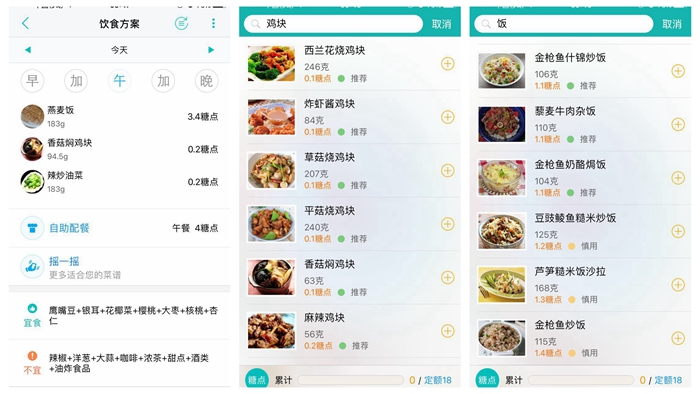
To help users more intuitively improve their health management, YueTang has pioneered the "Sugar Point" system, which measures the impact of food on blood glucose fluctuations. Compared with generic calculation methods, Sugar Points are simpler and more effective for blood glucose control.
Yuetang converts users’ daily sugar intake and expenditure into a single “Sugar Point” value. Users can plan their diet and exercise based on this figure, reducing cumbersome table lookups and calculations to simple addition and subtraction of single- or double-digit numbers. This eliminates the need for complex mental effort, allowing for quick mental arithmetic, thereby lowering the barrier to use and significantly improving user adherence.
Yuetang also provides users with recommendations for daily meal and snack ratios, exercise plans, and nutritional supplement usage, with options to adjust these plans, ensuring that users can restore their health and enjoy a high-quality life.
To put it simply, serve God with all your heart.
For example, this is a dietary plan provided by Yuetang to users, who can either adopt it directly or make substitutions. Additionally, users can directly query the sugar content of food items for delivery orders and dining out through the client app, which is another significant convenience.
To enhance user stickiness, YueTang has also made more gamified attempts.Yuetang has established a behavioral science-based user incentive system that visually demonstrates the relationship between behaviors and health, enabling users to tangibly experience how behavioral interventions and self-management improve their health.
While ensuring precise and efficient service for individual consumers, Yuetang actively expands its business-to-business (B2B) channels. It has established partnerships and signed cooperation agreements with players in the insurance, health checkup, pharmaceutical e-commerce, food delivery, fresh food O2O, and sports and wellness sectors to jointly build a health management platform and achieve more comprehensive health outcomes.