

DeepCare Achieves 92.5% Diagnostic Accuracy in Breast Cancer Detection Using Proprietary Deep Learning Algorithm

DeepCare
Developer of AI-Powered Dental Imaging Analysis Systems
Although tiered diagnosis and treatment is a policy vigorously promoted by the state, patients still prefer to queue for specialist appointments at large hospitals when they fall ill. What exactly is the gap between senior and junior physicians, particularly in the diagnosis of major diseases such as cancer? Can artificial intelligence algorithms help physicians improve the accuracy of disease diagnosis? The DeepCare team recently conducted an interesting experiment in which senior and junior pathologists diagnosed the same set of digital pathology slides of breast cancer lymph node metastasis. The results showed a 30% discrepancy in diagnostic accuracy between junior and senior pathologists. Meanwhile, DeepCare also employed its self-developed deep learning-based intelligent algorithm model for disease diagnosis, achieving an accuracy rate of 92.5%.
Currently, individuals’ choice of hospital when ill is based on their self-assessment of the condition. Minor ailments such as colds can be managed at general hospitals, whereas patients seek specialist outpatient services at large hospitals only in severe cases. Why does this disparity exist? The rationale is straightforward: large hospitals boast more advanced medical equipment and higher-caliber, more trustworthy physicians, enabling more accurate and efficient treatment without delaying care.
In most patients’ healthcare journeys, clinical physicians are the medical professionals they encounter and know best. While it is commonly believed that clinical physicians make all diagnostic and therapeutic decisions, pathologists’ diagnostic reports play a pivotal role in guiding clinical management, particularly in the screening and treatment of major diseases such as cardiovascular and cerebrovascular disorders, malignant tumors, and cancers. Consequently, pathology is regarded as the gold standard for cancer diagnosis, and pathologists are often referred to as “the doctor’s doctor.” Given the decisive role of pathological diagnosis in the clinical management of serious illnesses, improving the diagnostic accuracy of pathologists has become a critical issue that cannot be overlooked.
DeepCare, a Chinese technology company that applies artificial intelligence to medical imaging screening and diagnosis, recently conducted an experiment comparing the diagnostic accuracy of senior and junior pathologists. The study selected 70 histopathological slides of breast cancer lymph node metastases, comprising 30 normal slides and 40 slides containing cancerous metastases. Participating physicians were required to diagnose whether cancer metastasis was present in the slides; if metastasis was identified, they also needed to delineate the precise areas of cancerous involvement.
The team invited senior physicians with over 40 years of experience from a top-tier Grade A tertiary hospital in Beijing, as well as junior physicians with 20 and 10 years of experience from a Grade A tertiary hospital in Beijing and another Grade A tertiary hospital in a third-tier city, respectively, to conduct a one-week cancer annotation experiment.
The experimental results showed that all physicians correctly identified all 30 normal slides. Among the 40 cancer slides, the diagnostic sensitivity was 97.5% for senior physicians with over 40 years of experience, 67.5% for physicians with 20 years of experience, and 57.5% for physicians with 10 years of experience.
Sensitivity (also known as the true positive rate) refers to the proportion of samples that are correctly identified as positive among those that are actually positive (e.g., the proportion of individuals who are truly ill and are diagnosed as such by a hospital). It is calculated as the ratio of true positives to the sum of true positives and false negatives (cases that are actually positive but are classified as negative).
This reveals a significant disparity in diagnostic judgments between senior and junior physicians, further highlighting the challenges facing China’s healthcare reform: How can we address the insufficient total volume of medical resources, their uneven distribution, and the scarcity of high-quality resources? It is well known that training pathologists is difficult. Professor Bian Xiuwu, a renowned pathology expert in China, noted at an academic conference on pathology that “In China, due to insufficient emphasis on pathological diagnosis, pathology is considered a ‘high-risk, low-income’ profession. Many medical students opt for clinical specialties, resulting in a severe shortage of outstanding pathologists in the pathology departments of many hospitals.”
To help pathologists improve diagnostic accuracy and save time reviewing slides, the DeepCare team has been actively exploring the application of artificial intelligence deep learning algorithms in pathological images. The developed algorithm was also applied in this experiment, with its results compared against those of physician diagnoses. Encouragingly, the sensitivity of the AI algorithm reached 92.5%.
DeepCare combines deep learning with traditional image analysis techniques. First, thresholding is employed to automatically segment pathological slides, thereby identifying tissue regions within the slides. Given the enormous size of whole-slide images, they are divided into smaller patches. A convolutional neural network (CNN) is then applied to classify these patches, yielding the probability of cancer presence in each patch. Finally, post-processing is performed on the classification results; for each potential cancerous region, 30-dimensional statistical and morphological features are extracted to determine whether the region contains metastatic cancer. The specific algorithmic workflow is illustrated in the figure below:
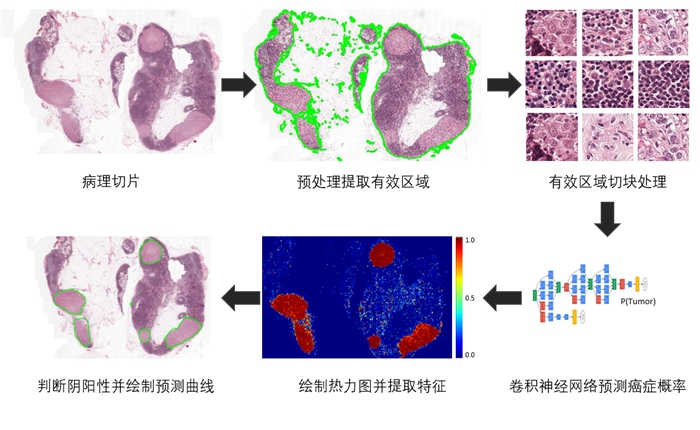
Algorithm Flowchart
Challenges in Algorithmic Diagnosis
(1) The pathological slide images are too large.First, histopathological whole-slide images are acquired using a scanner at 40x magnification. A single digital slide has an extremely high resolution, with average dimensions exceeding 100,000 by 200,000 pixels, and a file size of 1–2 GB, comparable to that of a 90-minute high-definition movie. The DeepCare team initially applied a multi-threshold-based image segmentation algorithm to the entire digital slide to remove background areas, retaining only the tissue regions. This approach reduced subsequent computational time by more than 82%.
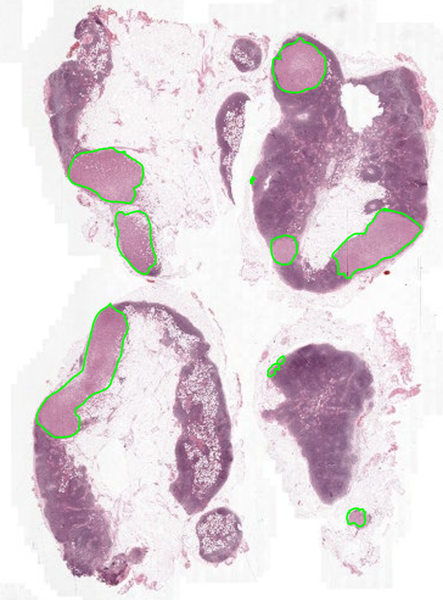
Single Full-Size Pathology Slide
(2) Cancer cells show no distinct morphological features.Due to the lack of distinct morphological features in cancerous regions, which exhibit considerable heterogeneity, traditional algorithms have demonstrated unsatisfactory performance in terms of both sensitivity and specificity when processing such images. In contrast, deep learning techniques, capable of accommodating large-scale parameters and capturing correlations among local features within images, have shown promising results in image classification and detection tasks.
Given the vast amount of information contained in pathological slide images, it is reported that pathologists at typical Grade A tertiary hospitals in China must review 100 to 200 slides per day to complete their workload within limited timeframes. While algorithms can be rapidly replicated and operate without fatigue, human brain training is a slow process and is susceptible to influences such as emotional factors. An experienced physician requires approximately five minutes to examine a single slide, whereas an algorithm can process one in just about one minute.
Furthermore, while physicians may wish to specialize in a specific disease entity, current hospital staffing arrangements often fail to accommodate this. This necessitates that physicians possess extensive interdisciplinary knowledge and rich clinical experience; indeed, cultivating an independent pathologist requires at least ten years of rigorous training. The collaboration between artificial intelligence and physicians can rapidly bridge the shortage of pathologists and enhance the diagnostic capabilities of primary care providers.
DeepCare team members also stated after the experiment concluded that there were still areas for improvement in this trial:
(1) Currently, this algorithmic model is designed exclusively for breast cancer and is not applicable to all types of cancer. DeepCare seeks to collaborate with hospitals to jointly develop algorithmic models suitable for other cancers.
(2) To develop high-precision algorithmic models, accurately annotated data is essential, which in turn requires the involvement of more senior, highly skilled pathologists for annotation tasks. In the future, DeepCare will need to collaborate with more senior physicians at major hospitals.
There remains significant room for exploration in the application of artificial intelligence algorithms to the recognition and diagnosis of pathological images. We understand that the DeepCare team will next conduct more detailed and in-depth research on algorithms aimed at improving sensitivity, specificity, and subtype classification, while also launching larger-scale and more standardized clinical trials. Although many uncertainties lie ahead, we remain confident that artificial intelligence will bring more positive and profound impacts to the field of pathology.
DeepCare is a technology company that applies artificial intelligence to medical imaging screening and diagnosis. It focuses on the research and development of technologies for the detection, recognition, screening, and analysis of medical images. By integrating machine vision, deep learning, and big data mining, DeepCare is committed to providing fast, accurate, and cost-effective medical image recognition solutions to healthcare institutions and medical device manufacturers. Co-founder and CEO Liu Sheng graduated from Harvard Business School, is a former senior consultant at McKinsey & Company, and a serial entrepreneur in Silicon Valley. Co-founder and CTO Dr. Ding Peng graduated from Dartmouth College in the United States and has extensive research experience in artificial intelligence. Other team members are experts in fields such as medical imaging and artificial intelligence. In June this year, DeepCare secured RMB 6 million in angel funding from FreeS Fund, achieving a current valuation of RMB 50 million.