

CRISPR's Off-Target Risk Remains a Key Hurdle Amid Gene Editing Market Battle: ZFN, TALEN, and CRISPR-Cas9 Compared
A review of the gene-editing technology market reveals a situation strikingly similar to the tape format war between Sony’s Betamax and JVC’s VHS in the 1980s. At the time, although most experts considered Betamax to be more feature-rich, better performing, and more durable, VHS ultimately emerged as the winner due to its lower price and suitability for extended viewing sessions. Kalorama Information, a healthcare market analysis firm, has conducted an overview of gene-editing technologies and companies; VCBeat (WeChat ID: vcbeat) has compiled and organized this information.
Gene editing technology is currently facing a dilemma reminiscent of the Sony and JVC format war. In the field of gene editing, precise and effective technologies, including those based on zinc finger nucleases (ZFNs) and transcription activator-like effector nucleases (TALENs), emerged many years ago. However, it was the advent of CRISPR technology, which offers simpler operation and lower costs, that truly drove the development of the gene editing market, or rather, becauseThe Emergence of CRISPR Technology Truly Established the Gene Editing Market。
Genome editing is the process of modifying the DNA of a specific organism by introducing functional proteins at specific target sites within the genome. “Editing”This term is not entirely comprehensive; while it does summarize the overall process, it may overlook certain critical steps. For instance, once a functional protein is introduced into the genome, it transforms the organism into one capable of self-editing and simultaneously stimulates cellular repair mechanisms, thereby enabling gene inactivation or the insertion of new target genes at specific sites within the genome.
Gene editing technology holds significant commercial value across numerous fields, including human health therapeutics, new plant varieties, new animal breeds, animal models for scientific research, novel compounds, and the development of energy sources. Examples of gene editing-based projects currently under development include treatments for HIV/AIDS, the development of herbicide-resistant Brassica plants, therapies for acute lymphoblastic leukemia, the development of genetically engineered soybeans, and even Bama pigs and rodent models based on gene editing.
Currently, many companies have demonstrated interest in the gene editing technology market. MilliporeSigma, Thermo Fisher Scientific, Dharmacon, GeneCopoeia, GenScript, Horizon Discovery Group, OriGene, Transposagen, and ToolGen are the key players in the gene editing technology market.
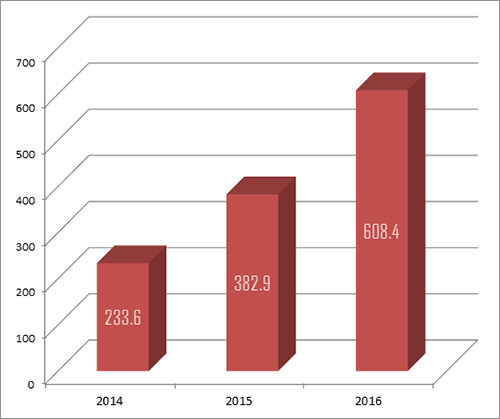
The Gene Editing Market Is Growing Year by Year(Tools, Reagents, Services, Supplies)Unit: Amount in millions of USD, 2014–2016.
Kalorama Information Estimates, gene editing tools, reagents, services, models, and other supplies related to this technology accounted for approximately $608 million of the market share in the gene editing technology market, an increase from $233 million in 2014. With the development of new applications and the addition of new projects, rapid growth is expected over the next five years.
The continuous advancement of therapeutic and agricultural applications using gene-editing technologies, coupled with increased public and private investment in the field, will also drive the market forward. Currently, a significant number of public and private investors have shown strong interest in leveraging gene-editing technologies to develop therapies for human health.
Companies such as Bayer, Biogen, Juno Therapeutics, Novartis, Pfizer, and Regeneron Pharmaceuticals are engaged in the development of therapeutic drugs using gene-editing technologies through various investments and collaborations with smaller firms. Beyond the development of human therapeutics, gene-editing technologies have commercial applications in many other fields, many of which are only just beginning to be explored.
In fact, we have mastered a variety of gene-editing technologies. The first to be introduced was zinc finger nuclease technology, or ZFN. Its targeting efficiency earned it the nickname “molecular scissors.” It has become a well-established technique and has been applied in humans and various other biological models, including Drosophila melanogaster, Arabidopsis thaliana, zebrafish, mice, and rats, making it a validated and widely recognized technology.
Zinc finger nuclease technology exhibits high specificity, thereby avoiding immune responses; however, this high specificity poses significant challenges, making the engineering of zinc finger DNA-binding proteins difficult, partly due to the bulky nature of the proteins themselves and their context-dependent binding properties. Furthermore, they are prone to off-target effects, which can lead to cell death or unintended mutations.
TALENs, introduced as the second generation of genome-editing nucleases, can largely avoid off-target effects on functional proteins compared with other technologies. Compared with zinc-finger nucleases (ZFNs), TALENs are simpler to use, faster to construct, and more cost-effective. Unlike ZFNs, TALENs are less susceptible to influences from the surrounding contextual binding environment; therefore, their design and engineering are less complex than those of ZFNs. Meanwhile, due to their high specificity for DNA target sites, TALENs produce minimal off-target effects relative to other enzymatic tools. However, assembling TALEN-encoding plasmids is a lengthy and labor-intensive process.
CRISPR-Cas9 technology was developed through research into the bacterial immune system. Within this system, bacteria employ DNA fragments as a defense mechanism to combat foreign agents such as viruses. Scientists reasoned that if the bacterial cellular environment is sufficiently conducive, why not develop a technology to intervene against foreign substances in a similar manner?
CRISPR sequences consist of numerous short, conserved repeat sequences (repeats) and spacer sequences (spacers). Spacers are variable sequences that correspond to exogenous genetic material previously encountered outside the bacterial genome. These spacer sequences are stored within the bacterial genome and serve as a memory mechanism that triggers the degradation of invading viral DNA upon reinfection. Decades have passed since this theory was first proposed, but tools for leveraging this technology did not become commercially available until 2012.
In CRISPR technology, the CRISPR array is first transcribed into a single RNA molecule, which is then processed into shorter CRISPR RNAs (crRNAs). These crRNAs guide Cas enzymes to degrade target nucleic acids. Each “guide RNA” recognizes its specific target sequence and directs the Cas9 enzyme to cleave the DNA strand, thereby stimulating the cell’s non-homologous end joining (NHEJ) or homology-directed repair (HDR) mechanisms.
CRISPR-Cas9 tools are exceptionally user-friendly, offering the fastest design and construction times at the lowest cost. As they do not involve protein engineering, CRISPR-Cas9 systems can be constructed within a few days, with costs kept to just a few hundred dollars. Consequently, the development of large libraries of short guide RNAs is relatively straightforward, facilitating their extensive application in high-throughput settings such as functional genomics research.
CRISPR-Cas9 tools can be easily redirected to virtually any location in the genome through simple modifications to the guide RNA sequence. Furthermore, due to their multiplex gene-editing capabilities, they enable faster and more cost-effective engineering of animal models for complex disease research compared to traditional breeding techniques.
However, CRISPR-Cas9 technology also has certain limitations, including off-target effects by the functional protein, which are considered a limitation of ZFNs as well. In contrast to the complex dimeric structures of ZFNs and TALENs, the CRISPR-Cas9 system features a simpler monomeric structure that binds to homologous sites via base pairing, resulting in lower specificity when binding to and cleaving the desired DNA sites. Moreover, for CRISPR-Cas9 technology, verifying off-target mutations is more challenging, necessitating extensive whole-genome scanning for mutations at all sites with similar homology, which entails a substantial workload.
Scientists have developed various strategies to enhance specificity and eliminate off-target effects, including the use of enzymes from different bacterial sources, engineered Cas9 enzymes, and modifications to the length and secondary structure of the guide RNA’s recognition sequence. Recently, in September 2015, scientists discovered a non-Cas9 CRISPR system, namely CRISPR-Cpf1, in *Francisella* bacteria, which offers unique advantages in addressing challenges in this field.
Comparison of ZFN, TALEN, and CRISPR-Cas9 Technologies
Technology | Advantages | Limitations |
ZFN | Low immunogenicity Easy to transport in vivo and in vitro The Most Established Technology for Human Gene Editing | Protein Engineering and Retargeting Challenges Off-target editing High Cost Diversification Difficulties |
TAFEN | High Specificity Easy to transport in vitro Simpler and more cost-effective than ZFNs Diverse and High-Throughput | The construction and retargeting processes are lengthy. Off-Target Editing Diversification Challenges |
CRISPER-Cas9 | Diverse and High-Throughput Re-targeting is simple Economical Price | Lower specificity compared with ZFNs and TALENs Complex Extracorporeal Transport Process Off-target editing |
Despite the advantages compared to other gene-editing technology tools,"Due to the relatively recent emergence of CRISPR-Cas9 technology, its therapeutic development has significantly lagged behind that of other gene-editing technologies.". Moreover, it remains unclear whether CRISPR technology will prove applicable to human health therapeutics in the future.As it stands, its propensity for off-target effects remains a major challenge., if this challenge is overcome, the safety of CRISPR technology for human therapeutics can be significantly improved. Thus, it is evident that striving to break through its limitations while preserving the advantages of CRISPR technology will be a major trend in the development of gene-editing technologies in the coming years.